债基投资

Search documents
今年要被债基玩死了……
Sou Hu Cai Jing· 2025-12-02 10:02
Core Viewpoint - The article discusses the performance of various bond funds in 2023, highlighting significant losses in certain categories, particularly in government bond funds and long-term bond funds, due to rising yields and market conditions. Group 1: Index Bond Funds - The 30-year government bond ETF has declined by approximately 4%, while the benchmark market-making government bond ETF has dropped by 0.65% [2] - The main contributors to the decline are the rising yields of government bonds, with the 5-year government bond yield increasing from 1.41% to 1.61%, a rise of 19 basis points, and the national development bond yield increasing from 1.47% to 1.79%, a rise of 32 basis points [2] - The "Dacheng Interbank Certificate of Deposit Index 7-Day Holding" has a small scale of only 4 million yuan, leading to losses as investment returns do not cover fund expenses [2] Group 2: Short-term Bond Funds - Short-term bond funds have averaged a return of 1.4%, with two funds reporting losses and 16 funds yielding less than 0.5% [3] - The two funds that lost money are small in scale, and their low size has led to high expense ratios eating into profits [3] Group 3: Long-term Bond Funds - Among 2019 long-term bond funds, 257 have reported losses, accounting for 12.7% of the total [4] - Long-term bond funds have averaged a return of 0.97%, which is about 0.4% lower than short-term bond funds [4] - The primary reason for the losses is the heavy investment in long-duration government bonds and policy financial bonds [5] Group 4: Market Conditions - The yield on 30-year government bonds is currently at 2.2%, with a low of 1.8% earlier this year, resulting in an average annual coupon yield of around 2% [6] - The maximum drawdown for the 30-year government bond index has been 16.75%, with a maximum drawdown of 6.41% this year, indicating a low investment value for long-duration government bonds [6] - Fund managers have been increasing the duration of their bond funds, which is seen as a risky move given the current yield environment [6] Group 5: Overall Market Sentiment - The overall market is still in an adjustment phase, with recent weak rebounds not indicating an end to the adjustment [11] - There is a lack of excitement in the market, with many sectors experiencing declines after previous rebounds, suggesting a cooling of market sentiment [11] - Despite the potential for further declines, there may be limited downside due to external funds eyeing investment opportunities [12]
净值、资金、发行三线升温,债基回暖带动配置热潮
第一财经· 2025-06-17 15:42
Core Viewpoint - The bond market has shown significant recovery in June, leading to a surge in bond fund investments, with 99% of bond funds achieving positive returns within the month, and over 75% of products reaching historical net asset value highs [1][3][4]. Group 1: Market Performance - As of June 16, 3,798 out of 3,836 bond funds reported positive returns, representing over 99% [3]. - Mixed secondary bond funds and convertible bond funds have outperformed, with top performers like Jin Ying Yuan Feng A and Hua Bao Enhanced Income A both achieving a 3.26% increase [3][6]. - Pure bond funds, while showing more moderate gains, still maintained nearly 100% positive return rates, with only 13 funds reporting slight losses [4]. Group 2: Fundraising and Investment Trends - The bond market's recovery has led to increased demand for bond funds, with at least 127 funds announcing restrictions on large subscriptions in the past month [5][8]. - New bond fund issuances have been successful, with some funds reaching their fundraising targets within days, indicating strong market enthusiasm [8]. - Bond ETFs have seen a net inflow of 31.979 billion yuan in June, surpassing the total inflow for April [8]. Group 3: Future Outlook and Strategy - Analysts suggest that the current fundamental conditions remain favorable for the bond market, with expectations of continued narrow fluctuations in yields [1][9]. - The focus for future investments is on high-quality credit bonds and short-duration strategies, as well as maintaining a balanced approach with equity assets [9][10]. - Convertible bonds are viewed as having limited overall value due to high valuations, with a recommendation for a diversified approach in investment [10].


英华号周播报|从博弈到缓和,大类资产配置怎么看?
Zhong Guo Ji Jin Bao· 2025-05-14 10:08
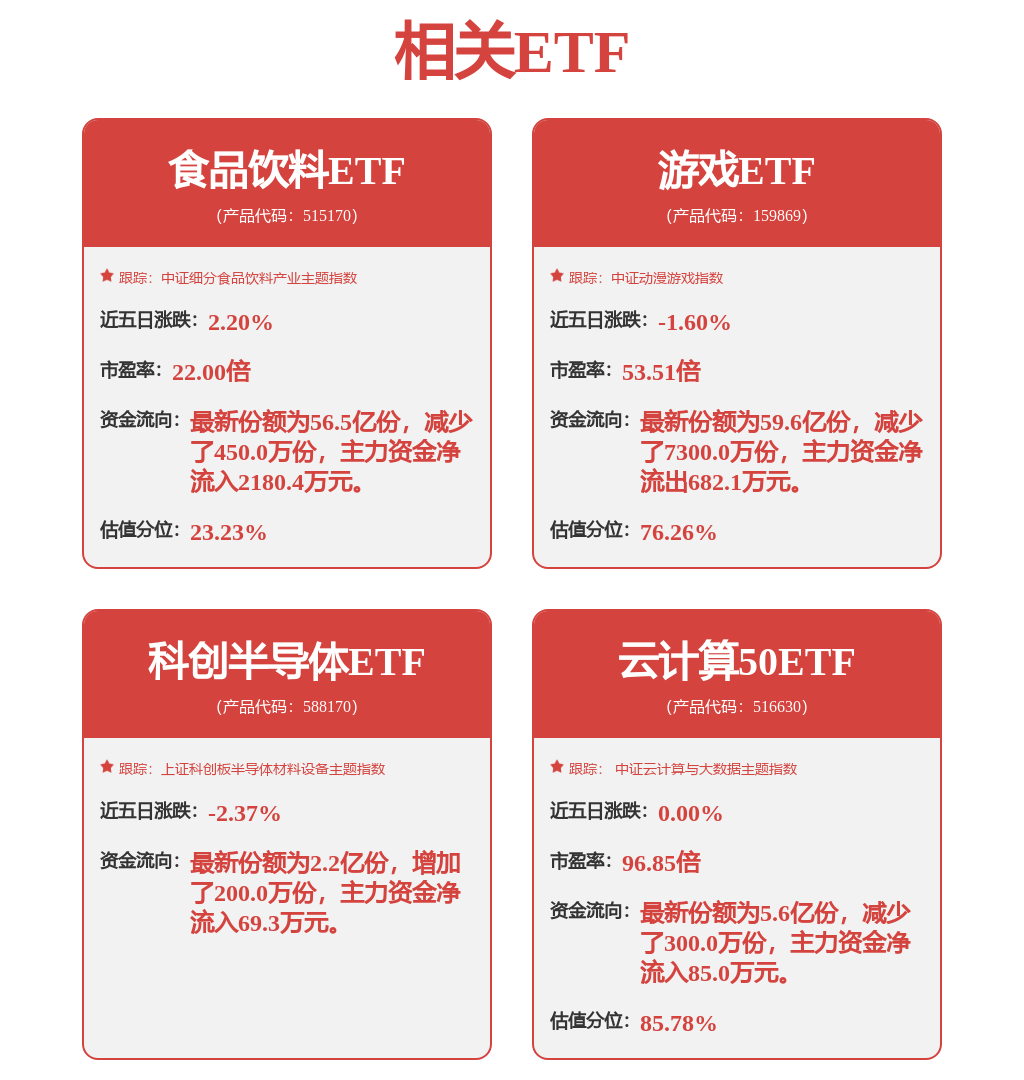
Group 1 - The article discusses the recent changes in tariffs and their implications for asset allocation strategies, highlighting a shift from confrontation to a more conciliatory approach in trade relations [1] - It emphasizes the importance of understanding the current complex landscape in China, particularly in the context of the ongoing tariff wars and their impact on various sectors [1] - The article features insights from industry experts on how to navigate the evolving investment environment, particularly focusing on the balance between "new" and "old" consumption trends [1] Group 2 - The article mentions the significant reforms in public funds and how these changes will affect future investment strategies, particularly in the context of market volatility [2] - It highlights the appeal of pure bond funds with set holding periods, which provide a balance between yield and liquidity, helping investors manage emotional responses during market fluctuations [2] - The article also notes the importance of disciplined investment approaches to achieve certainty in uncertain market conditions [2] Group 3 - The performance of various ETFs is analyzed, with specific focus on the Food and Beverage ETF, which has seen a recent increase of 2.20% and a net inflow of 21.8 million yuan despite a reduction in shares [5] - The Gaming ETF has experienced a decline of 1.60% with a significant outflow of 6.82 million yuan, indicating a shift in investor sentiment [5] - The Cloud Computing ETF remains stable with no change in performance, but has seen a slight net inflow, suggesting cautious investor interest [6]
一季度债基持仓大调整:信用债配置比例下降,政金债、国债受青睐
Mei Ri Jing Ji Xin Wen· 2025-04-28 07:32
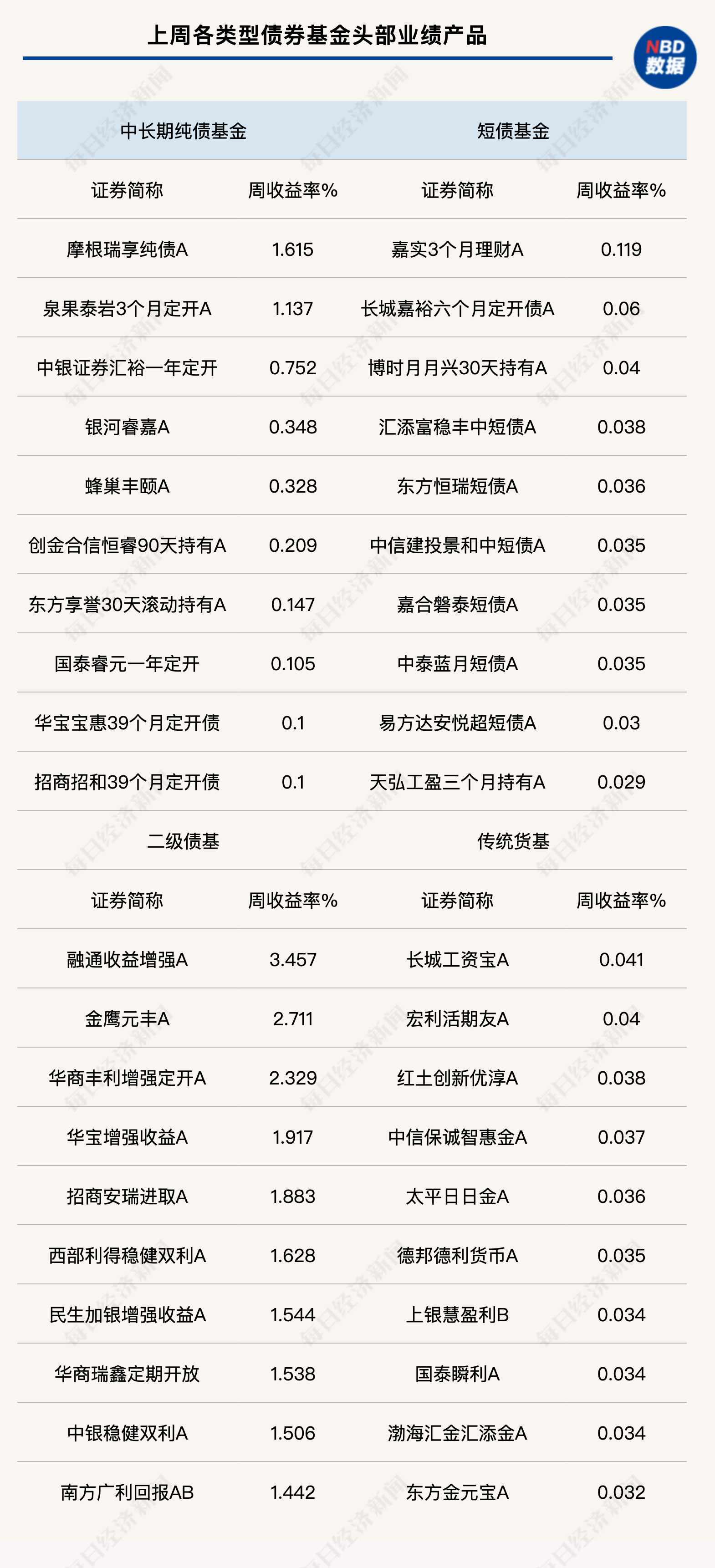
Group 1 - The core viewpoint of the articles indicates that institutional investors are reducing their allocation to credit bonds while increasing their holdings in policy financial bonds and government bonds in the first quarter of 2025 [2][3]. - The total management scale of actively managed bond funds reached 89,902.19 billion, a decrease of 3.95% compared to the previous quarter [2]. - The issuance of new actively managed bond funds in the first quarter totaled 797.09 billion, down approximately 175.69 billion from the previous quarter [2]. Group 2 - The proportion of credit bonds decreased from 54.63% to 53.12% compared to the previous quarter, indicating a shift in investment strategy [3]. - The median duration of pure bond funds slightly decreased from 2.30 years to 2.22 years, while the leverage ratio for "fixed income+" funds showed a downward trend [3]. - The market is expected to maintain a volatile pattern leading up to the May Day holiday, with cautious trading attitudes prevailing [4]. Group 3 - The analysis suggests that long-term interest rates are likely to continue fluctuating widely throughout the year, influenced by factors such as fiscal stimulus [5]. - The performance of certain medium to long-term pure bond funds has been strong, with some funds achieving notable weekly returns [4].