
储蓄与投资联盟

Search documents
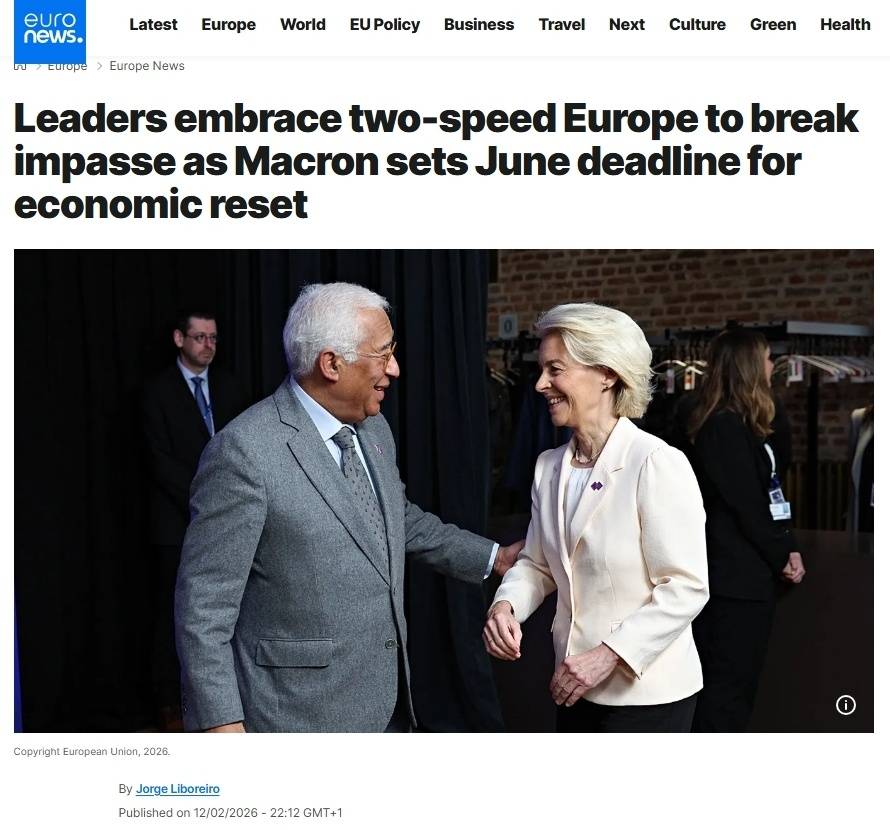
资讯很有料|欧洲多国拥抱“双速欧洲” 欧盟将分“快盟”和“慢盟”吗?
Sou Hu Cai Jing· 2026-02-13 18:22
Core Viewpoint - The concept of a "two-speed Europe" is gaining traction among European leaders as a means to enhance competitiveness and address political deadlock in economic reforms, raising concerns about potential division within the EU [1][8][12]. Group 1: Two-Speed Europe Concept - "Two-speed Europe" refers to the idea that if consensus cannot be reached among all EU members on economic agendas, smaller groups of countries can collaborate more swiftly [1][8]. - European leaders, including French President Macron, have set a deadline of June to finalize a comprehensive agenda for restarting the European economy, with plans to proceed under the "enhanced cooperation" clause if no progress is made [1][4]. - The "enhanced cooperation" clause allows at least nine member states to advance initiatives independently, as demonstrated by the EU's recent loan mechanism to Ukraine, which excluded certain countries [4][12]. Group 2: Political Shift and Urgency - The embrace of "two-speed Europe" signifies a political shift away from the EU's traditional consensus-driven approach, reflecting a growing urgency among leaders to act decisively in response to geopolitical challenges [5][8]. - Leaders from Germany, Denmark, and other nations acknowledge that the current geopolitical landscape necessitates a more competitive and independent Europe, marking a departure from previous discussions [5][7]. - The urgency is underscored by the perception that Europe's competitive edge is diminishing due to indecision and discord among member states [8][12]. Group 3: Internal Division Concerns - Despite the support for "two-speed Europe," there are ongoing concerns about internal divisions within the EU, as not all leaders are in agreement on this approach [12][13]. - The recent informal summit highlighted existing fractures, with some leaders excluded from discussions, indicating a selective approach to collaboration that could exacerbate divisions [12][13]. - The historical context of EU expansion has already created varying levels of economic and social development among member states, which may lead to further fragmentation if not addressed [13].

冯德莱恩重申 欧洲亟需简化监管规定
Xin Lang Cai Jing· 2026-02-11 08:57
Core Viewpoint - The European Commission President Ursula von der Leyen emphasized the need to simplify regulatory frameworks for businesses operating in the EU to enhance competitiveness against economies like the US and China [1] Group 1: Regulatory Environment - Von der Leyen highlighted the existence of 27 different financial systems within the EU, each with its own regulatory body, contrasting this with the more unified financial system in the US [1] - She pointed out that there are over 300 trading venues across the EU, leading to significant market fragmentation [1] Group 2: Market Development Goals - The goal is to create a large, deep, and liquid capital market, which aligns with the objectives of the EU's savings and investment alliance [1] - Von der Leyen announced plans to propose a unified market roadmap to EU leaders at the upcoming summit in March, aiming to clarify the timeline for deepening the EU single market initiatives by 2028 [1]
分析师看好法兴银行 称其仍有22%上涨空间
Xin Lang Cai Jing· 2026-01-07 13:41
Core Viewpoint - Société Générale has been leading the best-performing sector in Europe over the past year, with analysts indicating that the rally is not over yet [1] Group 1: Company Performance - Société Générale's focus on investment banking positions it to benefit from the EU's "Savings and Investment Union" initiative [1] - The stock price of Société Générale has surged by 159% over the past 12 months, outperforming all other members of the Stoxx 600 Banks Index, which increased by 67% during the same period [1] Group 2: Analyst Ratings - Analyst James Invine from Rothschild's Redburn has given Société Générale an initial "buy" rating and set the highest target price among all brokers tracked by Bloomberg [1]

瞄准33万亿欧元居民储蓄!欧盟拟打破金融服务国家壁垒,推动打造真正的统一资本市场
Hua Er Jie Jian Wen· 2025-12-04 13:22
Core Viewpoint - The European Commission is advancing a comprehensive plan to break down national barriers in the financial services sector, aiming to create a unified capital market that can compete with the United States, thereby revitalizing the struggling EU economy [1] Group 1: Regulatory Integration - The plan proposes a series of technical measures focused on regulatory integration, granting greater powers to the European Securities and Markets Authority (ESMA) [2] - It suggests simplifying cross-border operations through enhanced "passport" systems for regulated markets and central securities depositories, and allowing pan-European trading venues to consolidate their structures and licenses into a single entity [2] - The proposal aims to transfer regulatory authority over key market infrastructures, such as trading venues and central counterparties, to ESMA, highlighting the disparity in the number of central counterparties and securities depositories between the EU and the US [2] Group 2: Mobilizing Private Savings - A core objective of the plan is to unlock and reallocate the substantial private savings within the EU, as European households hold a significant portion of their assets in cash and deposits compared to their US counterparts [3] - It is reported that EU households possess up to €33 trillion in private savings, with approximately €300 billion flowing overseas annually, primarily to the US [3] - Policymakers believe that the fragmentation of the European financial market contributes to a cautious investment attitude among investors, leading innovative companies to seek funding and expansion opportunities in the US [3] Group 3: Economic Fragmentation - The fragmentation of the financial services market has been identified as a key factor undermining the EU's economic competitiveness, with the market capitalization of EU stock exchanges projected to be only 73% of its annual economic output in 2024, compared to 270% in the US [5] - Former ECB President Mario Draghi emphasized the need for a larger common savings pool and optimized investments to enhance productivity and growth in his report on improving European competitiveness [5] - ECB President Christine Lagarde has also stated that Europe must break internal barriers to move away from an outdated export-driven growth model [5]
国际金融市场早知道:8月18日
Xin Hua Cai Jing· 2025-08-17 23:23
Group 1 - The Trump administration announced a 50% import tariff on hundreds of steel and aluminum derivative products, with 407 product codes included in the U.S. Harmonized Tariff Schedule, effective from August 18, 2025 [1] - The U.S. government is considering using funds from the CHIPS Act to acquire a stake in Intel, with negotiations in early stages and various options being evaluated [1] - The Federal Reserve announced the termination of the "new activity supervision program" established in 2023, which was aimed at enhancing oversight of banks' cryptocurrency activities, reflecting a trend of regulatory relaxation in the crypto industry [1] Group 2 - The U.S. Trade Representative's office canceled a planned trip to India for negotiations, reducing the likelihood of reaching an agreement before the August 27 deadline [2] - The EU plans to unveil a specific proposal for a "Savings and Investment Alliance" this quarter, aimed at simplifying investment processes to channel bank deposits into investments, enhancing household wealth and broadening corporate financing channels [2] - Japan's Finance Minister emphasized the need for close cooperation between the government and the central bank to implement appropriate policies, despite the independence of monetary policy [2] Group 3 - U.S. retail sales increased by 0.5% month-on-month in July, marking the second consecutive month of significant growth, with the previous value revised from 0.4% to 0.9%, and a year-on-year increase of 3.9%, translating to a 1.2% real growth after inflation adjustment [2] - The Michigan Consumer Sentiment Index for August unexpectedly dropped to 58.6, the first decline since April, below the expected 62, with one-year inflation expectations rising to 4.9% and five-year expectations to 3.9% [2] - Japan's Q2 real GDP grew by 0.3% quarter-on-quarter and 1% year-on-year, marking five consecutive quarters of expansion, driven primarily by a 1.3% increase in business equipment investment despite high inflation suppressing personal consumption [2]
欧洲央行首席经济学家连恩:我们强调,建立一个更具韧性的金融体系——这包括推动储蓄与投资联盟的进展、完成银行联盟以及引入数字欧元——都将有助于提升货币政策在不断变化的环境中的有效性。
news flash· 2025-06-30 11:18
Core Viewpoint - The European Central Bank emphasizes the need to establish a more resilient financial system, which includes advancing the savings and investment union, completing the banking union, and introducing a digital euro to enhance the effectiveness of monetary policy in a changing environment [1] Group 1 - The establishment of a more resilient financial system is a priority for the European Central Bank [1] - Advancing the savings and investment union is part of the strategy to improve financial resilience [1] - Completing the banking union is essential for enhancing the effectiveness of monetary policy [1] Group 2 - The introduction of a digital euro is a key component in adapting to a changing economic environment [1] - The focus on these initiatives aims to bolster the overall effectiveness of monetary policy [1]
欧洲央行管委内格尔:我们现在需要做的是建立储蓄与投资联盟,然后才是银行业联盟。
news flash· 2025-06-19 09:47
Group 1 - The core viewpoint is that the European Central Bank (ECB) needs to establish a savings and investment union before moving towards a banking union [1] Group 2 - The statement emphasizes the importance of creating a framework for savings and investments as a foundational step for future banking integration [1]