
光污染

Search documents
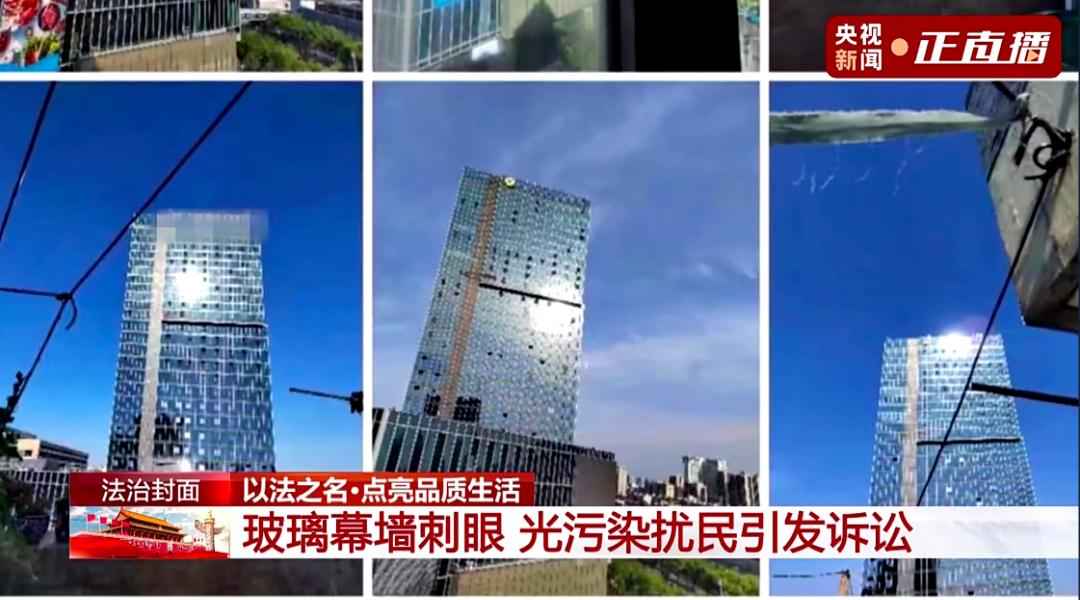
因对面玻璃太反光,宁波女子获赔6.5万,我们正遭光污染“白+黑”双重伤害?
3 6 Ke· 2025-12-29 03:26
Core Viewpoint - The article discusses the issue of light pollution, highlighting specific cases where individuals have suffered from excessive light exposure due to modern architectural designs and urban lighting practices [2][4][10]. Group 1: Case Studies of Light Pollution - A resident in Ningbo, Ms. Wang, experienced severe discomfort due to strong reflective light from a newly constructed building across the street, leading her to seek legal recourse [1][2]. - The court confirmed that the glass facade of the building caused significant "light pollution," affecting Ms. Wang's quality of life, resulting in a compensation of 65,000 yuan for the installation of low-transmittance glass [2][4]. - Another case from Chongqing involved a large LED display that emitted strong light, which was deemed to constitute severe light pollution, leading to a court order for cessation of the light emissions [4][6]. Group 2: Types of Light Pollution - "Bright pollution" is defined as light pollution caused by reflective surfaces like glass facades, which can lead to eye damage and increased risks of cataracts due to prolonged exposure [7][10]. - The phenomenon of "artificial daylight" refers to excessive outdoor lighting at night, which disrupts biological rhythms and can lead to health issues such as insomnia and anxiety [10][12]. - Research indicates that even short exposures to strong artificial light can trigger anxiety-like behaviors in animals, highlighting the broader ecological impact of light pollution [12].

原来光污染与阿尔兹海默病风险显著相关 你知道吗
Yang Shi Xin Wen· 2025-12-26 02:17
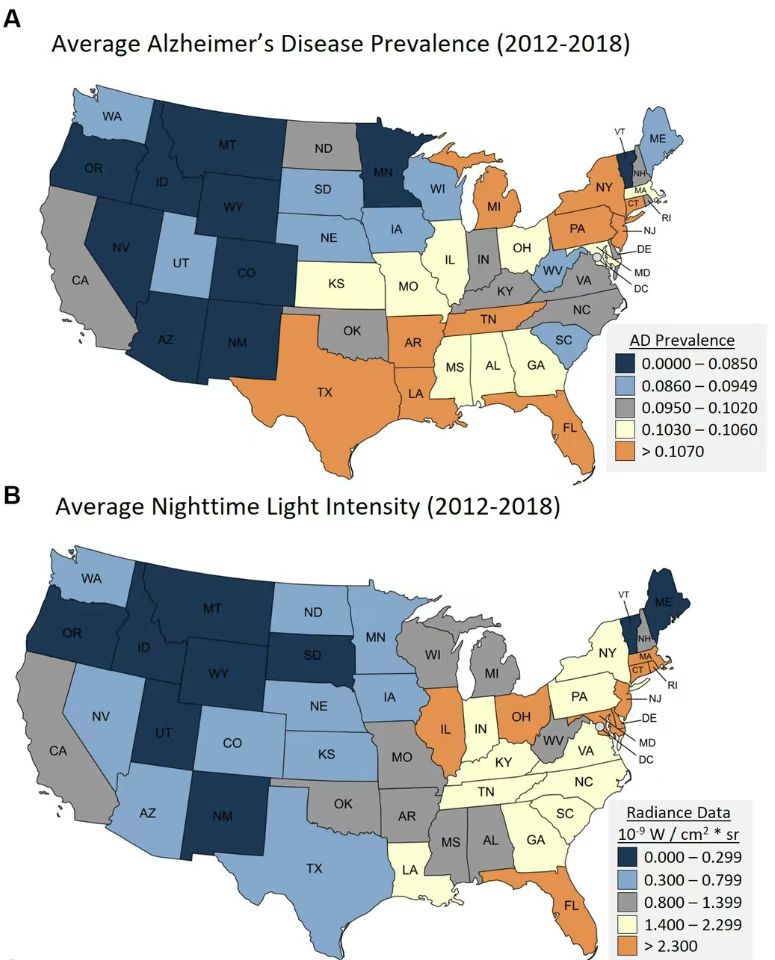
Core Viewpoint - A study published in September 2024 suggests a potential link between light pollution and an increased risk of Alzheimer's disease, providing new insights for further research in this area [1][2]. Group 1: Light Pollution and Alzheimer's Disease - The research compared light pollution levels across 48 states in the U.S. with local medical records, revealing a significant positive correlation between light pollution and Alzheimer's disease [2]. - For individuals aged 65 and older, light pollution is one of several risk factors for Alzheimer's, alongside alcohol abuse, chronic kidney disease, depression, diabetes, and hypertension [5]. - In contrast, for those under 65, light pollution may be the primary risk factor influencing the likelihood of developing Alzheimer's disease, although this only indicates a correlation, not causation [5]. Group 2: Physiological Effects of Light Pollution - A study involving 20 participants showed that those sleeping in lit rooms had faster heart rates, indicating overactivation of the sympathetic nervous system, which disrupts the body's rest during the night [8]. - Insulin secretion was also affected, with increased insulin resistance observed in participants exposed to light during sleep, potentially raising diabetes risk [10]. Group 3: Sleep Disruption and Alzheimer's Disease - Light pollution directly contributes to insomnia, with a study in South Korea indicating that 22% of 52,000 participants used sleep medications, with higher usage correlating with increased light pollution [11]. - Insomnia is closely linked to Alzheimer's disease, as a study of 511 participants found that more severe insomnia symptoms correlated with poorer cognitive performance over four years, particularly in carriers of the APOE ε4 gene [13].
原来光污染与阿尔兹海默症风险显著相关 你知道吗
Xin Lang Cai Jing· 2025-12-25 15:18
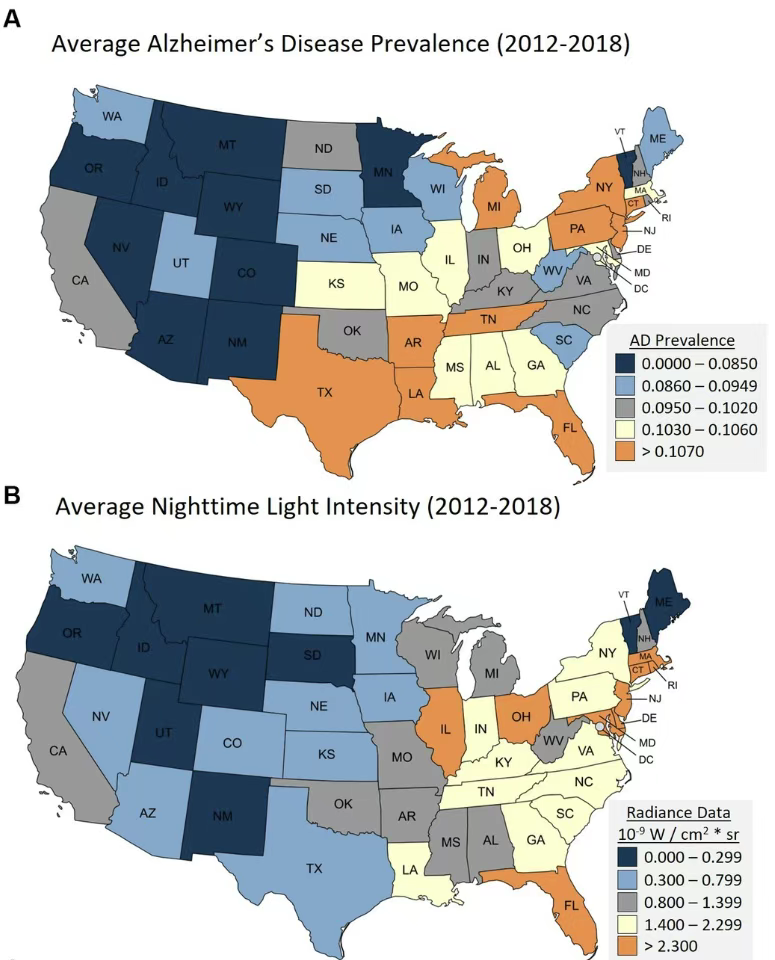
Core Viewpoint - A study published in September 2024 suggests a significant correlation between light pollution and the risk of Alzheimer's disease, indicating that exposure to artificial light at night may negatively impact health and cognitive function [1][2]. Group 1: Research Findings - The research compared light pollution levels across 48 states in the U.S. with local medical records, revealing a notable positive correlation between light pollution and Alzheimer's disease [2]. - For individuals aged 65 and older, light pollution is one of several risk factors for Alzheimer's, alongside alcohol abuse, chronic kidney disease, depression, diabetes, and hypertension [5]. - In contrast, for those under 65, light pollution may be the primary risk factor influencing Alzheimer's disease risk among various assessed factors [5]. Group 2: Physiological Effects of Light Pollution - A study involving 20 participants showed that those sleeping in lit rooms had increased heart rates, indicating heightened sympathetic nervous system activation, which disrupts the body's natural rest during the night [6]. - Insulin secretion was also affected, with participants exposed to light showing increased insulin resistance, potentially leading to a higher risk of diabetes [8]. - Animal studies indicated that exposure to nighttime light led to reduced dendritic spine density in hippocampal neurons and behavioral changes resembling depression, suggesting that the detrimental effects of light pollution may be more severe than previously understood [8]. Group 3: Sleep Disruption and Alzheimer's Connection - Light pollution directly contributes to sleep disturbances, with a study in South Korea finding that 22% of 52,000 participants used sleep medications, with higher usage correlating with increased light pollution [9]. - A follow-up study on 511 participants indicated that more severe insomnia symptoms were linked to poorer cognitive performance over four years, particularly in carriers of the APOE ε4 allele, which is associated with increased Alzheimer's risk [10]. - The research emphasizes the importance of maintaining dark sleeping environments to mitigate the effects of light pollution on sleep and cognitive health [10].
“最强外脑”上线,技术调查官是个什么“官”?
Sou Hu Cai Jing· 2025-08-04 02:16
Core Viewpoint - The article emphasizes the role of technology investigation officers in enhancing the efficiency and quality of legal proceedings in Shanghai's Jing'an District, showcasing a model for modernizing judicial practices and improving the business environment [1][2][3]. Group 1: Technological Integration in Legal Proceedings - Jing'an District has established inspection service stations in key commercial areas to create a first-class business environment and support new productivity [2]. - The introduction of technology investigation officers aims to address the increasing technical complexity of cases, particularly in areas like cybercrime and intellectual property [3][4]. - The first batch of 60 technology investigation officers was appointed to assist in resolving specialized technical issues within the judicial process [3]. Group 2: Case Studies and Practical Applications - A notable case involved the prosecution of an individual for unauthorized video distribution, where technology investigation officers helped identify over 4,000 instances of copyright infringement [3]. - In another case, technology investigation officers assisted in analyzing a self-developed program used for illegal account registration in online gaming, leading to a conviction [5]. - The involvement of technology investigation officers has significantly improved the confidence of prosecutors in handling complex cases involving computer programs and electronic evidence [5]. Group 3: Public Interest Litigation and Environmental Issues - The article discusses how technology investigation officers have been utilized in public interest litigation, particularly in addressing light pollution issues in residential areas [6][7]. - They employed scientific equipment to gather data on light pollution, which helped in establishing core evidence and facilitating multi-department collaboration for urban governance [7]. - The Jing'an District Prosecutor's Office has engaged technology investigation officers in various public interest cases, leading to over 200 instances of technical opinion issuance [7]. Group 4: Urban Governance and Safety - The article highlights the importance of integrating legal and technical expertise to enhance urban governance, particularly in traffic safety [8][9]. - Technology investigation officers have been involved in assessing traffic signal timing and road safety, leading to adjustments in traffic management across multiple intersections [8]. - The collaboration between prosecutors and technology investigation officers aims to create a more effective governance model that addresses urban challenges [9].

交警提示:天热开车谨防“情绪中暑”
Xin Hua Wang· 2025-08-02 08:04
Core Points - The article discusses the phenomenon of "emotional heatstroke," which is exacerbated by high temperatures and can negatively impact driving safety [1][2] - It emphasizes the importance of maintaining a calm mindset while driving, especially during hot weather conditions [1][2] Group 1: Emotional Heatstroke - "Emotional heatstroke" is defined as a summer emotional disorder that affects individuals when temperatures exceed 35 degrees Celsius, with high humidity and prolonged sunlight exposure [1] - The phenomenon can lead to negative psychological and physiological symptoms, including irritability and "road rage" among drivers [1] Group 2: Driving Safety Tips - Drivers are advised to overcome irritability by adhering to safe driving principles, such as yielding speed rather than changing lanes abruptly [1] - Regular ventilation in vehicles is crucial, as prolonged air conditioning can lead to poor air circulation [1] - Listening to soft music can help alleviate stress during driving, especially in congested traffic [2] - Drivers should take breaks if feeling drowsy and ensure adequate sleep to prevent fatigue [2] - Caution is advised regarding glare from reflective surfaces, which can cause visual discomfort and increase driving risks [2] - The use of sunglasses should be approached carefully, as overly dark lenses can delay reaction times [2]