
全球再通胀交易

Search documents
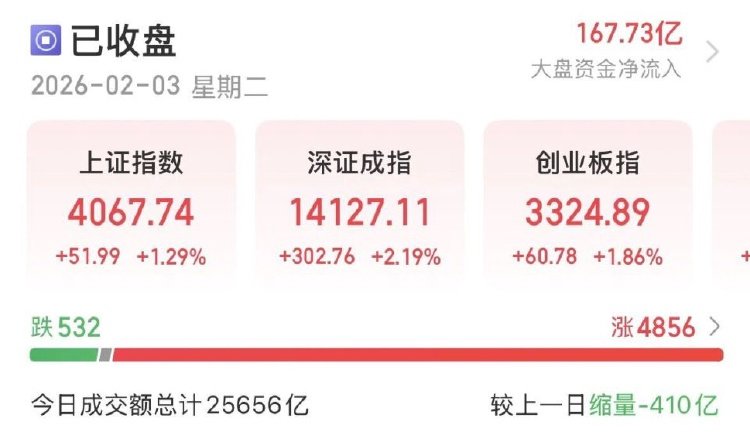
缩量大涨!A股反弹可持续多久
Guo Ji Jin Rong Bao· 2026-02-04 01:52
Core Viewpoint - The A-share market experienced a "V-shaped" rebound on February 3, with a total trading volume of 2.67 trillion yuan, indicating a positive market sentiment despite concerns about the sustainability of the rebound due to ongoing risk aversion ahead of the holiday season [1][3][15]. Market Performance - The Shanghai Composite Index rose by 1.29% to 4067.74 points, while the ChiNext Index increased by 1.86% to 3324.89 points, and the Shenzhen Component Index gained 2.19% [4]. - A total of 4856 stocks closed in the green, with significant rebounds in technology sectors such as military, machinery, and power equipment, as well as resource sectors like non-ferrous metals, steel, and chemicals [1][13]. Sector Analysis - Among 31 first-level industries, all except for banking saw gains, with 24 sectors rising over 1%. The comprehensive sector rose by 5.63%, and the defense and military sector increased by over 4% [8]. - The machinery equipment sector showed strong performance, with 11 related stocks hitting the daily limit, including notable gains from companies like Robotech and Jiepte [10]. - The power equipment sector also saw a surge, with 16 stocks reaching the daily limit, including Zairun New Energy and Aotewei [11]. Investor Sentiment - Despite the positive market performance, there remains a cautious sentiment among investors, with many still in a wait-and-see mode due to the proximity of the holiday and the lack of significant new capital entering the market [15][16]. - Analysts suggest that the current rebound is primarily a technical correction rather than a reflection of strong underlying fundamentals, with concerns about high institutional holdings in the machinery sector and cash flow pressures in the military sector [13][16]. Future Outlook - The market is expected to experience a phase of consolidation and potential volatility in the short term, with a likelihood of a "stop-loss" phase before a more stable recovery can occur [18][19]. - Analysts recommend a cautious approach to investment, focusing on sectors with clear growth trends such as AI and semiconductors, while also considering defensive positions in high-dividend sectors like power and banking [20][21].

期货日报:贵金属市场短期存在利空 长期“牛市”逻辑未改
Qi Huo Ri Bao· 2025-12-19 00:58
Group 1 - The global monetary and fiscal easing expectations are providing strong support for precious metal prices, although some varieties face potential negative disturbances due to changing macroeconomic conditions [1] - The Federal Reserve has entered a rate-cutting cycle, with expectations of a 25 basis point cut in both 2026 and 2027, and has recently conducted technical balance sheet expansion to maintain liquidity [2] - The uncertainty surrounding the Federal Reserve's monetary policy path may disrupt market expectations for liquidity expansion, potentially affecting precious metal prices [2] - Global debt and fiscal deficit expansion, along with ongoing gold purchases by central banks, are long-term bullish factors for the precious metals market, with gold prices showing a strong correlation with the total debt of major economies [2] Group 2 - Despite short-term negative factors, the long-term core trading logic for gold and silver remains unchanged, driven by global "reflation" trades, uncertainty in monetary policies, and geopolitical risks [3] - The People's Bank of China has been continuously increasing its gold reserves since November 2024, providing significant physical demand support for gold prices [3] - Key support and resistance levels for gold and silver prices are identified, with gold at $3900-$4100 per ounce support and $4400-$4600 per ounce resistance, and silver at $49-$54 per ounce support and $63-$72 per ounce resistance [3] Group 3 - The platinum and palladium markets are experiencing long-term support due to their emerging "new energy metal" attributes, with global supply expected to tighten by 2026 [4] - Factors such as high mining costs, unstable power supply, and aging production equipment are contributing to slow growth in platinum production, while demand is supported by stricter automotive emissions standards [4] - The palladium market faces pressure from the increasing market share of electric vehicles, with expectations of a shift towards a more relaxed supply-demand balance by 2026 [4] - Both platinum and palladium are undergoing significant changes in their supply-demand dynamics due to the energy structure transition, necessitating close monitoring of short-term disturbances [4]