
全球卫生治理

Search documents
美公共卫生专家:退出世卫组织后美国将更脆弱
Mei Ri Jing Ji Xin Wen· 2026-01-22 14:03
Core Viewpoint - The United States has officially withdrawn from the World Health Organization (WHO), which may weaken its influence in global health governance and make the country more vulnerable to future pandemics [1]. Group 1: Impact on Global Health - The WHO plays a crucial role in disease monitoring, updating vaccine standards, and data sharing, which are essential for managing public health [1]. - The withdrawal of the U.S. from the WHO will not halt global health governance, but it will diminish the U.S.'s influence in political, policy, and health matters worldwide [1].
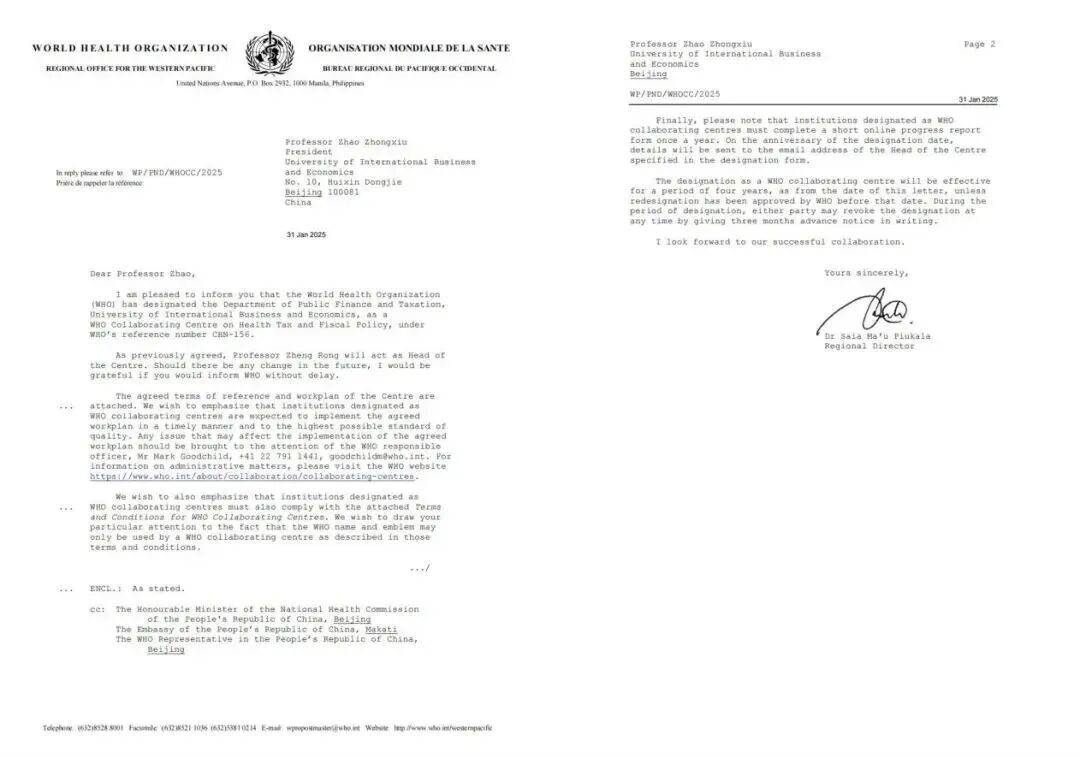
全球唯一!我校获批世界卫生组织经济政策合作中心
Sou Hu Cai Jing· 2025-12-18 10:12
Core Viewpoint - The University of International Business and Economics (UIBE) has been recognized as the "World Health Organization Health Tax and Fiscal Policy Cooperation Center (CHN-156)" in 2025, highlighting its strength in health economics research and global health governance, and marking a significant upgrade from its previous designation as the WHO Tobacco Control and Economic Policy Cooperation Center (CHN-119) [1][2]. Group 1: Strategic Positioning - The WHO cooperation center is a crucial platform for global public health knowledge production and policy collaboration, primarily composed of renowned medical and public health institutions [2]. - UIBE's unique advantages in trade, finance, taxation, and economic governance allow it to showcase its professional value in international health governance [2]. - The center's name change reflects an expansion of research areas from tobacco to a broader range of health taxes, enhancing UIBE's influence in global health fiscal policy [2][6]. Group 2: Research Capabilities - UIBE leverages its interdisciplinary strengths in economics, taxation, public management, and health economics to produce high-level research outcomes that contribute to global health tax reform [6]. - The center has developed a systematic research framework and actively participates in global health tax cooperation projects with organizations like WHO and the World Bank [6]. - The TaXSiM tobacco tax simulation model developed by UIBE has been recognized for its accuracy in predicting tax reform outcomes and has been adopted in multiple countries [6]. Group 3: Global Governance Engagement - UIBE plays a significant role in international public health cooperation under the Belt and Road Initiative, providing technical assistance and training to various countries [7]. - The center has established a regional high-level dialogue platform, enhancing cooperation among fiscal, tax, customs, and health departments across China and neighboring countries [7]. - UIBE experts actively participate in international discussions on public health policies, contributing to the transformation of Chinese experiences into global public goods [7]. Group 4: Talent Development - UIBE integrates scientific research with talent cultivation, creating a comprehensive training pathway that includes course teaching, research practice, international cooperation, and organizational internships [9]. - The center has successfully facilitated students' internships at international organizations, enhancing their global perspectives and competencies [9]. - Notable alumni have secured positions in prestigious organizations like WHO and the World Bank, demonstrating UIBE's effectiveness in preparing students for international roles [9]. Group 5: Future Outlook - UIBE aims to further consolidate its academic advantages and international influence in health tax and fiscal policy research, contributing significantly to global public health progress [10]. - The center is committed to responding to public challenges through rigorous research and professional capabilities, while also supporting national decision-making [10]. - UIBE seeks to enhance its global competitiveness in policy research and talent development, reinforcing its role in advancing human health and well-being [10].

加快建设健康中国(学习贯彻党的二十届四中全会精神)
Ren Min Ri Bao· 2025-12-17 22:11
Core Viewpoint - The construction of a healthy China is a significant strategic task that aligns with the modernization goals of socialism and aims to enhance the health and well-being of the population, as outlined in the "Suggestions" from the 20th Central Committee [1][2]. Group 1: Strategic Significance - Accelerating the construction of a healthy China is crucial for the overall strategy of Chinese-style modernization, providing sustainable human support for economic and social development [3]. - It is a major strategic decision related to promoting common prosperity for all people, emphasizing equitable and high-quality healthcare services [3][4]. - The initiative is also vital for gaining strategic advantages in the context of global changes, enhancing public health and biosecurity, and participating in global health governance [4]. Group 2: Overall Requirements - The "15th Five-Year Plan" period is critical for laying the foundation for achieving socialist modernization, requiring alignment with the central government's decisions [5]. - The work must adhere to principles of innovation and public welfare, ensuring that healthcare services are equitable and accessible [5][6]. - Emphasis on a coordinated approach is necessary to balance various relationships, including government and market dynamics, efficiency and equity, and domestic and international considerations [6]. Group 3: Key Tasks - The goal is to increase the average life expectancy of residents to around 80 years by 2030, with major health indicators reaching high-income country levels [8]. - Strengthening public health capabilities is essential, including improving disease monitoring, emergency response, and healthcare integration [9]. - Reforming public hospitals with a focus on public welfare and enhancing the quality of medical services is a priority [10]. - Developing a comprehensive service system for chronic disease prevention and management is crucial, particularly for major chronic diseases [12]. - Promoting traditional Chinese medicine alongside modern healthcare practices is part of the strategy to enhance healthcare diversity [13]. - Improving population health services and supporting family planning and child-rearing initiatives are necessary for high-quality population development [14]. - Enhancing the capabilities and ethical standards of the healthcare workforce is vital for improving service delivery and patient care [15].
国家卫健委主任雷海潮:全国1600万名医疗卫生服务人员遍及城乡
Zhong Guo Xin Wen Wang· 2025-12-01 07:02
Group 1 - The core message emphasizes China's achievements in building a comprehensive healthcare system, which includes 1.09 million medical institutions and 16 million healthcare workers across urban and rural areas, successfully enduring the challenges posed by the pandemic [1] - Since the beginning of the 14th Five-Year Plan, the average life expectancy of Chinese residents has increased by over 0.2 years annually, projected to reach 79 years by 2024, placing China among the leading middle-income countries in health performance with relatively low resource investment [1] - The phased goal for the Healthy China initiative aims for an average life expectancy of around 80 years by 2030, with a long-term target set for 2035 [1] Group 2 - In the realm of global health cooperation, China has dispatched medical teams to 77 countries and regions since 1963, with a total of 30,000 personnel participating in initiatives such as "Bright Action," "Caring Action," and surgical clinics, while also supporting the establishment of the Africa CDC [2] - There are over 60 Sino-foreign joint venture hospitals in China, with pilot foreign-owned hospitals in 7 provinces and 9 cities, alongside initiatives to explore medicinal plant resources through the "New Era Shennong Tastes Hundred Herbs" campaign [2] - China is committed to open innovation and sharing development outcomes in healthcare, reinforcing its support for multilateralism and collaboration with the World Health Organization in various fields, including pandemic response and traditional medicine, contributing to the UN's 2030 Sustainable Development Goals [2]
第七十八届世界卫生大会在瑞士日内瓦举行 为完善全球卫生治理贡献中国智慧
Ren Min Ri Bao· 2025-05-29 22:05
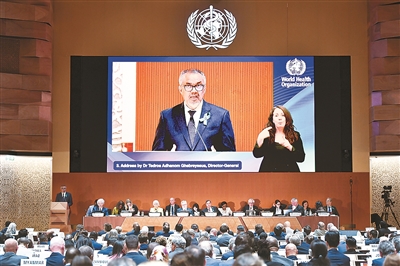
Group 1: Global Health Initiatives - The 78th World Health Assembly was held in Geneva, Switzerland, focusing on themes such as universal health coverage, non-communicable diseases, and responses to public health emergencies [1] - China actively participated in discussions and hosted several side events to share its experiences in health development and promote global health cooperation, receiving widespread acclaim [1] Group 2: Digital Health Leadership - China showcased its leadership in digital health by co-hosting a side event on "Empowering Primary Health Care through Digital Intelligence" with Ethiopia, Peru, Tanzania, and Thailand [2] - The presentation highlighted the "AI + Smart Mobile Hospital" initiative in Zhejiang Province, which provides quality medical services to remote villages through mobile medical units equipped with advanced technology [2] - WHO officials acknowledged the potential of digital technologies to enhance primary healthcare and bridge health disparities globally [2][3] Group 3: Traditional Medicine - A side event on "Implementing Traditional Medicine Strategies to Promote Universal Health Coverage" was co-hosted by China, Malaysia, Nepal, Saudi Arabia, and Seychelles, marking the first such event at the World Health Assembly [4] - China's unique path in developing traditional medicine was emphasized, with officials expressing a willingness to share experiences and collaborate internationally [4] - The WHO's Assistant Director-General praised China's achievements in traditional medicine and highlighted the importance of sharing best practices globally [4] Group 4: Pandemic Agreement - The assembly approved the "Pandemic Agreement," which is considered a significant achievement in global health history [6] - China actively participated in the negotiations for the agreement, advocating for equitable access to health products for developing countries [7] - WHO officials stressed the need for strong international cooperation to address common health challenges [7] Group 5: Commitment to Multilateralism - China expressed its commitment to multilateralism and support for the WHO's internal reforms to enhance efficiency and better serve member states' health needs [8] - The Chinese delegation emphasized the importance of building a global health community and advancing the global health governance system towards a more equitable direction [8]
聚焦全球健康,共筑防护网络(环球热点)
Ren Min Ri Bao Hai Wai Ban· 2025-05-21 22:45
Core Points - The 78th World Health Assembly is taking place in Geneva, Switzerland, focusing on global health issues and the adoption of the "Pandemic Accord" [4][5] - The "Pandemic Accord" aims to enhance global pandemic preparedness and response, marking a significant achievement in global health governance [5][6] Group 1: Pandemic Accord - The "Pandemic Accord" was approved after three years of negotiations among WHO member states and is considered a milestone in global health history [5][6] - The accord includes establishing a pathogen access and benefit-sharing system, enhancing research and development capabilities, and creating a global supply chain for health products [6] - It reflects a consensus among countries on the need for coordinated global action to prevent and respond to pandemics [6] Group 2: China's Role - China actively participated in the assembly, advocating for equitable access to health products for developing countries and sharing its health reform experiences [8][9] - The Chinese government emphasizes a health-first approach, with a goal of increasing life expectancy to 79 years by 2024 [8] - China has provided significant global health support, including 5 billion personal protective items and 2.3 billion vaccine doses during the COVID-19 pandemic [9] Group 3: Global Health Governance Challenges - The WHO's recent report highlights mixed progress towards the "Triple Billion" targets, with significant setbacks due to the COVID-19 pandemic [10][11] - Non-communicable diseases are becoming the leading cause of premature death among populations under 70, exacerbated by issues like air pollution and mental health [10] - The withdrawal of some countries from the WHO poses challenges to global health governance, emphasizing the need for strengthened multilateral cooperation [11]
世界卫生大会召开在即 中国代表团介绍参会情况
Zhong Guo Xin Wen Wang· 2025-05-18 15:49
Group 1 - The 78th World Health Assembly will open on May 19, with China's delegation actively participating and sharing its contributions to global health governance [1][2] - China is committed to supporting the World Health Organization (WHO) in its central coordinating role in global health governance and aims to enhance the health interests of developing countries [1] - The assembly will review the draft of the "Pandemic Accord," which is of significant interest, and China will support WHO's leadership in global public health governance [1] Group 2 - China is integrating traditional medicine into its health system and promoting the fusion of traditional and modern medicine, collaborating with over 40 countries and regions [2] - The theme of the general debate at the World Health Assembly is "Creating a Healthy World," and China will host side events to share its experiences [2]
中国坚定支持多边主义,推动全球卫生治理体系朝着更加公正合理的方向发展
人民网-国际频道 原创稿· 2025-05-18 09:40
Group 1 - The Chinese delegation at the World Health Assembly emphasizes the commitment to building a healthy China and achieving significant health milestones, including a projected life expectancy of 79 years by 2024 and a reduction in infant mortality to 4.0‰ [1] - China has actively participated in global health governance, sending 1,067 medical personnel to 59 countries and regions, serving over 2 million patients, and establishing cooperation with 48 hospitals in 43 countries [2][3] - The Chinese government has made arrangements for Taiwan's participation in global health affairs under the One China principle, with 12 individuals approved to attend WHO technical activities in the past year [3] Group 2 - The development of traditional Chinese medicine is highlighted, with China collaborating with over 40 countries and regions to integrate traditional medicine into the Belt and Road Initiative and supporting the inclusion of traditional medicine in the International Classification of Diseases [4] - China is reforming its disease control system to enhance public health and is constructively participating in negotiations for a pandemic agreement, contributing to global public health safety [4] - The 78th World Health Assembly will take place from May 19 to 27, with China hosting side events on primary health care, traditional medicine, and mental health, aiming to share experiences and promote international cooperation in health [4]