
全球经济重心转移

Search documents
世界首次五百强断崖差,日本149家,美国151家,中国3家,现在呢?
Sou Hu Cai Jing· 2026-02-27 13:53
Core Insights - The global economic landscape has shifted from a US-Japan dominance to a US-China rivalry, with Japan losing its prominence and falling to a third-tier position [2][4]. Group 1: US Economic Performance - The US maintains a strong economic presence, with a slight decrease in the number of Fortune 500 companies from 151 in 1995 to 138 in 2025, reflecting a loss of only 13 companies [4]. - Major US tech companies like Apple, Microsoft, and Amazon dominate the high-value sectors, achieving an average profit of $9.7 billion, which is more than double that of Chinese firms [4]. Group 2: Japan's Decline - Japan's representation in the Fortune 500 has drastically decreased from 149 companies in 1995 to only 38 in 2025, a decline of over 70% [4]. - The once-strong Japanese electronics and automotive sectors have either been surpassed by Chinese and Korean competitors or have gradually diminished, with only Toyota and Mitsubishi UFJ Financial Group remaining in the top 100 [4]. Group 3: China's Rise - China has seen a remarkable increase in Fortune 500 companies, growing from 3 in 1995 to 130 in 2025, making it the second-largest country in terms of representation, just behind the US [6][10]. - The rise of Chinese companies is attributed to a gradual process, starting with state-owned enterprises in energy and finance, followed by the emergence of private firms like BYD and Pinduoduo, which have quickly climbed the rankings [6][10]. Group 4: Financial Performance of Chinese Companies - The top Chinese companies by revenue include State Grid Corporation with ¥42,322.24 million and China National Petroleum Corporation with ¥31,844.66 million, showcasing significant earnings [7]. - Despite the increase in quantity, the average profit of Chinese firms is only $4.2 billion, significantly lower than that of US companies, indicating a need for improvement in quality and international presence [7][8]. Group 5: Economic Transition - The last thirty years have seen a shift in the global economic center, driven by different developmental paths: the US leveraging innovation and globalization, Japan lagging due to industrial upgrades, and China capitalizing on reform and a complete industrial chain [8][10].


印度宣布:成功超过日本!转头向中国发出一份特殊邀请函,承认了中国的实力和地位
Sou Hu Cai Jing· 2025-12-31 08:57
Economic Overview - India's GDP has reached $4.18 trillion, surpassing Japan to become the fourth-largest economy globally, with expectations to overtake Germany in the next three years [1] - Despite the large GDP, India's per capita GDP is less than one-twelfth of Japan's, indicating a challenge in translating economic growth into national welfare [1] Strategic Diplomatic Moves - The invitation to China for the 2026 Global Artificial Intelligence Summit coincides with the economic report release, reflecting a strategic choice by the Modi government [3] - This invitation is seen as a low-risk diplomatic probe in the context of tense border situations and a lack of strategic trust between India and China [3] - India's recognition of China's leading position in global technology, particularly in AI, is evident in its invitation, aiming to enhance its own technological capabilities and international influence [3] Geopolitical Dynamics - India faces a long-term strategic competition with China, necessitating careful balancing in its foreign policy, especially amid rising US hostility towards China [5] - The Modi government seeks to enhance its international competitiveness through cooperation with China while balancing its national interests [5] - India's ambition to lead in the Global South and compete with China for influence is fraught with challenges, as it attempts to replicate China's success in elevating developing nations [5] Economic Sustainability Challenges - Despite rapid economic growth, India's reliance on external markets remains significant, with much of its manufacturing still in the early stages and dependent on imports [7] - The need for technological advancement, self-innovation, and industrial upgrading is critical for sustaining economic growth [7] - The transition from strong economic data to inclusive development and strategic positioning in complex international relations is a key issue for India's future [7]
加拿大总理:全球经济重心正在转移
Yang Shi Xin Wen Ke Hu Duan· 2025-11-25 01:40
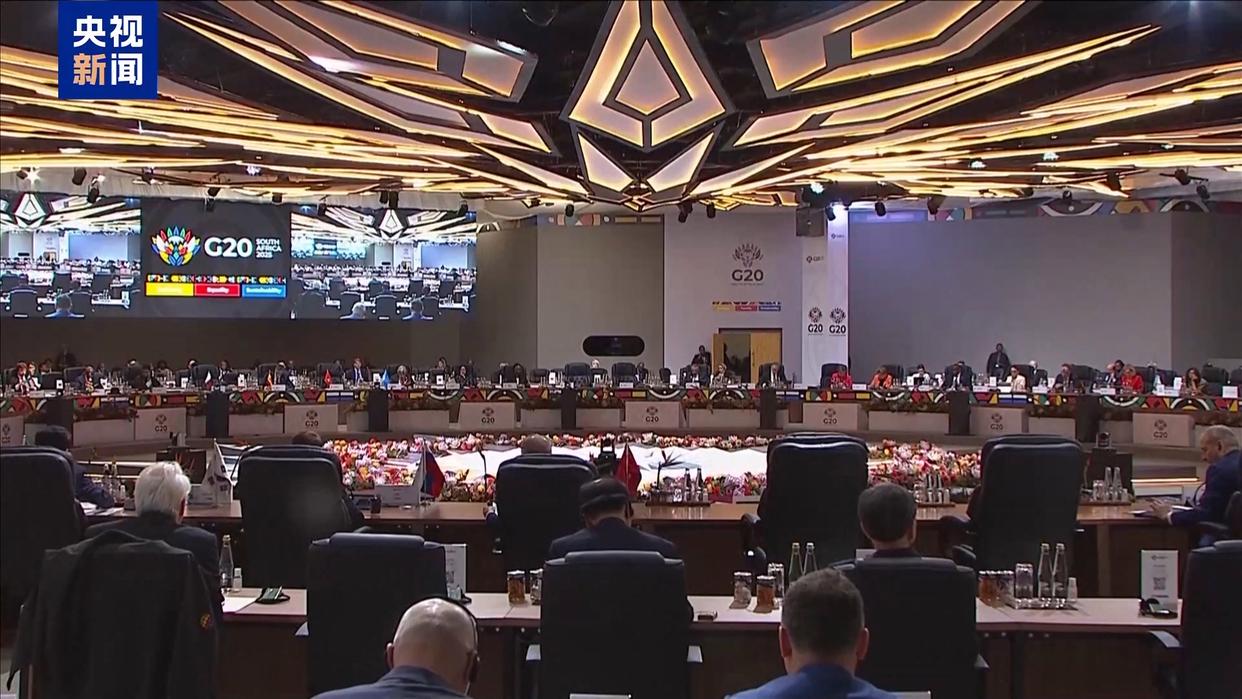
Group 1 - The G20 summit in South Africa gathered economies representing three-quarters of the global population, two-thirds of global GDP, and three-quarters of global trade, despite the absence of the United States [3][5] - The summit highlights a shift in the global economic focus, moving from the concentration of capital, production, and power in the last century to a future defined by the diffusion of technology, energy, and influence [3] - The rise of Global South countries and the new roles played by middle powers like Canada in new multilateral mechanisms are shaping this transition [3] Group 2 - The U.S. government officially boycotted the summit, with the U.S. Embassy in South Africa reiterating its stance against participating and opposing any summit outcomes without U.S. consent [5] - South Africa responded to the U.S. boycott by stating that the U.S. has lost its "speaking" rights due to its refusal to participate, indicating a resistance to U.S. pressure [5]
加拿大总理:世界没有美国也能运转 全球经济重心正在转移
Zhong Guo Xin Wen Wang· 2025-11-24 06:13
Core Viewpoint - Canadian Prime Minister Mark Carney emphasized that the world will continue to function without the United States, highlighting the shifting focus of the global economy [1] Group 1: Global Economic Dynamics - Carney stated that the G20 summit brought together countries representing three-quarters of the global population, two-thirds of global GDP, and three-quarters of world trade, despite the absence of the U.S. [1] - This situation serves as a reminder of the ongoing shift in the global economic center of gravity [1] Group 2: Canada's Economic Strategy - Canada is actively signing new agreements and seeking new investors to advance its economic plans [1] - The country aims to expand trade cooperation and promote investment growth, particularly in sectors such as artificial intelligence and energy, while deepening partnerships with the Indo-Pacific region and Europe [1]
加拿大总理就美国缺席G20峰会态:全球经济重心正在转移
Xin Jing Bao· 2025-11-24 05:00
Group 1 - The core viewpoint of the article highlights that despite the absence of the Trump administration, the G20 summit reached significant consensus among participating nations [1] - Canadian Prime Minister Carney emphasized that the summit included countries representing three-quarters of the global population, two-thirds of the GDP, and three-quarters of trade volume [1] - Carney has expressed strong dissatisfaction with Trump's policies during his campaign and is focused on reducing Canada's economic dependence on the U.S. since taking office [1] Group 2 - Carney stated that Canada will not allow Trump to dictate the agenda in the ongoing trade negotiations between Canada and the U.S. [1]