全球南方国家崛起

Search documents
洞察世界经济的分化与重塑
Jing Ji Ri Bao· 2026-01-24 21:55
Global Economic Overview - In 2025, the global economy faces multiple challenges, including increased tariffs from the US impacting the multilateral trade system and rising geopolitical tensions affecting supply chains [1] - The International Monetary Fund (IMF) projects a global economic growth rate of 3.2% for 2025, highlighting structural issues and a growing divide between developed and emerging markets [1] Growth Patterns - Global economic growth is slowing, with developed economies like the US, Eurozone, and Japan facing significant challenges, while emerging markets are projected to grow at 4.2% [2] - The ASEAN countries are particularly strong, maintaining a growth rate of 4.7%, indicating a shift in the global economic landscape [2] Trade Dynamics - The global trade system has been severely impacted by the US's imposition of tariffs, raising the average effective tariff rate to its highest level since 1934 [4] - This tariff policy has led to a significant increase in trade costs and has distorted global supply chains, with estimates suggesting a 40% rise in supply chain costs due to these tariffs [5] Financial Market Trends - The international gold price has seen its largest increase since the 1978 oil crisis, driven by rising credit risks associated with the US dollar and increasing government debt [7] - The share of the US dollar in global foreign exchange reserves has declined to around 56%, the lowest in 30 years, indicating a shift towards a more diversified monetary system [7] Debt Concerns - Global debt has reached $337.7 trillion, exceeding 350% of GDP, with significant concerns regarding the sustainability of debt levels in both developed and developing countries [8] - High-interest rates are exacerbating debt pressures, particularly in low-income countries, which face a repayment gap of $741 billion, the highest in over 50 years [8] Technological and Industrial Transformation - Artificial intelligence (AI) and green industries are identified as dual drivers of the global economy in 2025, with significant investments from major tech companies [9] - The global digital trade export scale has increased from $4.59 trillion to $7.23 trillion from 2020 to 2024, reflecting a robust growth rate of 12.1% [11] Emerging Market Influence - Emerging economies, particularly in the Global South, are becoming key players in reshaping the global economic landscape, contributing 80% to global economic growth [12] - The rise of these economies is supported by deepening South-South cooperation and regional integration efforts, enhancing their role in global trade [12][13]
加拿大总理:全球经济重心正在转移
Yang Shi Xin Wen Ke Hu Duan· 2025-11-25 01:40
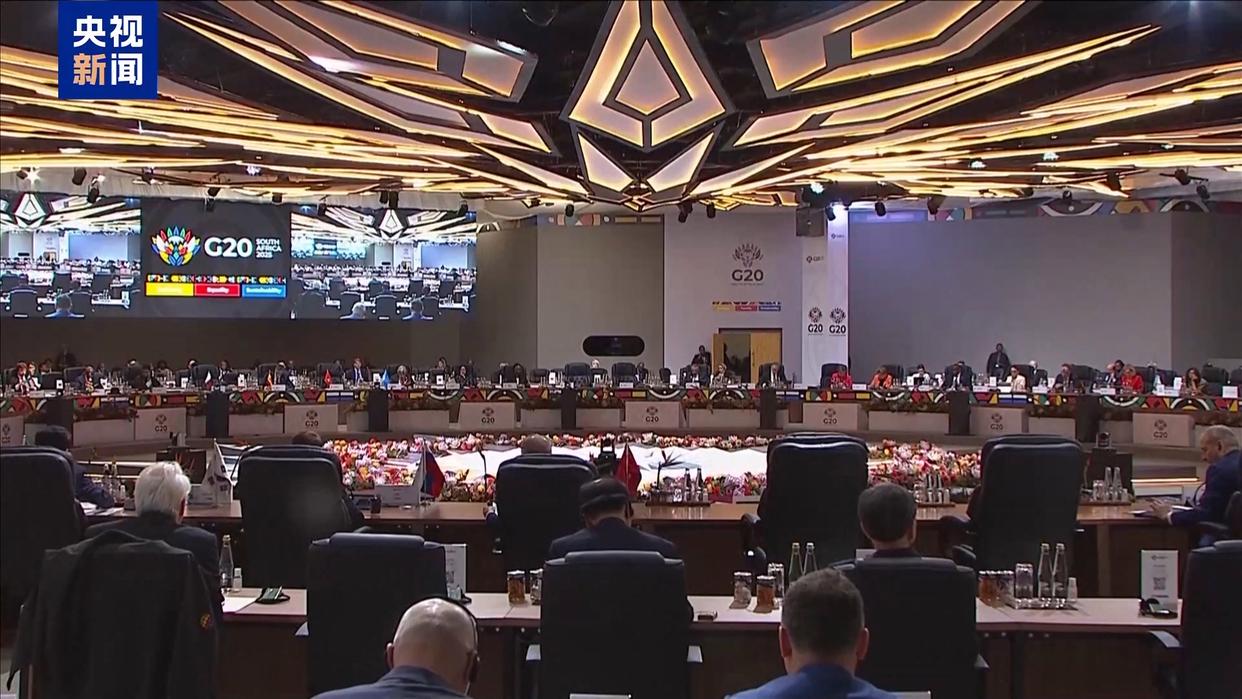
Group 1 - The G20 summit in South Africa gathered economies representing three-quarters of the global population, two-thirds of global GDP, and three-quarters of global trade, despite the absence of the United States [3][5] - The summit highlights a shift in the global economic focus, moving from the concentration of capital, production, and power in the last century to a future defined by the diffusion of technology, energy, and influence [3] - The rise of Global South countries and the new roles played by middle powers like Canada in new multilateral mechanisms are shaping this transition [3] Group 2 - The U.S. government officially boycotted the summit, with the U.S. Embassy in South Africa reiterating its stance against participating and opposing any summit outcomes without U.S. consent [5] - South Africa responded to the U.S. boycott by stating that the U.S. has lost its "speaking" rights due to its refusal to participate, indicating a resistance to U.S. pressure [5]

中国经济:世界格局之变中的稳定源与引力场
Zhong Guo Qing Nian Bao· 2025-08-31 02:01
Group 1: Global Economic Landscape - China's macroeconomic policies are focused on expanding domestic demand and maintaining medium to high-speed economic growth, providing essential support for the global economy [1] - Developed economies are facing weakened growth momentum and structural challenges exacerbated by tariff policies, leading to a decline in consumer spending and capital confidence [2][3] - The collective rise of global South countries is contributing significantly to world growth, with their trade accounting for 45% of global goods trade and contributing 80% to global growth [4] Group 2: Challenges in Developed Economies - Developed economies are experiencing a self-reinforcing cycle of decline due to protectionist measures, which fail to address structural economic issues [3] - The U.S. tariff policies have not resulted in the expected manufacturing return, instead increasing production costs and inflation, leading to a drop in personal consumption expenditure growth to 1.4% [2] - Other developed economies, such as Europe and Japan, are also suffering from reduced growth momentum due to their reliance on U.S. exports and supply chain connections [2] Group 3: Resilience of Global South - Global South countries are diversifying their economies and reducing reliance on traditional markets, with a young population providing a robust labor force and consumer market [4] - These countries are actively pursuing industrialization and integration into higher-value segments of global supply chains, enhancing their economic resilience [4] - Strengthened South-South cooperation is providing a robust support system against external risks, with initiatives like BRICS+ and RCEP enhancing regional collaboration [5][6] Group 4: China's Role in the Global Economy - China is emerging as a "stabilizing source" in the global economy, with a growth rate of 5.3% in the first half of 2025, attracting significant foreign investment [7] - The country is committed to high-level opening-up policies, with a 11.7% increase in newly established foreign enterprises, particularly in high-tech manufacturing [8] - China advocates for multilateralism and actively participates in global governance reforms, contributing to a more inclusive international economic order [9]
“甲亢姐”首次来中国,体验科技感和未来感后开始说中国好话!网友:还是欣赏你以前无知的桀骜不驯
Xin Lang Cai Jing· 2025-08-30 23:27
Group 1 - The article discusses a notable shift in perception towards China by a previously critical Indian host after her visit to China during the Shanghai Cooperation Organization (SCO) summit [1][9] - The SCO summit is highlighted as the largest ever, with leaders from over 20 nations gathering, marking a significant event in the post-pandemic context [5][9] - The summit serves as a platform for China to showcase its technological advancements, emphasizing technology as a core message to the world [9] Group 2 - Advanced technologies, including robots and drones, were prominently featured at the summit, demonstrating China's capabilities in enhancing supply chain efficiency [6][9] - The event is positioned as a counter-narrative to Western patronization of Global South countries, signaling a shift in global power dynamics [7][9] - The transformation in the host's attitude reflects a broader recognition of China's development and its contributions to global progress, as noted by various online commentators [9]

《南方崛起》多语种报告在巴西里约热内卢发布
Xin Hua Wang· 2025-07-17 14:16
Core Viewpoint - The "Southern Rise" multilingual report released by Xinhua News Agency highlights the collective awakening and rise of global South countries, showcasing their efforts towards self-reliance and development in the context of significant global changes [1][2]. Group 1: Report Overview - The report, comprising approximately 100,000 words, includes research findings from Xinhua News Agency since 2024, illustrating the innovative practices of the global South in their collective rise [1]. - It features case studies from Africa, Latin America, the Middle East, and the Asia-Pacific region, providing a comprehensive view of the global South's awakening [1]. Group 2: Regional Insights - The report emphasizes the historical and cultural observations of the global South, integrating political realities and rich case studies to present a broad perspective [1]. - The story of Potosí, Bolivia, as highlighted in the report, exemplifies the resilience and transformative spirit of global South countries in their pursuit of change [2]. Group 3: Economic Impact - Global South countries now account for over 40% of the world's economic share, significantly altering the political, economic, and cultural landscape globally [2]. - These countries are becoming a key force in the transformation of the international order, reflecting their growing influence [2].
以包容合作、共同发展谱写时代新乐章(国际论坛)
Ren Min Ri Bao· 2025-05-18 22:02
Group 1 - The article emphasizes the importance of international cooperation, particularly between France and China, in addressing global challenges and fostering technological innovation [2][3] - The establishment of the Greater Bay Area International Vaccine Innovation Center in Shenzhen showcases the collaborative efforts in vaccine distribution and technology, highlighting the potential of cross-cultural partnerships [2] - China's significant market size, with over 1.4 billion people and more than 400 million middle-income individuals, positions it as a vital engine for global economic growth, contributing approximately 30% to global economic growth [3] Group 2 - The deepening cooperation between France and China, especially in third-party market collaborations, has shown substantial potential, with projects in Africa and Central and Eastern Europe [3] - The fourth round of third-party market cooperation projects signed in 2022 includes seven projects in infrastructure, environmental protection, and renewable energy, totaling over $1.7 billion [3] - The article advocates for a future where global development is characterized by collaboration rather than conflict, promoting a harmonious international community [4]