全球资产配置大迁移

Search documents
“私募魔女”李蓓:中国富人的钱放在海外越来越不安全
Xin Lang Cai Jing· 2025-12-02 14:59
Group 1 - The current environment for Chinese wealth is characterized by a lack of safe investment options, with significant events highlighting the risks of holding assets overseas, such as the freezing of Russian oligarchs' assets and the seizure of cryptocurrency by the U.S. [1][29] - UBS's potential relocation to the U.S. to comply with regulatory demands signals an escalation in international asset capture efforts, raising concerns among Chinese entrepreneurs about the safety of their overseas investments [1][11] - The A-share and Hong Kong stock markets are viewed as "small blessings" in the current global asset landscape, with the CSI 300 index having a PE ratio of approximately 13 times and an implied return of 7% [21][30] Group 2 - Despite ongoing economic deflation, core ROE has stabilized due to the exit of weaker firms, allowing leading companies in sectors like construction and real estate to improve profitability [2][21] - Leading companies in struggling industries are beginning to see profit recovery, with some construction firms reporting net profits of 6% and real estate companies achieving over 10% net profit on new projects [21][34] - There is a significant amount of wealth in China currently concentrated in fixed income, with low risk appetite among residents, which could drive future capital migration towards equities [2][21] Group 3 - The potential for a bull market in A-shares and Hong Kong stocks is anticipated if the Chinese economy stabilizes and ROE improves, especially as global capital may shift towards Chinese assets due to challenges in the U.S. [2][21][36] - The mismatch between China's manufacturing share in the global market and its international currency status suggests that as the economy recovers, the renminbi's role in trade settlements and reserves may increase [21][36] - The current low risk appetite and the concentration of wealth in fixed income could act as catalysts for a significant reallocation of assets towards equities in the future [2][35]


视频|李蓓:两年后有一轮全球资产配置的大迁移 资金流向中国
Xin Lang Zheng Quan· 2025-12-01 09:50
Core Insights - The 2025 Analyst Conference highlighted expectations for a significant influx of global capital into the A-share market, suggesting a potential bull market in China [1] Group 1: Economic Outlook - By 2025, China's economy is expected to have rebounded, with a likely recovery in Return on Equity (ROE) [1] - Following supply-side adjustments, Chinese companies are anticipated to demonstrate improved profitability and resilience [1] Group 2: Global Investment Trends - It is projected that AI investments in the United States will likely slow down, coinciding with unsustainable high fiscal deficits [1] - The anticipated economic conditions may trigger a new wave of global asset reallocation [1]
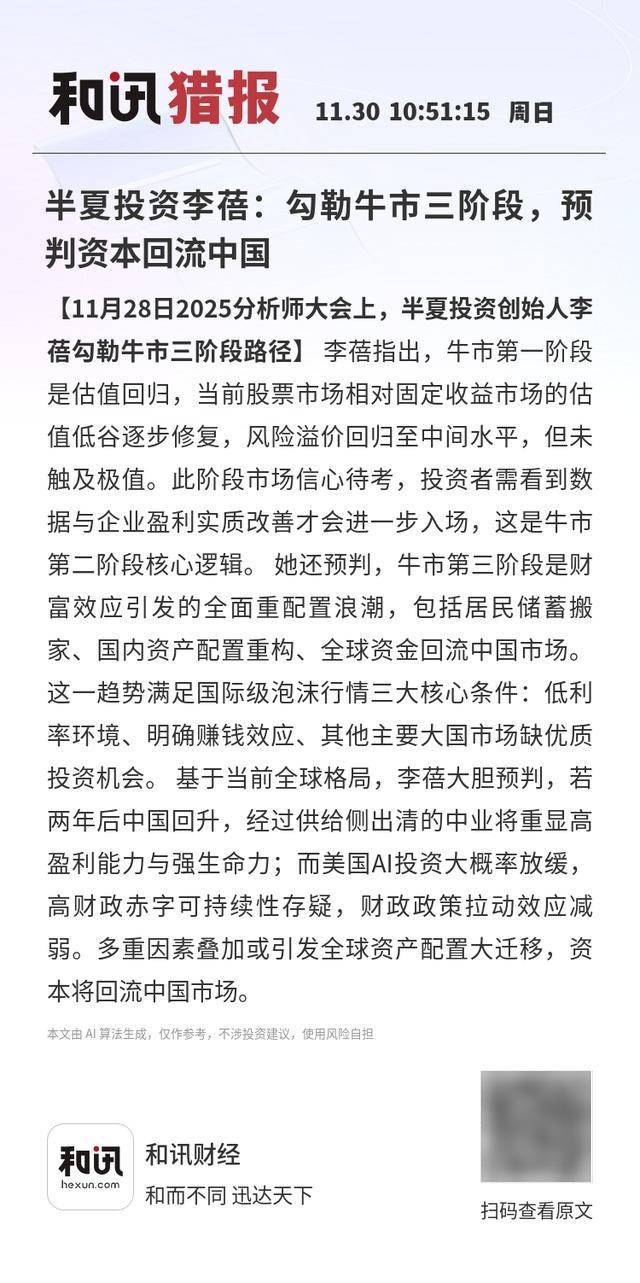
半夏投资李蓓:勾勒牛市三阶段,预判资本回流中国
Sou Hu Cai Jing· 2025-11-30 06:40
Group 1 - The core viewpoint of the article is that the founder of Banxia Investment, Li Bei, outlines a three-stage path for a bull market, starting with valuation recovery and moving towards a comprehensive reallocation of wealth driven by the wealth effect [1] - The first stage of the bull market involves a gradual recovery of stock market valuations relative to fixed income markets, with risk premiums returning to mid-levels but not reaching extremes [1] - The second stage is contingent on investors seeing tangible improvements in data and corporate earnings before further market entry [1] Group 2 - The third stage is characterized by a wave of comprehensive reallocation, including the migration of household savings, restructuring of domestic asset allocations, and the return of global capital to the Chinese market [1] - Li Bei predicts that if China rebounds in two years, the domestic industry will regain high profitability and vitality after supply-side clearing, while AI investments in the U.S. are likely to slow down, raising doubts about the sustainability of high fiscal deficits [1][3] - Multiple factors may trigger a global asset allocation migration, leading to capital flowing back into the Chinese market [1][3]
李蓓最新十大观点:金价已明显高估,A股牛市分为三大阶段目前仅处第一阶段,这一轮行情非常可能会泡沫化
Xin Lang Zheng Quan· 2025-11-30 03:02
Core Viewpoint - The 2025 Analyst Conference highlighted the challenges faced by wealthy individuals in asset allocation and the potential for a significant bull market in China, driven by economic recovery and global capital inflows [1][3][4]. Market Conditions - The Chinese stock market is currently in the first phase of a bull market, characterized by valuation recovery, with risk premiums still above historical averages [3][25]. - The market is undergoing a critical testing phase, where confidence and economic performance will determine the next steps [3][25]. Economic Outlook - A forecast suggests that in two years, the Chinese economy is likely to recover from deflation, leading to improved corporate profitability and a rise in stock index ROE [4][29]. - The current global economic landscape, particularly the high fiscal deficit in the U.S., raises doubts about the sustainability of the dollar's value and could trigger a reallocation of global capital towards China [4][29]. Investment Opportunities - Leading companies in A-shares are showing signs of profitability recovery, which is crucial for stabilizing core index ROE and reducing downward risks [1][4]. - The real estate sector, while facing challenges, has seen some leading firms restructure their profit models, indicating potential for recovery [4][15]. Historical Context - Historical analysis indicates that significant market bubbles require three conditions: a low-interest environment, a clear profit-making effect, and a lack of investment opportunities in other major markets [3][27]. - The previous A-share bubble in 2006-2007 was largely due to the collapse of the U.S. housing market, making China an attractive investment destination [3][27]. Future Projections - The potential for a new global asset allocation migration is anticipated, with capital likely to flow back into the Chinese market as its economic conditions improve [4][29]. - The current low-risk appetite among domestic investors and the significant wealth accumulation in China could serve as fuel for a future bull market [25][30].