全球金融格局重塑

Search documents
尘埃落定,中美实力步入对等新阶段,黄金储备数据公布,美元主导地位受冲击
Sou Hu Cai Jing· 2025-12-08 22:11
Group 1 - The latest U.S. National Security Strategy acknowledges China as a world power nearly equal to the U.S., marking a significant shift in U.S. foreign policy [1][3] - The U.S. is strategically retracting its global influence, focusing more on its own hemisphere, which has been humorously referred to as a transition from "global leader" to "hemispheric leader" [1][3] - This acknowledgment of China's status is seen as a tactical move to foster domestic political unity against China and to pressure allies in Europe and the Indo-Pacific to take a stand [3] Group 2 - China's central bank has been increasing its gold reserves, with a total of 74.12 million ounces as of November 2025, reflecting a clear strategy to hedge against risks and reduce reliance on U.S. Treasury bonds [5][7] - The share of gold in China's foreign exchange reserves has risen to 7%, indicating a significant increase in the importance of gold as a financial asset for China [7] - The trend of "buying gold and selling U.S. debt" is not merely an investment adjustment but a strategic move to counter U.S. financial dominance and enhance the credibility of the Chinese yuan [7][9] Group 3 - The issuance of sovereign bonds denominated in yuan by Russia signifies a shift in global financial dynamics, moving away from traditional currencies like the dollar and euro [9] - Over 75% of trade between China and Russia no longer uses the dollar, indicating a broader trend of "de-dollarization" that is causing concern in the U.S. [9][12] - The U.S. faces significant economic challenges, including a national debt exceeding $37 trillion, which is prompting a shift in global financial strategies [12][14] Group 4 - China's approach to countering U.S. challenges is characterized by patience and strategic depth, focusing on reducing U.S. debt holdings while enhancing trade relationships with Southeast Asia and the EU [14][15] - The gradual decline of the dollar's dominance in global reserves is evident, with countries increasingly diversifying their reserves and exploring local currency settlements in trade [17] - The ongoing changes in the global financial landscape suggest a slow but certain transition away from dollar dependency, as countries like India and Brazil increase their gold reserves and explore alternative currencies [17]

华尔街日报酸评:中国正用我们的武器打败我们,中国是最大赢家?
Sou Hu Cai Jing· 2025-11-04 17:03
Core Insights - The global financial focus is shifting from the US, which is burdened by $38 trillion in debt and has recently cut interest rates, to China, which has successfully issued $4 billion in sovereign bonds in Hong Kong, attracting $40 billion in global capital [1][3][4] Group 1: US Financial Situation - The Federal Reserve faces a dilemma: raising interest rates could worsen the debt crisis, while lowering them would signal failure, with the IMF predicting the US debt-to-GDP ratio will reach 133% by 2025, the highest since World War II [3][4] - The US struggles to maintain its national creditworthiness, even facing challenges in funding its nuclear arsenal [3][4] Group 2: China's Financial Strategy - China has maintained the world's largest foreign exchange reserves at over $3.2 trillion for 18 consecutive months, and its recent issuance of sovereign bonds in Hong Kong is part of a strategy to counter the US dollar [4][11] - The issuance of $20 billion in US bonds last year attracted $40 billion in subscriptions, demonstrating China's ability to leverage its financial instruments to challenge US dominance [6][11] Group 3: Global Financial Dynamics - Countries like Argentina and Turkey, suffering from dollar dependency, are looking to China for financial support, indicating a shift in global financial alliances [6][12] - China's approach contrasts with the US's coercive tactics, as it builds trust through cooperation rather than dominance [11][12] Group 4: Market Reactions and Future Implications - Major financial institutions like Goldman Sachs and Morgan Stanley are increasing their research efforts in China, focusing on sectors like consumption, renewable energy, and high-end manufacturing, indicating a strategic investment shift [15][16] - If China normalizes the issuance of dollar-denominated bonds, it could influence global capital flows by $1-1.5 trillion over the next five years, reducing the Federal Reserve's control over global interest rates [16][17] Group 5: Philosophical and Strategic Perspectives - The operation of dollar bonds is seen as a tactical maneuver, with capital flows representing the momentum, and the cooperative model embodying the overarching strategy [19]
上海市欧美同学会金融沙龙举行 探讨新形势下的国际经贸与投资
Sou Hu Cai Jing· 2025-10-21 11:32
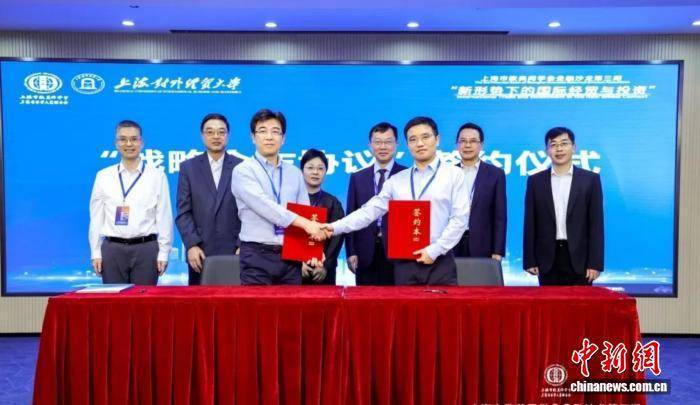
Core Viewpoint - The Shanghai Overseas Chinese Students Association Financial Salon focuses on the new international economic and trade landscape, emphasizing China's next steps in opening up and the process of economic globalization, which impacts the global development pattern [1][3]. Group 1: Event Overview - The third session of the Shanghai Overseas Chinese Students Association Financial Salon was held at Shanghai University of International Business and Economics [1]. - The event serves as a platform for academic and industry exchange, addressing new challenges in international economics and trade [1]. Group 2: Key Themes and Discussions - Experts discussed various topics including Sino-U.S. trade, sustainable development in the Global South, global supply chain restructuring, tariffs, cross-border finance and payments, Southeast Asian investments, and the international expansion of Chinese enterprises [3]. - The discussions included analysis of policy trends, strategic layouts, and practical case studies [3]. Group 3: Strategic Collaborations - A strategic cooperation agreement was signed between the Shanghai Overseas Chinese Students Association Financial Branch and the Financial Management School of Shanghai University of International Business and Economics [3].