
公共利益公司(PBC)

Search documents
OpenAI转型为公益型公司(PBC),强化微软协同并提升资本弹性
Haitong Securities International· 2025-10-29 05:13
Investment Rating - The report does not explicitly provide an investment rating for the industry or specific companies involved. Core Insights - OpenAI's transition to a Public Benefit Corporation (PBC) enhances its capital flexibility and valuation, now estimated at approximately US$135 billion, significantly up from US$80-90 billion in mid-2023, establishing it as a leading player in the AI sector [2][8]. - Microsoft increases its stake in OpenAI to 27%, solidifying its strategic partnership and maintaining its role as a primary cloud provider, which is expected to bolster its position in the enterprise AI services market [4][9]. - The restructuring allows OpenAI to collaborate with other cloud providers, enhancing its supply chain flexibility and reducing reliance on a single vendor, which may mitigate risks associated with GPU shortages [3][10]. Summary by Sections Corporate Restructuring - OpenAI has completed its restructuring into a PBC, allowing it to attract external capital while balancing public benefit and commercial goals [1][7]. - The new structure removes previous profit limitations, enabling more flexible financing options [4][14]. Microsoft Partnership - The increased ownership stake gives Microsoft greater influence over OpenAI, ensuring continued access to AI models and integration across its products [4][9]. - This partnership is expected to enhance the visibility of AI revenue streams for Microsoft, particularly in its Azure and Copilot ecosystems [12]. Market Position and Strategy - OpenAI's new governance model provides a template for balancing ethical considerations with capital efficiency, potentially attracting sovereign funds and strategic investors [11][14]. - The removal of Microsoft's compute exclusivity clause allows OpenAI to engage with other cloud vendors, which could optimize operational costs and reduce risks associated with supply chain dependencies [3][10].

OpenAI「割席」微软,复盘兄弟反目往事丨氪金·大事件
36氪· 2025-06-19 09:10
Core Viewpoint - The article discusses the evolving relationship between OpenAI and Microsoft, highlighting their shift from collaboration to competition, particularly after OpenAI's recent partnership with Google Cloud for AI model training and operation [3][4][12]. Group 1: Partnership Dynamics - OpenAI and Google Cloud's partnership was officially established in May 2023, providing OpenAI with new computing power for AI model training [4]. - The collaboration signifies a formal split between OpenAI and Microsoft, which had been deteriorating for over six months due to disagreements [5][12]. - OpenAI's valuation has reached $300 billion, while Microsoft's market capitalization has surged to $3.5 trillion, indicating both companies' significant growth in the AI sector [7]. Group 2: Underlying Tensions - The tensions between OpenAI and Microsoft were foreshadowed by events such as Sam Altman's removal as CEO of OpenAI in November 2023, and Microsoft's CEO Satya Nadella's ambiguous statements regarding OpenAI's future [6]. - Disputes over intellectual property rights have been a critical factor in the deteriorating relationship, with OpenAI reluctant to share key model information with Microsoft [9][10]. - Following a series of conflicts, Microsoft began to tighten its investment and resource supply to OpenAI, while OpenAI sought alternative partnerships, such as with Oracle [10][12]. Group 3: Structural Changes at OpenAI - OpenAI announced plans to transition to a profit-oriented structure by 2025 but later decided to maintain control under a non-profit parent company while creating a Public Benefit Corporation (PBC) [14][15]. - The restructuring aims to eliminate profit caps and allow for a traditional capital structure, enabling direct equity ownership for employees and investors [15]. - Negotiations with Microsoft regarding equity stakes and revenue sharing have been complex, with OpenAI aiming to reduce Microsoft's share while ensuring its support for the restructuring [18][20]. Group 4: Future Implications - The ongoing negotiations indicate a shift in Microsoft's strategy from ownership to operational leverage, allowing it to maintain access to OpenAI's technology without the complexities of governance [21]. - The outcome of these negotiations remains uncertain, with indications that OpenAI executives have considered legal action against Microsoft for monopolistic practices [22][23].

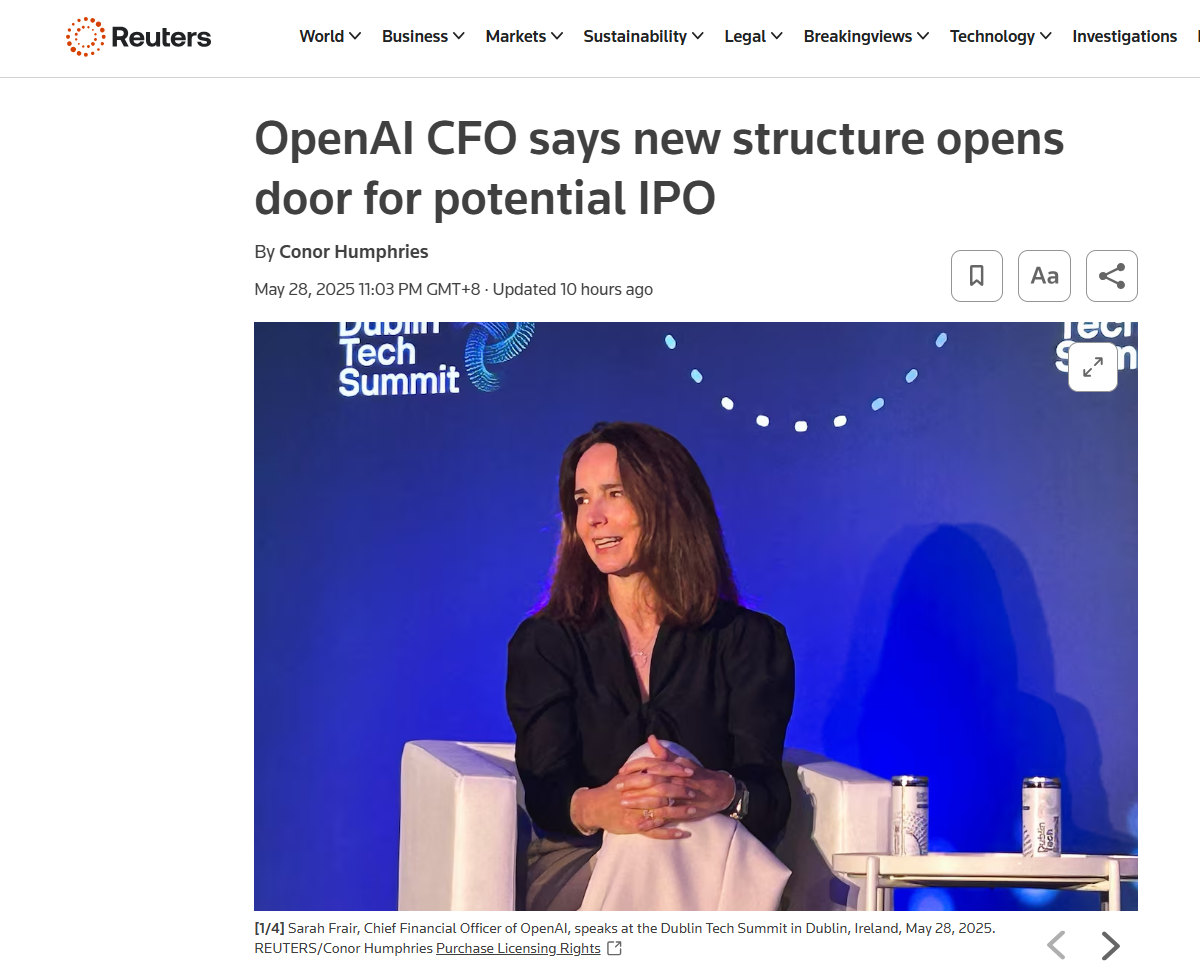
OpenAI 首席财务官:公司正在为IPO铺平道路
Huan Qiu Wang· 2025-05-29 02:21
Group 1 - OpenAI is restructuring its organization to prepare for a potential initial public offering (IPO), with the decision to proceed depending on the company's readiness and the overall market environment [1][3] - Microsoft has invested over $13 billion (approximately 93.5 billion RMB) in OpenAI [3] - OpenAI transitioned its for-profit business to a "public benefit corporation" (PBC) model, aiming to balance shareholder returns with social responsibility [3] Group 2 - The non-profit parent company of OpenAI will retain control over the PBC and act as the main shareholder, while the for-profit business can continue fundraising to maintain a competitive edge in the generative AI sector [3] - The CFO of OpenAI emphasized that the PBC structure provides a possibility for an IPO, but it is not guaranteed [3] - OpenAI's CFO highlighted the importance of being well-prepared for an IPO and waiting for the right market conditions, stating that stability is crucial for public companies [3]
全球 AI 产业观察(1): OpenAI 收购 Windsurf 加码 AI 工具,转型 PBC 或冲击融资预期
Haitong Securities International· 2025-05-06 14:33
Investment Rating - The report does not explicitly provide an investment rating for the industry or the specific company involved. Core Insights - OpenAI has agreed to acquire AI-assisted coding tool Windsurf for approximately $3 billion, marking its largest acquisition to date. Additionally, OpenAI is transitioning its for-profit subsidiary into a Public Benefit Corporation (PBC) to balance capital attraction with its mission of benefiting humanity [1][6]. - The acquisition of Windsurf aims to accelerate the development of an AI developer tools ecosystem, integrating advanced AI models with mature IDE tools to enhance code generation and developer engagement [2][7]. - The competitive landscape for AI coding assistants is intensifying, with major players like Microsoft's GitHub Copilot and Google's Gemini emerging. OpenAI's acquisition is expected to strengthen its market position and leverage user data for model optimization [3][8]. - The transition to a PBC structure may reduce OpenAI's appeal to traditional investors, as it requires balancing profit-making with social and environmental impacts, potentially leading to concerns about earnings performance [4][9]. - The "Stargate" initiative, a collaboration involving significant investments in AI infrastructure, may face increased uncertainty in fundraising due to the structural changes associated with the PBC transition [4][10]. - Overall, the report suggests that OpenAI's strategic moves reflect a commitment to enhancing its AI tool ecosystem and expanding its market share, while also highlighting potential challenges in attracting traditional investment [4][11]. Summary by Sections - **Acquisition of Windsurf**: OpenAI's acquisition of Windsurf for $3 billion is aimed at building a comprehensive AI development tool ecosystem, enhancing code generation capabilities, and increasing developer engagement [1][2][3]. - **Competitive Landscape**: The AI coding assistant market is becoming increasingly competitive, with OpenAI's acquisition expected to bolster its technological capabilities and market share against rivals [3][8]. - **Transition to PBC**: OpenAI's shift to a PBC structure may deter traditional investors due to the dual focus on profit and social impact, potentially complicating fundraising efforts for large projects like Stargate [4][9][10]. - **Strategic Direction**: The report concludes that OpenAI's recent actions indicate a strategic focus on strengthening its AI tools ecosystem and optimizing model performance, while also acknowledging the challenges posed by its new corporate structure [4][11].