公募基金费改新规

Search documents
固定收益周报:股债同跌同涨,原因何在?-20251221
Western Securities· 2025-12-21 11:06
1. Report Industry Investment Rating No relevant content provided. 2. Core Viewpoints of the Report - Since November, the "stock - bond double - fall" and "stock - bond double - rise" phenomena have frequently occurred, and the yield curve has steepened. The traditional stock - bond seesaw has failed periodically due to changes in loose expectations and institutional behavior [1][9]. - The market's loose expectations have eased, and the growth rate of broad liquidity has declined. The market's expectation of further monetary policy easing next year is not strong. Institutions are taking profits on equity floating gains at the end of the year, and the bond market's ability to hedge equity fluctuations is poor [1][2][9]. - Fundamentally, the economic growth momentum in November was still weak, with some improvement in external demand and inflation but continued drag from domestic demand. However, the bond market was insensitive to fundamental positives. The bond market is expected to remain in an oscillating range, and it is recommended to focus on the coupon strategy at the end of the year [2][10]. 3. Summary According to Relevant Catalogs I. Review Summary and Bond Market Outlook - This week, bond market sentiment was volatile, with institutional behavior dominating the market. The yields of 10Y and 30Y Treasury bonds decreased by 1bp and 2bp respectively. The bond market is expected to be affected by the unimplemented public fund fee reform and the performance of the equity market, maintaining an oscillating range [8][10]. II. Bond Market Review 2.1 Funding Situation - The central bank had a net injection, and funding rates remained stable at a low level. This week, the central bank's net open - market injection was 190 billion yuan. Next week, the maturity volume is less than the previous week [12][14]. 2.2 Secondary Market Trends - Yields first rose and then fell. The yields of key - term Treasury bonds decreased, and most key - term Treasury bond spreads widened. The spread between 10Y and 30Y Treasury bonds decreased by 1bp to 39bp, at a high historical percentile [22]. 2.3 Bond Market Sentiment - The inter - bank leverage ratio continued to rise to 108.0%, and the exchange leverage ratio rose to 123.3%. The median duration of medium - and long - term pure - bond funds decreased slightly, and the implied tax rate of 10 - year CDB bonds narrowed [33]. 2.4 Bond Supply - This week, the net financing of interest - rate bonds decreased by 383.4 billion yuan compared with last week. Treasury bonds, local government bonds, and policy - bank bonds all saw a decline in net financing. Next week, a 7Y Treasury bond will be newly issued, and the planned issuance scale of local government bonds will decrease [45][49]. III. Economic Data - In November, industrial growth slowed slightly, and investment and consumption demand weakened. Since December, second - hand housing transactions and automobile consumption have recovered. Industrial production performance remains divided [56]. IV. Overseas Bond Markets - US inflation data was unexpectedly lower than expected, increasing the probability of a Fed rate cut in March next year. The Bank of Japan raised interest rates by 25 basis points. US bonds rose, and the Japanese bond market fell [64][65]. V. Major Asset Classes - The CSI 300 index adjusted slightly this week. The Nanhua Rebar Index and Shanghai gold rose, while the Nanhua Crude Oil Index weakened. The performance of major asset classes was: rebar > Shanghai gold > convertible bonds > US dollar > Chinese - funded US dollar bonds > Chinese bonds > live pigs > CSI 300 > CSI 1000 > Shanghai copper > crude oil [69]. VI. Policy Review - Multiple policies were introduced this week, including the State Council's deployment of implementing the decisions of the Central Economic Work Conference, the opening of the Shanghai Stock Exchange's bond repurchase business to overseas institutional investors, the public consultation on the "Insurance Company Asset - Liability Management Measures", the proposal of ideas for expanding effective investment in the "14th Five - Year Plan", and the deployment of the CSRC and Shenzhen Financial Office [72][74][75].
关于年内利率走势的展望分析
Sou Hu Cai Jing· 2025-09-23 03:09
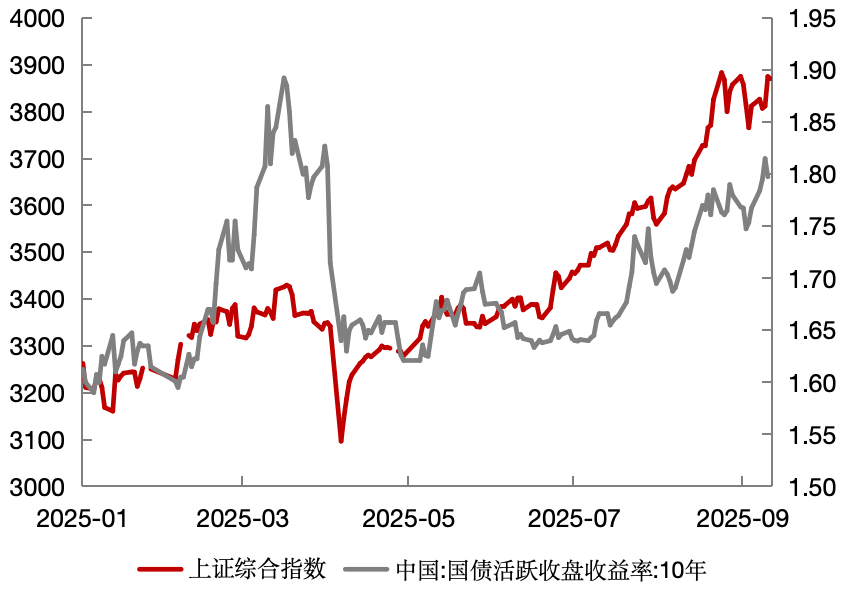
Group 1 - The bond market is currently in a chaotic phase, influenced by weak fundamentals and strong risk appetite, with expectations of two phases in market performance for the remainder of the year [1][2] - The first phase, from mid-September to October, is expected to see a recovery in the bond market, with the 10-year government bond yield potentially peaking around 1.85% [1][25] - The second phase, from November to mid-December, may see an increase in policy expectations, with the yield center likely to rise, potentially reaching a high of around 1.9% [1][26] Group 2 - Bond yields have fluctuated, with the 10-year government bond yield rising from 1.65% at the end of June to above 1.81%, before retreating to 1.79% by September 12 [2] - The "stock-bond seesaw" effect has been observed, where rising stock market performance leads to increased bond yields, as seen with the Shanghai Composite Index rising from 3440 to above 3880 [2][4] - The macroeconomic environment shows limited changes, with GDP growth in the first half of the year at 5.3%, but subsequent months showing weaker consumption and investment data [2][3] Group 3 - Monetary policy remains moderately accommodative, with potential for further interest rate cuts following the Federal Reserve's recent rate reduction [3] - Institutional behavior is impacting the bond market, with banks and insurance companies showing varied levels of bond purchasing activity [13][14][15] - Recent regulatory changes regarding fund sales fees are expected to increase redemption pressures on bond funds, potentially leading to higher bond yields [19][20] Group 4 - Historical analysis indicates that previous "stock-bond seesaw" phases have led to significant movements in both markets, with the current phase expected to be less impactful than past occurrences [7][9] - The bond market's sensitivity to stock market movements is anticipated to weaken, with the bond market's performance becoming less reactive to stock price changes [10][26] - The overall bond market is expected to maintain a stable yield environment, with predictions of slight fluctuations in the coming months [22][25]