
关键矿产市场

Search documents
又一个战略储备诞生?报道:美国国会两党力推25亿美元关键矿产战略储备计划
Sou Hu Cai Jing· 2026-01-15 12:16
Core Viewpoint - A bipartisan group of U.S. lawmakers is introducing the SECURE Minerals Act, which aims to establish a $2.5 billion Strategic Resilience Reserve to stockpile critical minerals, reducing reliance on external supply chains and ensuring stable raw material supply for domestic technology and manufacturing [1][2]. Group 1: Legislative Details - The SECURE Minerals Act will be proposed by Senators Jeanne Shaheen and Todd Young, along with Representatives John Moolenaar and Rob Wittman [1]. - The reserve will operate similarly to the Strategic Petroleum Reserve, with physical storage facilities for critical materials and a governance structure akin to the Federal Reserve, overseen by a seven-member committee appointed by the President and confirmed by the Senate [2]. Group 2: Economic Implications - The establishment of the reserve is seen as a necessary measure to protect national and economic security, with the potential to enhance high-paying jobs in key sectors such as aerospace, automotive, and technology [2]. - The initial investment of $2.5 billion may be expanded if the legislation passes, similar to the funding model of the CHIPS and Science Act, which authorized approximately $280 billion for semiconductor and scientific research [2]. Group 3: Strategic Objectives - The long-term strategy of the Strategic Resilience Reserve extends beyond mere storage; it aims to develop a domestic critical minerals market, enhance U.S. production capacity, and ensure a stable long-term supply for American businesses [3]. - The initiative is part of a broader effort to gain greater autonomy and bargaining power in the global competition for rare earth and other raw materials, which has already led to conflicts in Africa and increased interest in regions like Greenland [3].
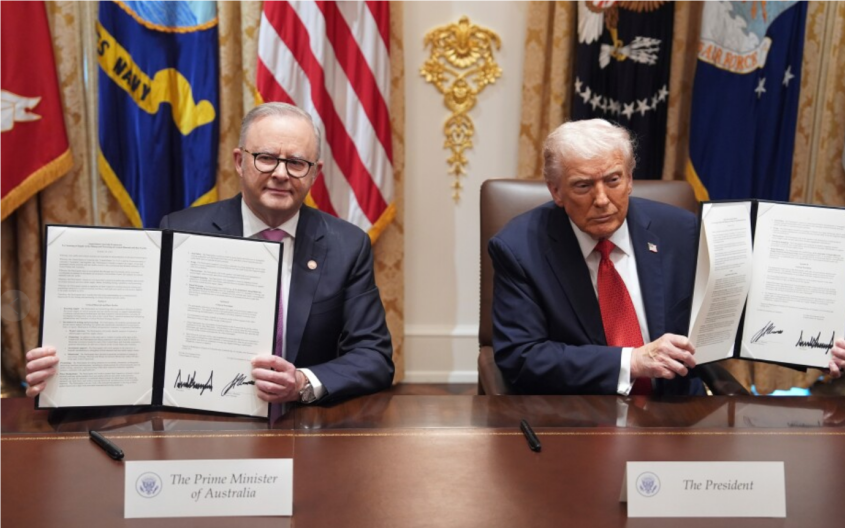
澳总理赴美推销,美澳达成85亿美元关键矿产合作协议
Huan Qiu Wang· 2025-10-21 02:38
Core Points - The United States and Australia signed a key mineral agreement aimed at enhancing mining and processing capabilities, with a total project value of $8.5 billion [1][3] - The agreement is expected to accelerate investments in three types of projects, including U.S. investments in Australian processing facilities [3] - The U.S. plans to invest in a gallium refining plant in Western Australia with an annual capacity of 100 tons, supported by approximately $2.2 billion in financing from the Export-Import Bank of the United States [3] Industry Context - The agreement marks a significant step in U.S.-Australia relations, aiming to counter China's dominance in the critical minerals market [3] - Australia, despite being a major source of critical minerals, relies heavily on China for processing, with over 90% of its lithium being sent to Chinese refineries [3] - The partnership seeks to address the weaknesses in Australia's domestic processing capabilities, which are relatively underdeveloped compared to its mining strengths [3]

图解丨2024年全球稀土产量分布
Ge Long Hui· 2025-10-11 04:10
Core Insights - The U.S. Geological Survey indicates that China's rare earth production will account for nearly 70% of global output in 2024 [1] - From 2020 to 2023, the U.S. imported 70% of its rare earths from China, highlighting China's dominance in the market [1] Industry Position - China holds a leading position in the global critical mineral market, particularly in rare earths, lithium, cobalt, and nickel [1] - The country controls over 60% of global rare earth production, approximately 70% of lithium refining, nearly 70% of cobalt processing, and over 90% of battery-grade graphite production [1]