关键矿产贸易联盟

Search documents
万斯正式向中方下达战书,50多国齐聚华盛顿,把高市早苗高兴坏了
Sou Hu Cai Jing· 2026-02-18 16:47
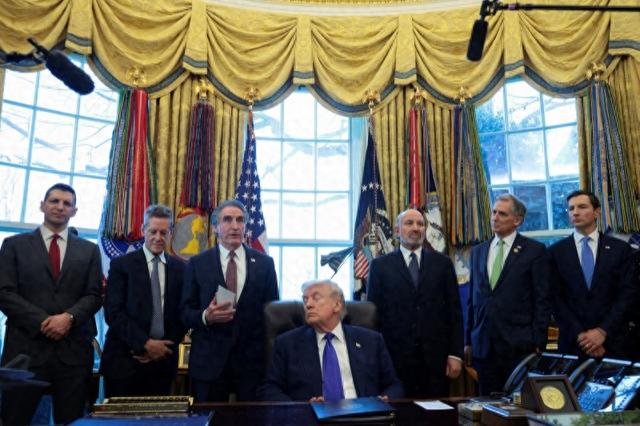
Core Viewpoint - The U.S. Vice President announced a significant decision to establish a "critical mineral price floor" and impose "adjustment tariffs" in collaboration with allies, aiming to challenge China's dominance in the global mineral market [3][5][6]. Group 1: Meeting Overview - The "critical minerals ministerial meeting" was convened in Washington, attended by representatives from 55 countries, including Germany, Brazil, India, and Japan, indicating a united front against China's market monopoly [3][5]. - The meeting focused on creating a new "critical mineral trade alliance" to ensure that mineral market prices are not controlled by a single country but managed collectively by alliance members [3][5]. Group 2: Strategic Implications - The U.S. government's policy shift reflects a strategic change from the previous administration's "America First" approach to a multilateral strategy in response to China's stronghold in the mineral sector [6][10]. - The establishment of a price floor aims to stabilize mineral prices, which is crucial for the U.S. economy and national security, particularly for industries like high-tech weapons, semiconductors, and electric vehicles [8][14]. Group 3: Japan's Role - Japan plays a critical role in this alliance due to its significant demand for essential minerals like rare earths and lithium, and it has expressed a strong commitment to countering China's influence [10][12]. - The collaboration between the U.S. and Japan in the mineral supply chain has been ongoing since 2025, focusing on joint resource development and risk-sharing [12]. Group 4: Challenges and Responses - The proposed alliance aims to reshape the global supply chain and ensure supply security for the U.S. and its allies, while also providing private financing support for member countries [14][16]. - China's response emphasizes its constructive role in maintaining global supply chain stability, despite facing increased external pressure from the U.S. and its allies [16][19].


美国急建“去中国”关键矿产体系,日媒:至少面临长达十年的艰巨挑战
Xin Lang Cai Jing· 2026-02-18 01:53
Core Viewpoint - The United States is attempting to reduce its dependence on China in the critical minerals sector through significant investments, strategic reserves, and supply chain restructuring, but faces a challenging reality that may take up to a decade to overcome [1][4]. Group 1: U.S. Initiatives - The U.S. government has launched a $12 billion strategic reserve plan for critical minerals and is forming a "critical minerals trade alliance" to exclude China [1]. - The Biden administration has committed over $30 billion in investments and loans to the private sector in the past six months for critical minerals [1][3]. - The "Project Vault" initiative aims to establish a strategic reserve with $10 billion in loans from the Export-Import Bank and nearly $2 billion in private sector investments [3]. Group 2: Challenges and Limitations - Experts warn that the U.S. measures may not adequately address short-term supply shocks, as replacing Chinese suppliers quickly is highly challenging [3][4]. - China controls 60% of global rare earth mining and 90% of refining capacity, making it difficult for the U.S. to achieve self-sufficiency in the near term [4][8]. - The average time from discovering a mine to operational status is about 16 years, complicating the U.S. efforts to ramp up domestic production [7]. Group 3: Market Dynamics - The "Project Vault" may only cover 45 days of demand for 44 critical minerals, raising concerns about its effectiveness [4][5]. - The U.S. government's transparency regarding its budget and plans may weaken its bargaining power, potentially increasing procurement costs [5]. - The U.S. has invested in several mining companies, including MP Materials, which operates the only rare earth mine in the U.S. [5][8]. Group 4: Long-term Outlook - Analysts suggest that it may take years for the U.S. to build sufficient rare earth supplies, and by then, China's need for export controls may diminish [4][10]. - A more promising alternative could be investing in new technologies to enhance refining and processing capabilities, which have shown potential for innovation [8][9]. - Japan's experience shows that even with over a decade of investment, reducing dependence on China in critical minerals is a long-term challenge [10].