
再通胀周期

Search documents
掌控日本的“铁娘子” 正牵动着美股与日元的命运?
智通财经网· 2026-02-10 07:06
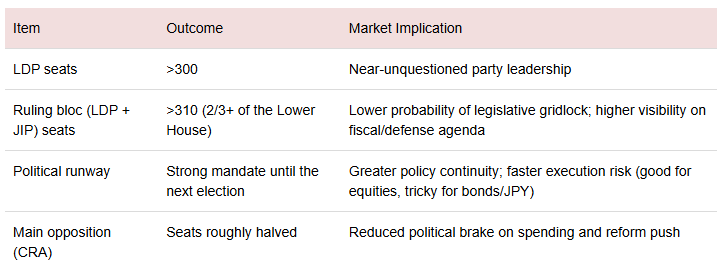
Core Viewpoint - The recent election results in Japan have granted Prime Minister Sanna Takashi and her ruling coalition significant political power, enabling efficient decision-making and potential economic policy changes that could impact global markets [1][2]. Group 1: Political Landscape - The ruling coalition led by Takashi's Liberal Democratic Party (LDP) secured approximately 316 seats, forming a majority with the Japan Innovation Party (JIP) to control around 350 seats in the House of Representatives [2]. - This majority allows the coalition to streamline legislative processes, reducing the likelihood of political gridlock and facilitating quicker implementation of policies [2][3]. - The opposition party's seats have been roughly halved, diminishing their influence on spending and reform initiatives [3]. Group 2: Market Implications - The election outcome has led to a bullish sentiment in the stock market, with indices like Nikkei 225 and TOPIX reaching historical highs, driven by expectations of fiscal stimulus and economic growth [4]. - The Japanese yen has depreciated significantly, with the USD/JPY exchange rate nearing 159, as market participants anticipate increased government spending and rising debt levels [6][7]. - Long-term Japanese government bonds (JGB) are experiencing higher yields due to concerns over fiscal risks and potential government spending plans [7]. Group 3: Investment Strategies - The "Takashi Trade" strategy involves going long on Japanese equities while being cautious with long-term JGB investments, which are viewed as high-risk assets [5]. - Investors are advised to consider the dynamics of yen carry trades, where borrowing in yen to invest in higher-yielding assets could lead to significant losses if the yen appreciates unexpectedly [10][11]. Group 4: Economic Scenarios - Analysts have outlined three potential scenarios for Japan's economic outlook: 1. **Moderate Reflation**: Continued fiscal stimulus with controlled debt levels, leading to stable yen and manageable bond yields [13]. 2. **Bond Vigilante 2.0**: Aggressive tax cuts and defense spending could lead to a reassessment of long-term bond risks, potentially pushing yields above 4% [14]. 3. **Yen Shock & Carry Trade Unwind**: A shift towards hawkish monetary policy could result in a rapid appreciation of the yen, triggering a sell-off in global equities as investors liquidate positions [15].

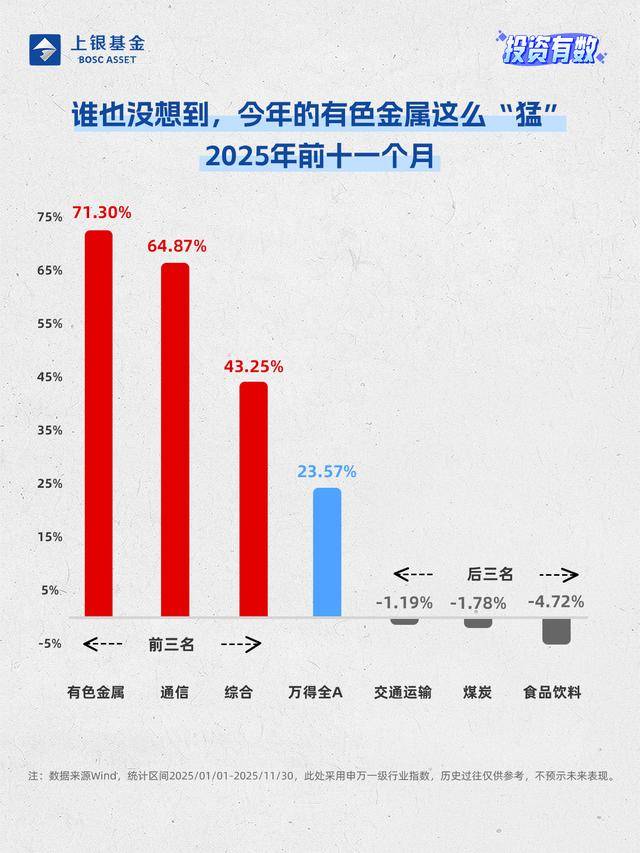
投资有数|有色金属年内涨幅超70%,超级周期或已起步
Sou Hu Cai Jing· 2025-12-11 11:28
Group 1 - The core viewpoint of the article highlights that the leading sector in the A-share market is not the thriving TMT (Technology, Media, and Telecommunications) sector, but rather the traditionally viewed sector of non-ferrous metals [1] - The industry is expected to achieve good revenue growth in 2025, indicating that strong fundamentals will support stock price stability [2] - The global commodity resource market has reached a rolling yield bottom in 2020, suggesting a historical cycle of mean reversion is likely to occur [4] Group 2 - The issuance of fiat currency globally has become a central factor influencing industrial metal prices, emphasizing the importance of economic development fundamentals [6] - In the domestic market, the "anti-involution" trend has initiated a new inflation cycle, with cyclical resource companies in the A-share market expected to benefit from both global and domestic cycles, leading to a recovery in prosperity [9] - Investment opportunities in the current A-share resource sector can be captured through actively managed equity funds, with a specific focus on global commodity resources [11]
日本央行维持利率不变 静待经济复苏强度
Jin Tou Wang· 2025-09-22 05:07
Core Viewpoint - The article highlights the cautious stance of the Bank of Japan in maintaining interest rates amid global uncertainties and domestic inflation slowdown, signaling readiness to address external fluctuations while monitoring the sustainability of Japan's economic recovery [1] Group 1: Monetary Policy - The Bank of Japan's decision to keep interest rates unchanged reflects a prudent policy approach in the face of increasing global uncertainties and slowing domestic inflation [1] - Analyst Hiroaki Amemiya indicates that the current strategy aims to support the economy in the early stages of a "re-inflation cycle" [1] Group 2: Currency Outlook - As the interest rate differential between Japan and the U.S. narrows, the Japanese yen is expected to strengthen, enhancing Japan's international purchasing power and supporting domestic demand [1] - The USD/JPY pair has shown signs of a bullish rebound, but the potential impact of interest rate differentials may play a significant role [1] Group 3: Industry Preparedness - Japan's industrial, manufacturing, and automotive sectors are well-prepared to face global trade headwinds and are likely to benefit from supply chain restructuring trends [1] - The USD/JPY has been fluctuating within the range of 145.00 to 150.00, having previously broken a long-term downward trend line, but faced rapid selling pressure after brief highs [1]