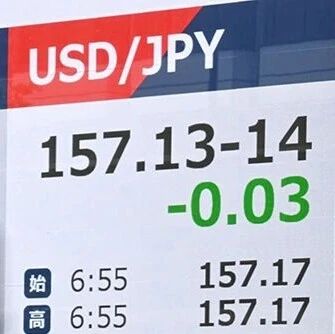
再通胀政策

Search documents
Retail Traders Ignite Silver & Gold Volatility, Impacts in AI & EV Industries
Youtube· 2026-02-11 01:01
Market Overview - Precious metals, including gold, silver, copper, and platinum, have experienced notable price volatility at the start of 2026, contrasting with a more stable 2025 [1] - The decline in the dollar's strength has contributed to the fluctuations in precious metal prices [1] Speculation and Market Dynamics - Speculators have shifted their focus from Bitcoin to precious metals, particularly SLV and GLD, treating them as new "meme stocks" [1] - Silver is characterized as a slower market compared to gold, making it easier for speculators to influence its price [1] Price Trends and Predictions - Despite recent declines, gold and silver prices are still up approximately 18-19% year-to-date [2] - There is a belief that silver prices could rise significantly, potentially surprising many investors [5] Market Manipulation - A notable incident involved a large Chinese speculator who deliberately pushed silver prices down, which is reminiscent of past market behaviors [4] - The market is currently facing a significant short position, indicating potential for future price rebounds [4] Industrial Demand and Substitution Risks - Silver's industrial demand is increasing due to its applications in renewables, electric vehicles, and AI data centers [8] - There is a concern that if silver prices rise too high, industries may seek substitutes, similar to trends seen in semiconductor pricing [10] Global Market Trends - There is a rotation occurring in the markets, with capital moving from technology stocks to other sectors and international markets [12] - The U.S. technology sector, particularly the "Magnificent Seven," has dominated market performance, but there are signs of a shift towards broader market participation [15][18] Performance Metrics - The Russell index has shown an increase of 8%, while the S&P is up 2%, and the NASDAQ remains flat year-to-date [17] - Energy stocks and mining companies have seen significant gains, with increases of 20-30% [17]


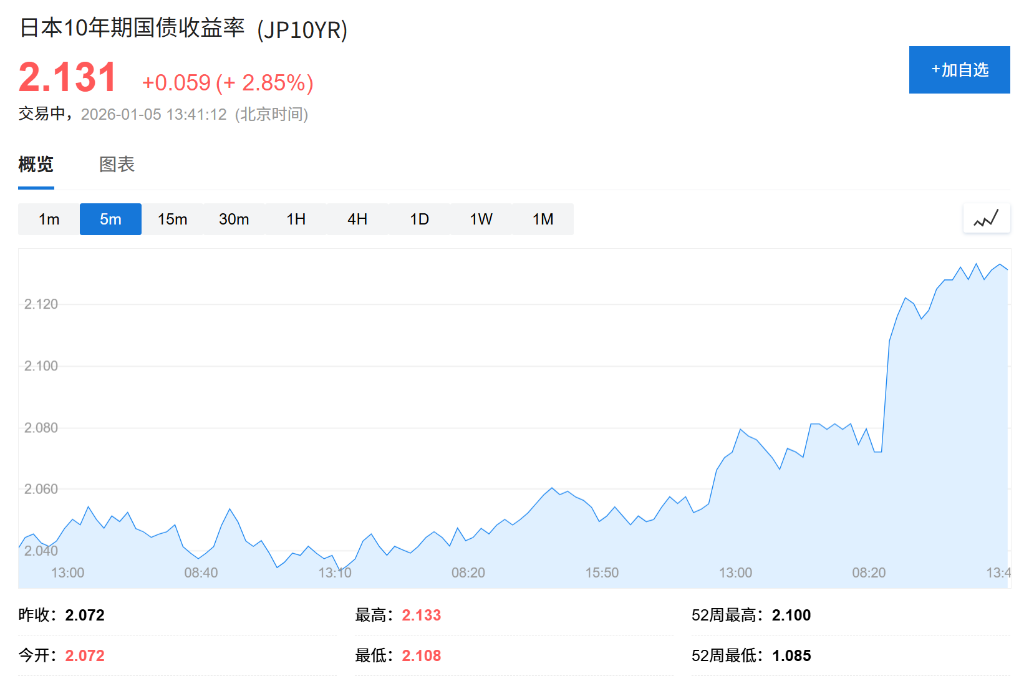
财政与通胀担忧挥之不去,日本10年期国债收益率攀升至1999年以来新高
Hua Er Jie Jian Wen· 2026-01-05 06:23
Group 1 - The Japanese government, led by Prime Minister Sanae Takaichi, has approved a budget totaling 122.3 trillion yen (approximately 780 billion USD), with defense spending set to reach a record level next year [4] - The 10-year Japanese government bond yield rose by 5 basis points to 2.12%, marking the highest level since 1999, amid concerns over fiscal expansion and inflationary pressures [1] - Market analysts indicate that the government's fiscal policy is a key factor pushing up long-term yields, with expectations of "re-inflation" policies contributing to ongoing upward pressure on Japanese government bond yields [5] Group 2 - The volatility in the Japanese bond market is influenced by global macroeconomic conditions, particularly following a sell-off in U.S. long-term bonds, which has steepened the yield curve [6] - The Japanese Ministry of Finance plans to reduce the issuance of ultra-long bonds in the upcoming fiscal year starting in April, which may help balance supply and demand in the bond market [5] - Despite high current yield levels, market caution prevails ahead of the upcoming 10-year Japanese government bond auction, as concerns about the Bank of Japan lagging behind inflation persist [5]
日本政府顾问:无需等到160关口,高市政府将更积极干预日元
Hua Er Jie Jian Wen· 2025-11-23 07:44
Core Viewpoint - The Japanese government, under Prime Minister Fumio Kishida, is expected to adopt a more proactive stance on yen intervention to mitigate inflationary pressures caused by a weak yen, with intervention thresholds potentially lower than the widely anticipated 160 yen per dollar [1][2]. Group 1: Government Intervention - Takuji Aida, a member of the government advisory panel, indicated that the Kishida administration will actively intervene in the foreign exchange market, reflecting concerns over inflation [1]. - The Japanese authorities have previously intervened in the market when the yen fell below the 160 yen mark, which has been considered a threshold for intervention [2]. - Finance Minister Shunichi Suzuki stated that the government would respond appropriately to excessive currency fluctuations, with currency intervention being one of the options [1][2]. Group 2: Economic Context - The yen recently fell to a 10-month low against the dollar, surpassing the 157 yen mark, prompting increased verbal intervention from Japanese authorities [1]. - Aida noted that Japan has ample foreign exchange reserves, providing sufficient conditions for intervention actions [1][6]. - The market had previously expected intervention to occur only after the yen reached 160, but Aida's comments suggest that action could be taken sooner if volatility increases [2]. Group 3: Inflation and Monetary Policy - Since Kishida's appointment in October, market expectations regarding the Bank of Japan's potential interest rate hikes have put pressure on the yen [5]. - The Bank of Japan is set to hold its next policy meeting on December 19, where Governor Kazuo Ueda discussed the gradual withdrawal of previous monetary easing policies with Kishida [5]. - Aida emphasized the government's concern that a weak yen could exacerbate inflationary pressures, despite Kishida's support for re-inflation policies [5]. Group 4: Fiscal Spending Priorities - Aida also mentioned that Japan should prioritize investments in areas such as artificial intelligence, naval frigates, and defense, even if it requires issuing bonds [6]. - The new government aims to balance stable economic growth with inflation control [6]. - Aida reiterated that Japan's substantial foreign exchange reserves support intervention actions, providing the government with policy space to address currency fluctuations [6].
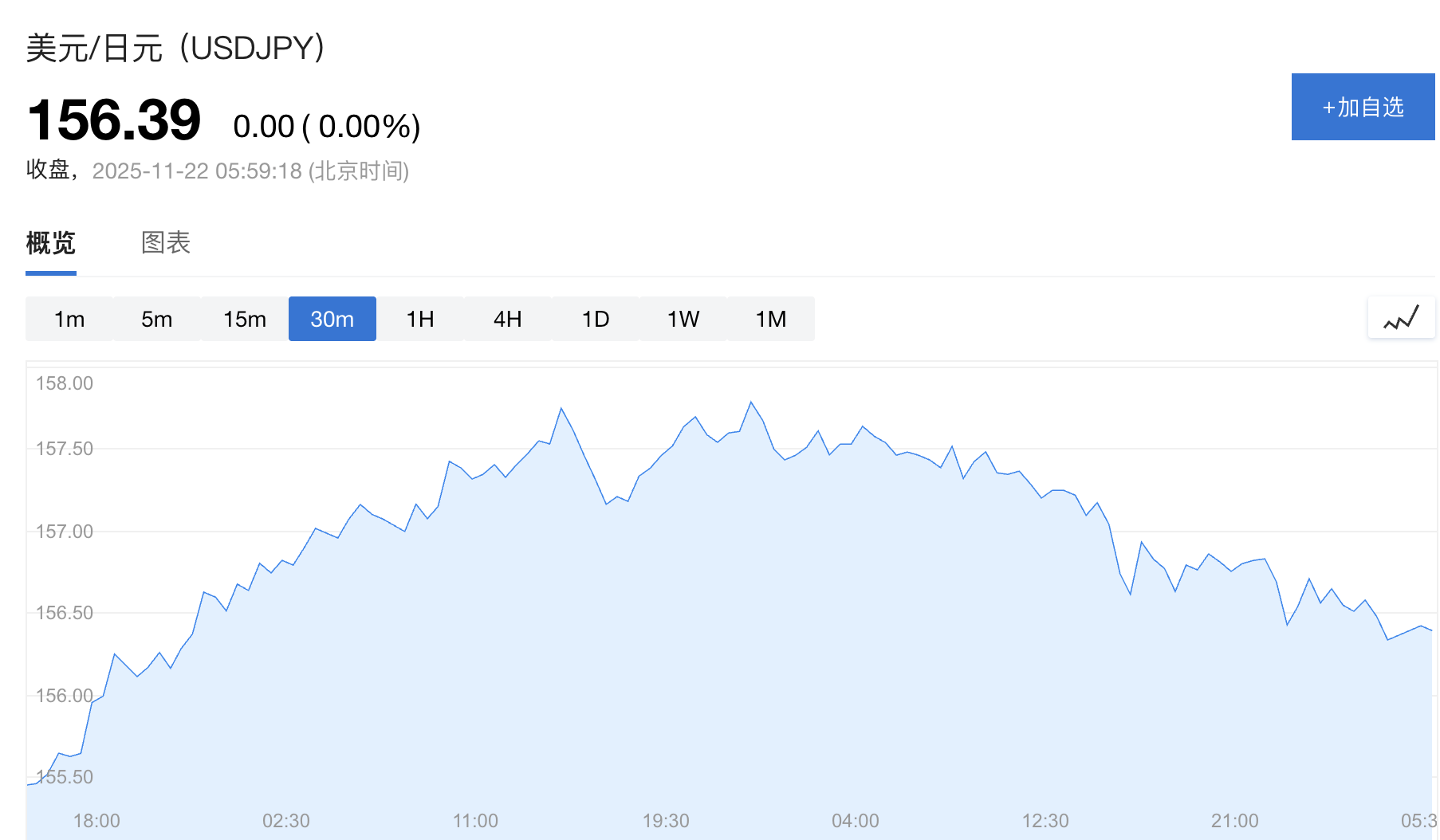
日美央行的“按兵不动”在加剧日元贬值
日经中文网· 2025-11-21 07:43
Core Viewpoint - The Japanese yen has depreciated significantly against the US dollar, reaching a 10-month low, primarily due to the diminishing expectations of a rate cut by the Federal Reserve and skepticism regarding the Bank of Japan's potential interest rate hike in December [2][4][6]. Group 1: Yen Depreciation Details - The yen's exchange rate against the US dollar fell to the range of 157.5 to 157.9 yen, marking the first time since January 15 that it has reached this level [4]. - Compared to the exchange rate of 147 yen per dollar before Prime Minister Suga Yoshihide's victory in the Liberal Democratic Party presidential election, the yen has depreciated by approximately 10 yen [4]. - The yen has also weakened against the euro, reaching a rate of 181.5 to 181.9 yen per euro, setting a new low since the euro's introduction in 1999 [4]. Group 2: Factors Behind Yen Depreciation - The acceleration of yen depreciation is attributed to multiple factors, including the declining probability of a rate cut by the Federal Reserve, leading to increased buying of the dollar and selling of the yen [6]. - The Federal Reserve's meeting minutes indicated a strong likelihood of maintaining the current policy rate, which has contributed to the market's shift in sentiment regarding future rate cuts [6][7]. - The US government shutdown has obscured the actual economic situation, further diminishing expectations for a rate cut [6]. Group 3: Market Expectations and Economic Data - Market predictions for the Federal Reserve's policy rate have shifted, with the probability of a rate cut in December dropping from 50% to 30% [7]. - The upcoming economic data releases, including US employment figures and retail sales, are crucial for assessing economic trends before the December Federal Reserve meeting [8]. - The Bank of Japan's potential interest rate hike is under scrutiny, with current market expectations for a December rate increase at around 40%, down from approximately 60% earlier in November [9]. Group 4: Government and Central Bank Stance - There is a lack of heightened vigilance from the Japanese government and the Bank of Japan regarding currency intervention, contributing to the market's inclination to sell the yen [10]. - Recent discussions among Japanese officials did not address the exchange rate specifically, leading to disappointment among market participants who anticipated a stronger stance against yen depreciation [10].