
军控

Search documents
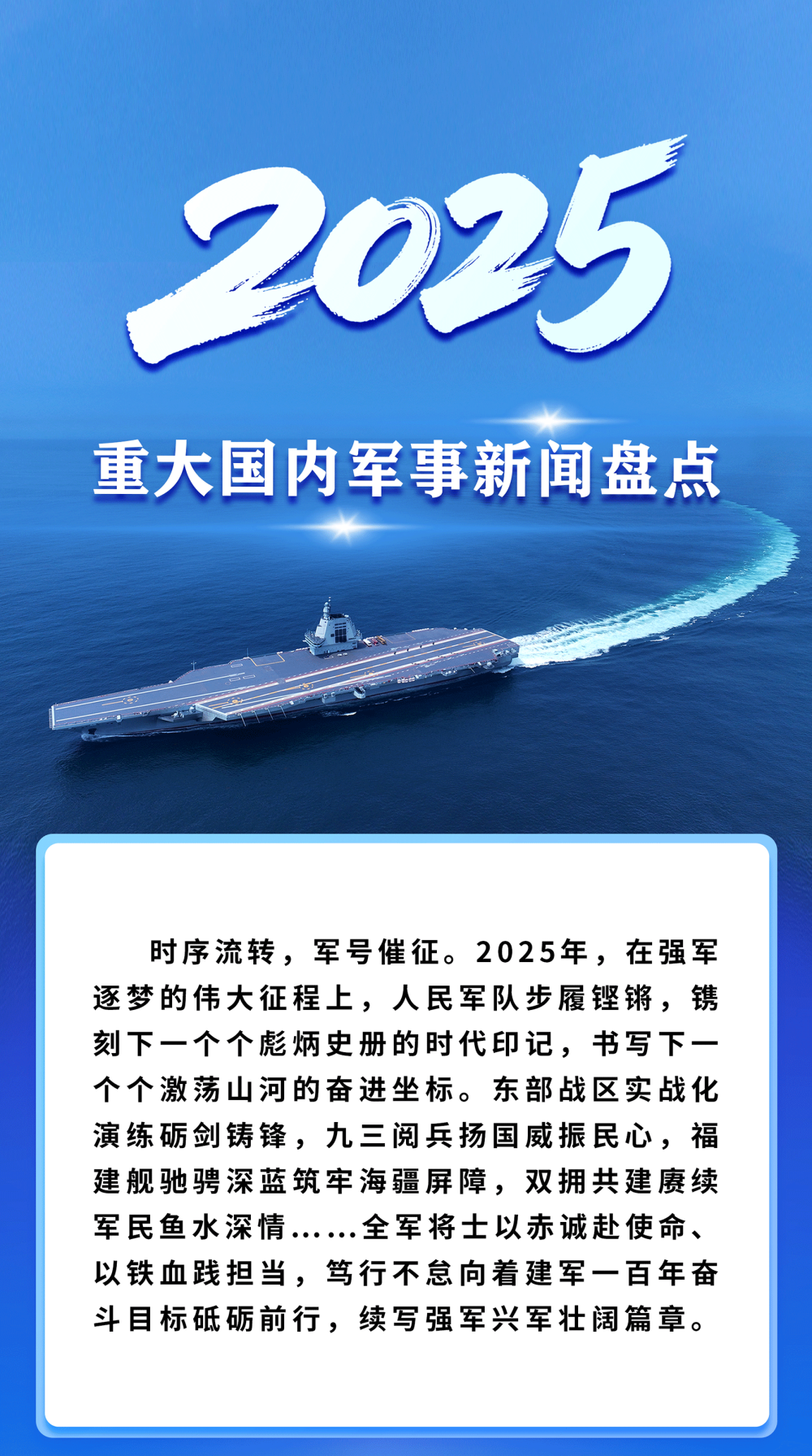
回望2025,重大国内军事新闻盘点
Xin Lang Cai Jing· 2025-12-26 16:58
Group 1 - The core viewpoint of the news is the emphasis on strengthening military capabilities and enhancing the legal framework within the People's Liberation Army (PLA) through the implementation of new regulations and military exercises [5][11][29] - The newly revised "Internal Regulations," "Disciplinary Regulations," and "Formation Regulations" of the PLA will take effect on April 1, 2025, aiming to improve the rule of law within the military [5][11] - The Eastern Theater Command is conducting joint exercises around Taiwan, named "Thunder in the Strait-2025A," to enhance combat readiness and test joint operational capabilities [7][8] Group 2 - Xi Jinping has made significant remarks on the importance of military-civilian unity, highlighting the need for continuous development of this relationship as a political advantage [9][11] - The PLA is set to issue a new "Reserve Personnel Certificate" starting March 1, 2025, which will serve as an effective identification document for reserve personnel [28] - The first electromagnetic catapult aircraft carrier, Fujian, has been commissioned, showcasing China's advancements in naval technology and military capabilities [24][25]

中国在最新的发射井中部署百枚洲际导弹?外交部回应
券商中国· 2025-12-23 09:03
Group 1 - The Chinese government has recently released a white paper titled "China's Arms Control, Disarmament and Non-Proliferation in the New Era," which outlines its nuclear policy and arms control stance [1] - China adheres to a no-first-use policy regarding nuclear weapons and maintains its nuclear capabilities at the minimum level necessary for national security, avoiding an arms race with any country [1] - The Chinese side has actively participated in the review process of the Treaty on the Non-Proliferation of Nuclear Weapons and maintains dialogue with various parties on nuclear arms control issues [1] Group 2 - The Chinese Foreign Ministry spokesperson criticized the U.S. for its internal report suggesting that China has deployed over 100 intercontinental ballistic missiles in new underground silos, labeling such claims as part of the U.S.'s strategy to modernize its nuclear forces [1] - The spokesperson emphasized that the U.S., as the largest nuclear power, should fulfill its special priority responsibility for nuclear disarmament and significantly reduce its nuclear arsenal to create conditions for other nuclear-armed states to join the disarmament process [1]
列国鉴·年终观察丨俄核威慑力量升级的战略意义
Xin Lang Cai Jing· 2025-12-21 09:22
Core Viewpoint - Russia's recent development of the "Zircon" nuclear-powered cruise missile and the "Poseidon" nuclear-powered unmanned underwater vehicle is seen as a strategic move to enhance its nuclear deterrent capabilities, prompting a response from the U.S. to initiate equivalent nuclear weapons testing [1][2]. Group 1: Weapon Development and Testing - President Putin has publicly highlighted the testing of the "Zircon" cruise missile and the "Poseidon" unmanned underwater vehicle, emphasizing their advanced capabilities [2]. - The "Zircon" missile is reported to have a range that exceeds all known missiles globally, while the "Poseidon" can reach depths of 1,000 meters and is significantly faster than modern vessels [2][4]. - Both weapons are characterized as "game-changing" by Russian media, with analysts suggesting they will alter the strategic deterrence landscape dominated by the U.S. [4][6]. Group 2: Strategic Significance - The introduction of the "Zircon" and "Poseidon" enhances Russia's nuclear arsenal, which traditionally consisted of land-based intercontinental missiles, strategic submarines, and bombers, now adding these new categories as the fourth and fifth types of strategic nuclear weapons [6]. - These new weapons serve as important bargaining chips in arms control discussions, particularly as existing treaties do not cover such new systems, thereby increasing Russia's negotiating power [6][7]. - The development and demonstration of these weapons signal Russia's capability to maintain sovereignty despite internal and external challenges [7]. Group 3: Operational Effectiveness and Perception - While the technical specifications of the "Zircon" and "Poseidon" are impressive, their actual combat value remains uncertain, as their effectiveness depends on Russia's satellite navigation and electronic warfare capabilities [8]. - Analysts suggest that these weapons are primarily viewed as political tools and psychological deterrents rather than immediate combat assets, with no intention of deploying them in active conflict [8].

俄罗斯未收到美国对其军控提议的回应
Xin Lang Cai Jing· 2025-12-18 15:05
Group 1 - The core viewpoint is that Russia has proposed to adhere to the limits of the New START treaty for an additional year after its expiration, but the United States has not yet responded to this proposal [1][2]
蓝厅观察丨时隔20年中国发布新版军控白皮书 传递怎样的信息
Yang Shi Xin Wen Ke Hu Duan· 2025-11-28 02:23
Core Viewpoint - The release of the new white paper on arms control, disarmament, and non-proliferation by the Chinese government marks a significant moment, as it is the first comprehensive statement on these policies in 20 years, reflecting China's commitment to global security governance and international peace [2][4]. Group 1: Special Significance of the White Paper - The white paper summarizes China's basic policy positions and practical measures regarding arms control, disarmament, and non-proliferation over the past 20 years, especially since the 18th National Congress of the Communist Party [2]. - The timing of the release coincides with the 80th anniversary of the victory in World War II and the establishment of the United Nations, addressing the contemporary question of "war or peace? dialogue or confrontation?" [4]. Group 2: Emerging Security Governance - The white paper highlights the increasing nuclear risks in the current global landscape, citing conflicts such as the Russia-Ukraine war and the Israel-Hamas conflict as indicators of rising nuclear deterrence signals [8]. - It emphasizes the need for China to contribute wisdom to maintain and strengthen existing international arms control, disarmament, and non-proliferation mechanisms [8]. Group 3: New Concepts in Arms Control - The white paper introduces a new arms control concept characterized by fairness, cooperation, balance, and effectiveness, which will guide future arms control efforts [12][14]. - It clearly states China's policy of not engaging in any nuclear arms race and its commitment to maintaining global strategic stability and balance, asserting a no-first-use policy regarding nuclear weapons [14].

时隔20年中国发布新版军控白皮书 传递怎样的信息
Yang Shi Xin Wen Ke Hu Duan· 2025-11-28 00:29
Core Viewpoint - The release of China's new arms control white paper, titled "Arms Control, Disarmament and Non-Proliferation in the New Era," marks a significant moment as it is the first comprehensive statement on China's policies in this area in 20 years, reflecting its commitment to global security governance and international peace [1][2]. Group 1: Special Significance of the Release - The timing of the white paper's release coincides with the 80th anniversary of the end of World War II and the establishment of the United Nations, addressing the critical question of "war or peace?" and "dialogue or confrontation?" [1]. - The white paper summarizes China's basic policy positions and practical measures regarding arms control, disarmament, and non-proliferation, particularly since the 18th National Congress of the Communist Party [1]. Group 2: Challenges to International Arms Control - The current international arms control, disarmament, and non-proliferation systems face severe challenges, with key treaties like the Anti-Ballistic Missile Treaty and the Intermediate-Range Nuclear Forces Treaty no longer in effect [2]. - The white paper aims to contribute Chinese wisdom to the maintenance and strengthening of existing international arms control mechanisms [2]. Group 3: New Areas of Security Governance - The white paper highlights China's stance on emerging security governance in areas such as outer space, cyberspace, and artificial intelligence, marking the first time these topics are specifically addressed [3]. - It emphasizes the need to tackle the challenges posed by modern warfare, including the use of drones and cyber attacks, which are transforming the nature of conflict [3][4]. Group 4: New Era Arms Control Concept - The white paper introduces a new arms control concept characterized by fairness, cooperation, balance, and effectiveness, which will guide future arms control efforts [5]. - It clarifies China's policies regarding strategic forces and nuclear issues, asserting its commitment to not engaging in nuclear arms races [5][7]. Group 5: Commitment to Strategic Stability - The white paper conveys a clear message that China will not participate in any nuclear arms race and aims to maintain global strategic stability and balance [7]. - China adheres to a policy of no first use of nuclear weapons, emphasizing that its nuclear capabilities are intended solely for deterrence against potential nuclear threats [7].

时隔20年中国发布新版军控白皮书 传递怎样的信息?
Yang Shi Wang· 2025-11-27 17:04
Core Viewpoint - The release of the new white paper on arms control, disarmament, and non-proliferation by the Chinese government marks a significant moment, as it is the first such document in 20 years, reflecting China's commitment to global security governance and international peace [1][3]. Summary by Relevant Sections Historical Context - The white paper summarizes China's basic policy positions and practical measures regarding arms control, disarmament, and non-proliferation over the past 20 years, particularly since the 18th National Congress of the Communist Party [3]. Current Global Security Landscape - The world is facing rising nuclear risks, highlighted by conflicts such as the Russia-Ukraine war and the Israel-Hamas conflict, which signal nuclear deterrence. The risks of a nuclear arms race are increasing, with the U.S. continuously enhancing its nuclear arsenal [5]. Challenges to Existing Frameworks - The current international arms control, disarmament, and non-proliferation frameworks are under severe challenge, with key treaties like the Anti-Ballistic Missile Treaty and the Intermediate-Range Nuclear Forces Treaty no longer in effect. The white paper aims to contribute Chinese wisdom to strengthen these mechanisms [5]. Emerging Security Domains - The white paper introduces a dedicated section on security governance in emerging fields such as outer space, cyberspace, and artificial intelligence, reflecting the rapid military application of these technologies [6][8]. Specific Stances on Outer Space - For the first time, the white paper explicitly opposes offensive military policies in outer space, the formation of military alliances in this domain, the weaponization and militarization of outer space, and the involvement of commercial satellites in armed conflicts [10]. New Era Arms Control Concept - The white paper presents a new arms control concept characterized by fairness, cooperation, balance, and effectiveness, which is seen as a guiding principle for future arms control efforts [11]. Nuclear Policy Clarification - China emphasizes its non-participation in any nuclear arms race and reaffirms its policy of no first use of nuclear weapons, aiming to maintain global strategic stability and balance [13].

外交部:中国政府发布《新时代的中国军控、裁军与防扩散》白皮书具有重要意义
Xin Hua She· 2025-11-27 07:49
Core Viewpoint - The release of the white paper "China's Arms Control, Disarmament, and Non-Proliferation in the New Era" marks China's first comprehensive statement on its policies in this area in 20 years, highlighting its commitment to global security governance and international peace [1] Group 1 - The white paper was published on November 27, coinciding with significant anniversaries: the 80th anniversary of the victory in the Chinese People's War of Resistance Against Japanese Aggression and the 80th anniversary of the founding of the United Nations [1] - The Chinese government aims to demonstrate its responsibility and commitment as a major power in leading global security governance through this white paper [1]
新时代的中国军控、裁军与防扩散
Xin Hua She· 2025-11-27 02:30
Core Viewpoint - The white paper titled "China's Arms Control, Disarmament and Non-Proliferation in the New Era" emphasizes China's commitment to peace, development, and international cooperation in arms control and disarmament, while addressing the complex global security landscape and advocating for a multilateral approach to security governance [4][5]. Group 1: International Security and Arms Control Situation - The current international security landscape is characterized by increased geopolitical tensions, arms races, and regional conflicts, necessitating a renewed focus on multilateral arms control efforts [6][7]. - Major powers are competing for strategic advantages, leading to heightened military expenditures and regional instability, particularly in the Asia-Pacific region [6][7]. - The erosion of international arms control frameworks due to unilateral actions by certain countries poses significant challenges to global security [7]. Group 2: China's Policy Position on Arms Control - China's arms control policy is rooted in its cultural values of peace and cooperation, aiming to establish a world of lasting peace and universal security [9][10]. - The country advocates for a new type of international relations based on mutual respect, fairness, and win-win cooperation, emphasizing the importance of global governance [9][10]. - China maintains a defensive national defense policy, rejecting hegemonism and arms races, while promoting transparency in defense spending [10][11]. Group 3: Constructive Participation in International Arms Control - China actively engages in multilateral arms control processes, particularly in nuclear, biological, and chemical weapons, and adheres to international treaties [13][14]. - The country promotes the principle of no first use of nuclear weapons and advocates for nuclear disarmament and non-proliferation [15][19]. - China supports the establishment of a fair and just international arms control system, opposing double standards and unilateral actions that undermine global security [11][24]. Group 4: Emerging Areas of International Security Governance - China emphasizes the importance of governance in emerging security domains such as outer space, cybersecurity, and artificial intelligence, advocating for international cooperation and the establishment of norms [39][40]. - The country opposes the militarization of outer space and promotes the peaceful use of space, calling for comprehensive governance frameworks [39][40]. - China is committed to enhancing global biosecurity governance and actively participates in international efforts to prevent the misuse of biological technologies [30][31]. Group 5: Strengthening Non-Proliferation and Peaceful Use of Technology - China advocates for the peaceful use of nuclear energy and opposes the politicization of nuclear cooperation, supporting the rights of developing countries to access nuclear technology [27][28]. - The country emphasizes the need for a balanced approach to non-proliferation, urging all nuclear-armed states to commit to disarmament and non-proliferation obligations [24][25]. - China actively participates in international discussions on arms trade and supports measures to prevent the illicit transfer of conventional weapons [37][38].