冰雪产业发展

Search documents
冰雪春天丨中国冰雪产业的进阶之路
Zhong Guo Xin Wen Wang· 2026-02-11 00:48
Core Viewpoint - The Chinese ice and snow industry is entering a new phase of high-quality development, with the industry scale expected to exceed 1 trillion yuan by 2025, reaching 1,005.3 billion yuan, marking a significant milestone in its industrialization and systematic development [1] Group 1: Industry Growth and Development - The Chinese ice and snow industry has shown a positive trend of multi-point blossoming and continuous upgrading since the Beijing Winter Olympics, completing the improvement and balanced layout of the industrial chain [1] - The goal of "engaging 300 million people in ice and snow sports" has been successfully achieved, establishing a solid grassroots foundation for the industry's development [1] Group 2: Policy Support and Technological Empowerment - The State Council issued opinions in 2024 to clarify the direction of industry development, with local governments implementing supportive policies across various aspects such as venue construction and talent cultivation [2] - Technology has become a key variable in upgrading the ice and snow industry, transitioning from a support tool for events to an enabler throughout the entire industry chain, promoting green, intelligent, and popular development [2] Group 3: Integration and Innovation - The integration of ice and snow with other sectors, such as tourism and culture, is becoming a common practice, with ongoing development in areas like "ice and snow + education" [2] - Marginal innovations within the ice and snow industry are driving internal development, with examples like Harbin's ice and snow economy reflecting new consumer hotspots and economic growth points [3] Group 4: Future Goals and Strategies - The industry aims to achieve high-level coordinated development of major industrial chains by 2030, with a target scale of 1.5 trillion yuan [3] - To reach these goals, both supply and demand sides need to collaborate, enhancing the penetration of ice and snow sports and addressing challenges in various industry segments [3]
从北京到米兰,冰雪荣光闪耀冬奥
Xin Hua She· 2026-02-06 07:31
Core Insights - The Beijing Winter Olympics have significantly transformed China's winter sports landscape, engaging over 300 million people in winter sports and contributing to a healthier society and global winter sports development [1][6]. Group 1: Achievements and Developments in Winter Sports - China achieved its best-ever performance at the Winter Olympics, securing 9 gold, 4 silver, and 2 bronze medals, ranking among the top three in the medal tally [3]. - The success of young athletes like Su Yiming and Gu Ailing has inspired a new generation to participate in winter sports, showcasing the confidence and talent of Chinese youth [3][2]. - The establishment of a professional training system and international exchange platforms has provided strong momentum for the development of winter sports in China [3]. Group 2: Participation and Engagement - The number of participants in winter sports reached 292 million, with a participation rate of 20.61%, an increase of approximately 27.44 million from the previous season [6]. - The introduction of policies promoting free access to ice and snow activities for students has fostered a culture of participation among the youth [6]. Group 3: Economic Impact and Industry Growth - The ice and snow industry in China has seen substantial growth, with the market size increasing from 364.7 billion to 980 billion yuan from 2016 to 2024, and is expected to surpass 1 trillion yuan by 2025 [9]. - The winter sports industry is evolving from a short-term event-driven boom to a comprehensive development model encompassing equipment manufacturing, event operations, training services, and cultural tourism [9][10]. - The Beijing Winter Olympics have catalyzed the emergence of numerous businesses in the winter sports equipment sector, significantly boosting local economies [10]. Group 4: International Collaboration and Influence - The successful hosting of the Winter Olympics in Beijing has set a benchmark for future events, influencing the preparations for the Milan Winter Olympics [7][8]. - Global winter sports giants are increasingly attracted to China's vast market and innovative environment, leading to potential collaborations in the ice and snow industry [11].
吉林国际高山/单板滑雪挑战赛第五站举行
Xin Lang Cai Jing· 2026-01-19 23:21
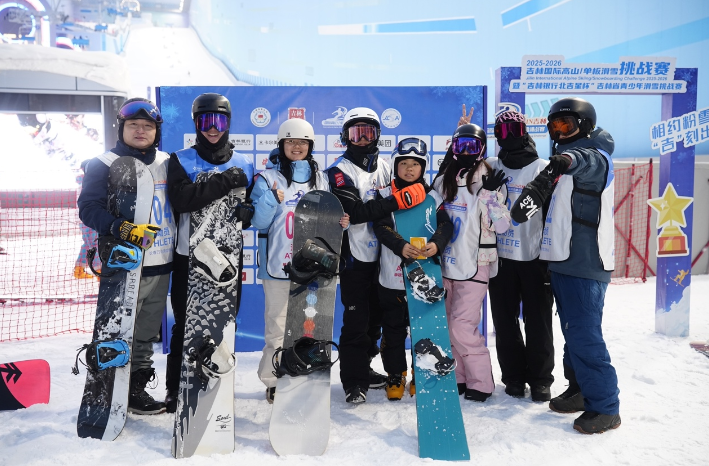
Core Viewpoint - The 2025-2026 Jilin International Alpine/Snowboard Challenge and the "Jilin Bank North Star Cup" Youth Skiing Challenge was held at the Changchun Wanda Ski Resort, marking a significant event in the winter sports calendar [1] Group 1: Event Overview - The event featured two main competitions: Alpine skiing giant slalom and snowboard parallel giant slalom, divided into adult men's, women's, and youth men's, women's categories [3] - Notable winners included Song Chunbo in the adult men's alpine skiing, Yu Lijun in the adult women's category, and Li Ze and Li Yufei in the youth categories [4] Group 2: Venue and Significance - This event was the first to be held in an indoor ski resort, breaking traditional seasonal limitations and providing a controlled environment for athletes [6] - The indoor setting allows for year-round competition and showcases the development of high-quality ice and snow events in urban areas, contributing to the high-quality growth of the ice and snow industry [6]

谁在守护长白山雪道?这群“雪季匠人”藏不住了!
Xin Lang Cai Jing· 2026-01-01 19:47
Core Insights - The snow industry is rapidly expanding, leading to the emergence of new professions such as snow equipment repair technicians, snow machine operators, snow groomer drivers, and ski lift managers, driven by the increasing demand for winter sports and tourism [2][3][6] Group 1: Industry Growth and New Professions - The ice and snow industry has seen significant growth, with new roles emerging due to the rising popularity of winter sports [2][3] - Workers in the industry are actively enhancing their skills and responsibilities to meet the challenges posed by industry upgrades and changing demands [2][6] Group 2: Job Transformation and Skills Development - Individuals like Tao Xin have transitioned from other professions to become snow equipment repair technicians, highlighting the trend of career shifts in response to industry growth [3][4] - The role of snow groomer drivers, such as Ge Xianwen, requires extensive training and experience, with a preparation period of up to six years to achieve proficiency [4][5] Group 3: Technical Challenges and Customer Expectations - The increasing knowledge of customers, influenced by social media, has led to higher expectations and personalized demands for services in the snow industry [6] - The warming winter trends have made snow quality more variable, complicating the work of snow groomers and requiring constant adaptation to new conditions [6][7] Group 4: Safety and Emergency Preparedness - Safety is a critical aspect of operations, with professionals like Tang Pengpeng responsible for the safety of ski lifts and emergency response protocols [5][7] - The industry emphasizes rigorous training and emergency drills to ensure quick and effective responses to potential crises, as demonstrated by past incidents [7]

冬博会开幕 逾500家品牌展示冰雪产业最新成果
Zhong Guo Xin Wen Wang· 2025-10-16 10:47
Core Points - The 2025 International Winter Sports Expo (Beijing) has opened in Beijing, celebrating its 10th anniversary with the theme "Starting Again to the World" and focusing on international cooperation in ice and snow sports, equipment, tourism, and culture [1][3] - The expo features four main activities: exhibitions, forums, industry matchmaking, and special events, with an exhibition area of approximately 20,000 square meters and over 500 global brands participating [1][3] - The event serves as a significant platform for international exchange in the ice and snow industry, showcasing cutting-edge technologies and innovative products in areas such as snow sports equipment, venue facilities, and tourism services [3] Industry Insights - The expo has evolved into a hub for the ice and snow industry, facilitating China's transition from a "major consumer" to a "strong industry" in ice and snow sports over the past decade [3] - China's comprehensive ecosystem in the ice and snow sector includes equipment manufacturing, event operation, talent cultivation, and cultural promotion, gaining increasing recognition from the international community [3] - The participation of renowned international brands from countries like Austria, Italy, Canada, and Slovenia highlights the global interest and collaboration in the ice and snow industry [3]

冰纷万象携手闫涵共启冰雪运动推广新篇章
Xin Hua Wang· 2025-09-28 03:00
Group 1 - The first Winter Youth Olympic Games figure skating champion, Yan Han, has signed a cooperation agreement with the professional ice rink brand "Ice Fun Vortex" to become its figure skating image ambassador [1][3] - The collaboration aims to reduce the participation threshold for ice and snow sports and to stimulate interest and enthusiasm among the youth for ice sports through various initiatives, including themed events, professional competitions, and a "Champion Public Welfare Classroom" [3][4] - The signing ceremony featured performances by young figure skaters, followed by Yan Han providing technical guidance and demonstrations to young learners, sharing insights from his sports career [3] Group 2 - The ice and snow industry in China is experiencing rapid development, driven by the initiative to engage 300 million people in ice and snow sports, with Liaoning Province actively promoting the integration of the ice and snow industry with cultural, sports, and tourism sectors [4]

冰雪行业“十五五”市场战略研究及投资建议可行性评估预测报告(2025版)
Sou Hu Cai Jing· 2025-05-21 02:12
Group 1 - The core viewpoint of the report is the historical development and current status of the global snow industry, highlighting its evolution from the mid-19th century to the present, with a focus on the growth of indoor snow facilities in countries lacking natural snow resources like China [2][4]. - The snow industry originated in the Alpine region in the mid-19th century, with significant development occurring after the first Winter Olympics in the early 20th century, leading to a boom in ski resort development in Switzerland and Austria [2][3]. - The snow industry experienced rapid growth in Europe and North America during the 1960s, followed by expansion into Asian markets in the 1970s, marking a phase of comprehensive expansion [3]. Group 2 - The current state of the snow industry indicates that outdoor ski resorts remain the primary business model, while countries like China are increasingly developing indoor snow facilities to tap into the snow consumption potential [4][5]. - As of April 2022, 68 countries have equipped outdoor ski resorts, with 62 located in the Northern Hemisphere, indicating a concentration of snow resources in this region [4]. - The global snow industry market size was approximately $136.53 billion in 2019, dropping to $66.22 billion in 2021 due to the pandemic, but is expected to recover to $95.03 billion in 2022, reflecting a year-on-year growth of 37.81% [4][5]. Group 3 - The number of ski resorts globally has shown a slight increase, with 5,764 resorts reported at the end of the 2021-2022 season, recovering from a dip during the pandemic [5]. - The number of participants in the global snow industry has stabilized, returning to pre-pandemic levels with 350 million participants in the 2021-2022 season, following a decline during the pandemic years [5][6]. - The Alpine region remains the most developed area for the snow industry, hosting 771 large ski resorts, which account for 37% of the global total, and attracting a significant portion of industry participants [6]. Group 4 - The market penetration rate for skiing is relatively saturated in Europe, with countries like Switzerland and Austria having rates of 35% and 34% respectively, while China's penetration rate is only 1%, indicating significant growth potential [6]. - The report emphasizes that the rapid development of the snow industry in China presents a new growth opportunity, as the country seeks to expand its snow sports market [6]. - The report outlines the future trends and investment opportunities in the snow industry, particularly during the "14th Five-Year Plan" period, which is expected to drive further growth and innovation [18][21].