
创新型产业集群

Search documents
十二连冠!昆山高企突破3500家
Su Zhou Ri Bao· 2026-01-07 01:09
Core Viewpoint - Kunshan has surpassed 3,500 effective high-tech enterprises, maintaining its position as the leader in Suzhou for 12 consecutive years, showcasing its robust innovation-driven industrial cluster [1] Group 1: High-tech Enterprises - The total number of high-tech enterprises in Kunshan has exceeded 3,500, leading all sectors in Suzhou [1] - Kunshan has achieved the highest number of high-tech enterprise applications, public recognitions, and net increases in Suzhou, demonstrating its strong innovation capabilities [1] - The city has seen a significant enhancement in the ability of enterprises to undertake major scientific and technological tasks, with 36 technology projects receiving upper-level support, including 17 national-level projects [1] Group 2: Innovation Ecosystem - A vibrant innovation ecosystem is supported by a well-optimized service system, facilitating the transformation of scientific achievements into industrial upgrades [1] - The establishment of a "R&D in Shanghai, manufacturing in Kunshan" collaborative mechanism has created a comprehensive support system from R&D to industrialization [1] Group 3: Growth of Enterprises - A number of high-growth enterprises have rapidly emerged, with the number of national-level technology-based small and medium-sized enterprises reaching 4,263, forming a dynamic innovation structure [1] - Kunshan has implemented a technology enterprise monitoring system and lifecycle services, increasing the high-tech enterprise recognition rate by nearly 10 percentage points [2] Group 4: Financial Support - Over 100 million yuan in high-tech enterprise subsidies have been allocated, benefiting 2,146 enterprises, alongside policies for R&D expense deductions [2] - The "Kunke Loan" program has provided over 8.3 billion yuan in financing to more than 1,460 technology-based enterprises, continuously enhancing the innovation funding sources [2]
打造火炬服务矩阵生态
Jing Ji Ri Bao· 2025-11-19 03:22
Group 1 - The integration of technological innovation and industrial innovation is crucial for achieving high-level self-reliance in technology and building a modern industrial system [1][3] - The Torch Center aims to promote the industrialization of high-tech achievements and create a multi-layered service matrix to accelerate the integration of technology and industry [1][3] - The Torch Program, initiated in 1988, has become a significant platform for the integration of technological and industrial innovation, contributing to the development of national high-tech industrial zones [3] Group 2 - There are currently 193 innovative industrial clusters in China, which include over 52,000 enterprises, with 26,000 being high-tech companies, covering all strategic emerging industries [4] - Suzhou High-tech Zone has established itself in the new generation of information technology and high-end equipment manufacturing, with significant growth in emerging industries like new energy and medical devices [4] - The financial sector plays a vital role in promoting the deep integration of technological and industrial innovation, enhancing the efficiency of the overall operation [5] Group 3 - The Ministry of Industry and Information Technology plans to establish a robust mechanism to support the high-quality development of high-tech industries and innovative industrial clusters, aiming for global competitiveness [5]

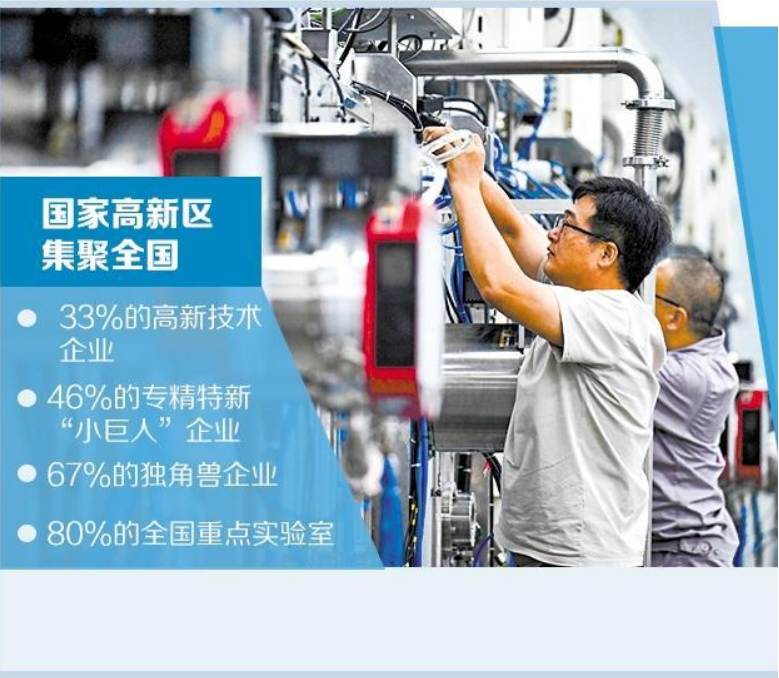
升级!178家国家高新区开启关键转型
Bei Jing Ri Bao Ke Hu Duan· 2025-11-12 08:29
Core Insights - The transition from "industrial agglomeration" to "innovation source" is crucial for China's 178 national high-tech zones, focusing on enhancing technological sourcing, achievement transformation, and industrial cultivation functions [3][4][5] Group 1: National High-Tech Zones - National high-tech zones have contributed 14.3% of China's GDP, housing 33% of high-tech enterprises, 46% of specialized "little giant" firms, and 67% of unicorn companies [3] - There are 151 innovative industrial clusters located in national high-tech zones, accounting for nearly 80% of the total [3] - Challenges include regional development imbalances, the need for enhanced innovation capabilities, and the optimization of industrial chain collaboration [3][4] Group 2: Emerging Industries - Various high-tech zones are shifting from factor-driven to innovation-driven development, with a focus on emerging industries such as new energy, photonics, and medical devices [5][7] - Suzhou High-tech Zone has over 300 companies in the photonics sector, generating nearly 90 billion yuan in output [5] - Shijiazhuang High-tech Zone's biopharmaceutical cluster has surpassed 100 billion yuan, with over 500 new drugs in development [7] Group 3: Upgrading High-Tech Zones - The upgrade of high-tech zones involves functional reconstruction and capability enhancement, focusing on advanced technology and future industries [4][8] - A comprehensive innovation ecosystem is proposed, emphasizing original innovation, technology transformation, and industrial amplification [8][9] - Various high-tech zones are implementing unique governance and resource integration mechanisms to enhance collaboration and innovation [9][10]
《关于促进长三角科技创新协同发展的决定》将于9月1日在三省一市同步施行—— 立法协同,推动科创协同(坚持和完善人民代表大会制度)
Ren Min Ri Bao· 2025-08-13 23:09
Core Points - The "Decision on Promoting Collaborative Development of Technological Innovation in the Yangtze River Delta" marks a new phase of legal governance for technological innovation in the region, effective from September 1 [1] - The decision aims to transform effective practices into institutional arrangements to address bottlenecks in collaborative technological innovation [1][2] - The legislation emphasizes the Yangtze River Delta's role as a strategic pillar in national technological strength and a hub for global innovation [1][2] Group 1: Major Technological Infrastructure - The Yangtze River Delta is home to significant national scientific centers and major research facilities, enhancing its reputation in technological innovation [2] - The decision promotes the establishment of a cluster of major technological infrastructure and collaborative planning for significant projects [2][3] - A shared service platform for technological resources has been created, with over 610 billion yuan worth of scientific instruments available for public use [2] Group 2: Innovation Support Mechanisms - The decision introduces a joint fund for basic research to support cross-regional and interdisciplinary collaborative research [3][4] - The "pay after use" mechanism for technology transfer has been adopted to reduce trial costs for small and medium enterprises [4][6] - Over 5,000 companies have utilized innovation vouchers, primarily in high-end equipment, new materials, and biomedicine sectors, with service amounts exceeding 5.5 billion yuan [3] Group 3: Collaborative Innovation Development - The decision outlines mechanisms for optimizing enterprise engagement in research and encourages market-driven construction of innovation incubators [7][8] - Successful case studies, such as the rapid commercialization of new antibacterial materials, demonstrate the effectiveness of collaborative innovation [7][8] - The implementation of the decision is expected to enhance the efficiency of technology transfer and promote deep integration of technological and industrial innovation [8] Group 4: Formation of Innovative Industrial Clusters - The decision supports the development of high-quality projects like the G60 Science and Technology Corridor and the Yangtze River Delta Ecological Integration Demonstration Zone [9] - Collaborative agreements have been signed among cities in the region to enhance innovation and industrial integration [9][10] - The establishment of innovation joint bodies in key sectors such as artificial intelligence and biomedicine is planned to accelerate breakthroughs in critical technologies [11]