
创新意识

Search documents
如何让科普点燃“精神火花”?天津大中小学“组队”作答
Zhong Guo Qing Nian Bao· 2026-02-02 02:13
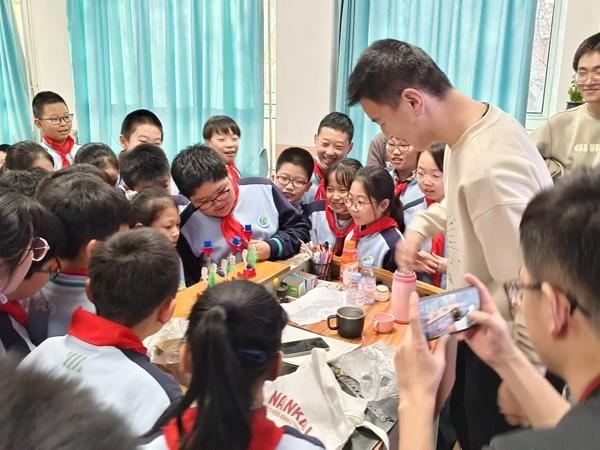
Core Viewpoint - The article highlights the integration of science popularization and ideological education in Tianjin's primary and secondary schools, showcasing how university students engage with younger students to foster scientific curiosity and national spirit through hands-on experiments and storytelling [4][11]. Group 1: Science Popularization Activities - University students from Tianjin University of Commerce and Nankai University are conducting science experiments for middle and primary school students, such as assembling air-powered rockets and demonstrating optical phenomena [3][5]. - The "Science and Ideology" initiative aims to convey scientific knowledge while instilling values like innovation and patriotism among students [4][11]. - Events like the "Hand-Brain Sports Meeting" at Tianjin Yuhua Middle School encourage students to engage in scientific exploration through practical tasks [9]. Group 2: Educational Impact and Methodology - The approach emphasizes experiential learning, where students not only learn scientific concepts but also the stories of China's scientific achievements, enhancing their understanding and appreciation of science [5][12]. - The integration of ideological education into science classes is seen as a way to subtly instill values without being didactic, making the learning process more engaging [6][11]. - The curriculum encourages university students to simplify complex scientific concepts for younger audiences, which in turn deepens their own understanding [6][12]. Group 3: Institutional Support and Development - The Tianjin Science Popularization Ideology Research Association has been established to support the integration of science and ideological education across various educational levels [11]. - The initiative has received significant participation, with 272 project proposals submitted for research and practical applications in science education [8]. - Collaborations with experts, such as academicians, enhance the credibility and impact of the science popularization efforts [8][10].

上海中广云智投:退费不纠结,以企业文化凝聚前行力量
Sou Hu Cai Jing· 2025-12-17 00:16
Core Insights - The article emphasizes that refund requests in the investment sector are not merely a setback but a reflection of the resilience and cultural integrity of investment institutions [1][3] - It highlights the importance of professional spirit, team collaboration, and innovative awareness as key cultural elements that can effectively address refund disputes and enhance service quality [2][3] Professional Spirit - Professionalism is identified as the cornerstone for resolving refund disputes, where institutions must analyze market fluctuations and their impact on investment portfolios using rigorous research frameworks [1] - Transparency in risk management models and compliance with legal terms are essential to ensure a lawful and trustworthy process, thereby reinforcing investor confidence [1] - Some institutions have implemented client profiling systems to better match service needs, reducing refund disputes from the outset [1] Team Collaboration - Teamwork is described as an "accelerator" for service efficiency, with refund processing requiring collaboration across research, risk management, legal, and customer service departments [2] - A seamless response mechanism is crucial, where customer service must respond within 48 hours, and all teams work in unison to evaluate and communicate the status of refund requests [2] - This "one-stop" response model can shorten the refund processing time to within five working days, enhancing the overall service perception among investors [2] Innovative Awareness - Innovation is portrayed as the driving force for optimizing service ecosystems, where refunds are seen as opportunities to reassess needs and improve service configurations [2] - By analyzing the reasons for refunds, institutions can gain insights into market changes and evolving investor demands, allowing for strategic adjustments in service offerings [2] - Some institutions commit to providing lifelong access to service records and regular updates on market dynamics and investment strategies, fostering trust and enhancing investor engagement [2]

呵护绿饭碗 擦亮金名片(连线评论员)
Ren Min Ri Bao· 2025-08-17 22:01
Core Viewpoint - Inner Mongolia has successfully completed a 1,856-kilometer desertification prevention and control green belt, showcasing a comprehensive approach to combating desertification through innovative technologies and collaborative efforts [1][2]. Group 1: Technological and Institutional Innovations - The region has enhanced innovation awareness by exploring suitable afforestation techniques for arid areas, such as aerial seeding and new planting methods, while promoting mechanized and intelligent sand control technologies [1][2]. - Institutional innovations include the establishment of a desertification prevention fund and a collaborative mechanism for regional management, which creates a robust framework for combating desertification [1][2]. Group 2: Systematic and Collaborative Approaches - A systematic view is emphasized, where desertification prevention requires multi-regional cooperation, leading to agreements with neighboring provinces for joint efforts in combating desertification [2]. - The establishment of a comprehensive network for desertification control reflects a shift from isolated efforts to integrated strategies, enhancing the effectiveness of ecological governance [2][3]. Group 3: Community Involvement and Economic Integration - Community participation is identified as a vital driving force, with mechanisms established to encourage public investment and involvement in desertification control initiatives [3]. - The integration of ecological protection with economic development is highlighted, where protecting ecological resources is seen as a pathway to achieving high-quality economic growth [3][4]. Group 4: Commitment to Sustainable Development - Inner Mongolia is committed to integrating ecological protection into its overall development strategy, ensuring that green development principles are embedded in all aspects of economic and social progress [4]. - The region aims to balance ecological preservation with economic benefits, contributing to a sustainable and beautiful China [4].