
制造智能化

Search documents
传统皮鞋业务承压 奥康国际多维度探索突破路径
Zheng Quan Ri Bao Wang· 2026-01-22 02:08
Core Viewpoint - Aokang International (603001) is expected to face significant challenges in 2025, with projected revenue of 1.923 billion yuan, a decrease of approximately 24.55% year-on-year, and a net loss of 237 million yuan attributed to industry environment and market demand changes [1][2] Group 1: Industry Overview - The Chinese footwear industry is undergoing structural adjustments, with significant differentiation among internal categories; the sports shoe segment is expanding rapidly, impacting traditional leather shoes [1] - Consumer demand is shifting from basic functionality to a combination of comfort, technology, and fashion, leading to a contraction in the demand for traditional business leather shoes [1] - Traditional leather shoe companies are facing transformation pains, as sports brands leverage cultural barriers through collaborations and marketing strategies, making it difficult for traditional brands to penetrate consumer preferences [1] Group 2: Company Strategy - Aokang International is committed to a transformation strategy, focusing on consumer-centric approaches and optimizing resource allocation to drive innovation and brand renewal [1][2] - The company is launching innovative products, such as the "QQ弹" trendy footwear series, which combines comfort and style to meet the diverse needs of younger consumers [1] - Aokang is enhancing its channel operations by optimizing inefficient stores and exploring differentiated competition in e-commerce, utilizing AI and creative video content to attract younger consumers [2] Group 3: Manufacturing and Future Outlook - The company is integrating AI, 3D vision, and automation technologies to establish a smart manufacturing system that improves R&D capabilities and production efficiency [2] - Industry experts suggest that while Aokang will continue to face performance pressure in the short term due to its traditional business image, long-term growth may be driven by brand rejuvenation, digital channel development, and smart manufacturing [2] - Aokang aims to enhance profitability and core competitiveness while exploring new growth opportunities and potential external development paths to ensure sustainable growth and value creation for shareholders [2]

“钢魂” 太钢不锈从“不锈钢”跃迁到“手撕钢”
Shang Hai Zheng Quan Bao· 2025-12-15 19:19
Core Viewpoint - Taigang Stainless Steel has evolved from a small steel producer to a global leader in the stainless steel industry, driven by continuous innovation and strategic development [3][4][5]. Company Development History - Taigang's origins date back to 1934, starting as a small steel plant with an annual production of only 16,000 tons [3]. - The company marked significant milestones, including the production of China's first stainless steel in 1952 and achieving an annual output of 1 million tons by 2003, entering the world's top eight stainless steel producers [4][5]. - In 2006, Taigang became the world's largest stainless steel producer with an annual capacity of 3 million tons [4]. Innovation and Technology - Taigang emphasizes innovation as a core strategy, successfully developing products like "hand-tear steel," which addresses critical supply issues in the market [6][7]. - The company has invested significantly in R&D, with 1.837 billion yuan allocated in the first half of 2025, resulting in 89 new patents and the establishment of 23 national standards [7][8]. - Taigang's focus on high-end products has led to over 60% of its sales coming from high-end products, including "hand-tear steel" and specialized alloys for the semiconductor industry [8]. Market Position and Strategy - The company aims to maintain its competitive edge by focusing on high-value products rather than increasing production capacity, especially in a market with over 50 million tons of stainless steel capacity and only a 70% operating rate [8]. - Taigang plans to reduce the proportion of ordinary stainless steel production from 60% to 40%, prioritizing high-temperature alloys and nuclear-grade steel [9]. Sustainability and Smart Manufacturing - Taigang is committed to green transformation, focusing on low-carbon technologies and aiming to establish a "near-zero carbon demonstration production line" by 2030 [9]. - The company is also investing in smart manufacturing, integrating AI into its operations to enhance efficiency and redefine the value chain in the steel industry [9].


2025年中国工业金属行业政策、产业链、产量、重点企业经营情况及趋势研判:新兴产业需求强劲,驱动工业金属创新升级[图]
Chan Ye Xin Xi Wang· 2025-12-03 01:17
Core Insights - The industrial metals sector is crucial for modern industrial systems, reflecting the economic operation status of a nation. The sector is characterized by high strength, corrosion resistance, and excellent processing performance, supporting key industries such as construction, machinery, automotive, electricity, and aerospace [1][13]. Industry Overview - Industrial metals, a subset of non-ferrous metals, include copper, aluminum, lead, and zinc, which are widely used in various industrial applications. The sector has a complete industrial chain in China, from mining to processing, with production and consumption at the global forefront [4][6][13]. - The demand structure is shifting, with traditional construction growth slowing, while emerging industries like new energy, high-end equipment, and electronic semiconductors are driving demand for high-precision, lightweight, and specialty alloys [1][13]. Industry Policies - Recent policies aim to enhance the resilience and security of the industrial metals supply chain. For instance, the "Copper Industry High-Quality Development Implementation Plan (2025-2027)" targets a 5%-10% increase in domestic copper resources by 2027 and aims for a 5% annual growth in the value added of the non-ferrous metals industry from 2025 to 2026 [9][13]. Industry Chain - The industrial metals industry chain consists of upstream mining exploration and selection, midstream smelting and purification, and downstream applications in construction, automotive, shipbuilding, machinery, electrical, and aerospace sectors [9][10][13]. Market Trends - The industrial metals sector is transitioning towards high-performance, lightweight, and green manufacturing, with a focus on new alloy materials and resource recycling. The "dual carbon" goals are expected to accelerate the development of energy-saving technologies and the recycled metals industry [1][13]. - The market for copper alloy materials is projected to exceed 3000 billion yuan by 2028, driven by the growth of new energy vehicles and advanced manufacturing sectors [18]. Key Companies - Major players in the industrial metals sector include Jiangxi Copper, Zijin Mining, and China Aluminum, which dominate the market due to their scale and resource advantages. Private companies like Nanshan Aluminum and Yunnan Aluminum are also gaining market share through innovation [2][18][19]. Production Statistics - China's copper production is expected to grow significantly, with the copper alloy materials market reaching 2367 billion yuan in 2024. The production of aluminum alloys is projected to increase from 629.4 million tons in 2015 to 1614.1 million tons in 2024, reflecting a compound annual growth rate of 11.03% [14][17][18].




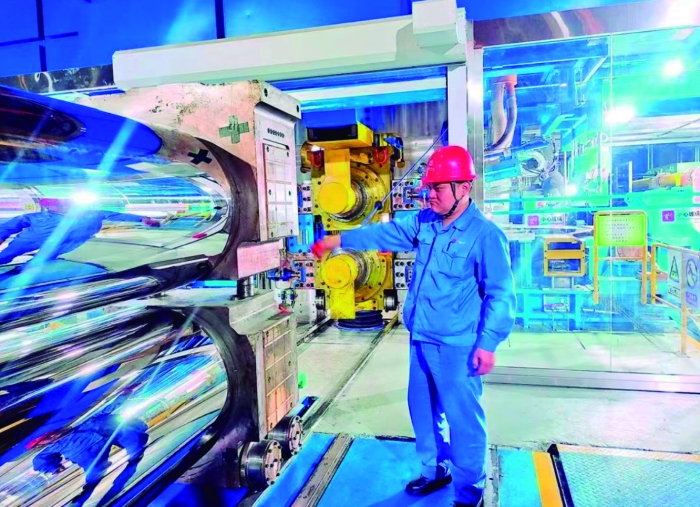
太钢不锈:未来发展将聚焦“产品高端化、绿色化、制造智能化”三个维度
Quan Jing Wang· 2025-09-13 04:37
Core Viewpoint - Taigang Stainless Steel (000825.SZ) is focusing on high-end product development and green manufacturing while responding to market demands and maintaining operational efficiency in a challenging steel industry environment [1][2][3] Group 1: Company Performance - In the first half of 2025, Taigang Stainless Steel achieved a revenue of 45.967 billion yuan and a net profit of 393 million yuan, representing a year-on-year increase of 182.74% [3] - The company's non-recurring net profit reached 316 million yuan, a significant increase of 652.96% compared to the same period last year [3] - Basic earnings per share were 0.069 yuan, up 187.50% year-on-year [3] Group 2: Industry Context - The steel industry is experiencing a decline in both supply and demand, with national macro-control policies positively impacting the profitability of carbon steel hot-rolled sheets [3] - The stainless steel sector is facing pressure on profitability due to challenges in both purchasing and sales [3] Group 3: Strategic Focus - The company is not planning significant capacity investments due to evident overcapacity in the stainless steel market, which has over 50 million tons of capacity with only a 70% operating rate [2] - Future strategies will focus on three dimensions: 1. Product high-endization, targeting high-demand products and enhancing brand value [2] 2. Green manufacturing, emphasizing low-carbon technologies and increased use of renewable energy [2] 3. Intelligent manufacturing, leveraging AI to redefine traditional steel production processes [2] Group 4: Project Involvement - Taigang Stainless Steel is poised to benefit from the Yajiang Hydropower Project, which is expected to generate a steel demand of 4-6 million tons, significantly impacting the steel industry [1] - The company has developed a range of supporting products for large-scale hydropower units since 2012, achieving recognition from both domestic and international high-end hydropower manufacturers [1]