
渠道数字化

Search documents
百威亚太(1876.HK)2025年年报点评:25年业绩继续承压 分红金额保持平稳
Ge Long Hui· 2026-02-14 14:12
Core Insights - Budweiser APAC achieved a total revenue of $5.764 billion in 2025, with an organic year-on-year decline of 6.1% [1] - The normalized EBITDA for 2025 was $1.588 billion, reflecting a year-on-year decrease of 9.8% [1] - In Q4 2025, revenue reached $1.073 billion, with an organic year-on-year decline of 4.2% [1] Revenue and EBITDA Analysis - For the full year 2025, the company reported a sales volume of 7.9658 million kiloliters, down 6.0% year-on-year, while Q4 sales volume was 1.3518 million kiloliters, down 0.7% [1] - The revenue per hectoliter for the full year 2025 decreased by 0.2%, and for Q4, it decreased by 3.5% [1] - The gross margin for 2025 was 50.1%, an increase of 0.13 percentage points year-on-year, while the normalized EBITDA margin was 27.6%, a decrease of 1.13 percentage points year-on-year [1] Regional Performance - In the Western Asia-Pacific region, Q4 2025 sales volume showed a slight organic growth of 0.1%, but revenue and revenue per hectoliter declined by 5.6% and 5.7% respectively, with normalized EBITDA down 40.0% [2] - India emerged as a growth highlight, with high-end and super high-end products accounting for over two-thirds of total revenue and contributing over 20% to revenue growth [2] - In the Eastern Asia-Pacific region, Q4 2025 revenue showed a slight organic decline of 0.6%, with sales volume down 3.7% but revenue per hectoliter up 3.2% [2] China Market Focus - The Chinese market faced continued pressure, with Q4 2025 sales volume down 3.9% due to weak on-premise channels and delayed Lunar New Year shipments [3] - The company plans to increase investment in channel and product mix expansion, with Q4 2025 revenue down 11.4% year-on-year [3] - The company aims to revitalize its market share in China as a core focus for 2026, with strategies including enhancing high-end and digital channel penetration [4] Future Strategies and Forecasts - For 2026, the company will increase commercial investment as a percentage of net revenue, focusing on core and emerging channels [4] - The profit forecasts for 2026 and 2027 have been revised down to $621 million and $680 million respectively, reflecting a decrease of 9% and 7% [4] - The current stock price corresponds to a PE ratio of 21x for 2026, 20x for 2027, and 18x for 2028, with a maintained "buy" rating based on competitive advantages in high-end and super high-end segments [4]

传统皮鞋业务承压 奥康国际多维度探索突破路径
Zheng Quan Ri Bao Wang· 2026-01-22 02:08
Core Viewpoint - Aokang International (603001) is expected to face significant challenges in 2025, with projected revenue of 1.923 billion yuan, a decrease of approximately 24.55% year-on-year, and a net loss of 237 million yuan attributed to industry environment and market demand changes [1][2] Group 1: Industry Overview - The Chinese footwear industry is undergoing structural adjustments, with significant differentiation among internal categories; the sports shoe segment is expanding rapidly, impacting traditional leather shoes [1] - Consumer demand is shifting from basic functionality to a combination of comfort, technology, and fashion, leading to a contraction in the demand for traditional business leather shoes [1] - Traditional leather shoe companies are facing transformation pains, as sports brands leverage cultural barriers through collaborations and marketing strategies, making it difficult for traditional brands to penetrate consumer preferences [1] Group 2: Company Strategy - Aokang International is committed to a transformation strategy, focusing on consumer-centric approaches and optimizing resource allocation to drive innovation and brand renewal [1][2] - The company is launching innovative products, such as the "QQ弹" trendy footwear series, which combines comfort and style to meet the diverse needs of younger consumers [1] - Aokang is enhancing its channel operations by optimizing inefficient stores and exploring differentiated competition in e-commerce, utilizing AI and creative video content to attract younger consumers [2] Group 3: Manufacturing and Future Outlook - The company is integrating AI, 3D vision, and automation technologies to establish a smart manufacturing system that improves R&D capabilities and production efficiency [2] - Industry experts suggest that while Aokang will continue to face performance pressure in the short term due to its traditional business image, long-term growth may be driven by brand rejuvenation, digital channel development, and smart manufacturing [2] - Aokang aims to enhance profitability and core competitiveness while exploring new growth opportunities and potential external development paths to ensure sustainable growth and value creation for shareholders [2]

肖竹青解读中国酒业2025核心关键词与2026展望
Sou Hu Cai Jing· 2025-12-29 11:37
Core Insights - The article discusses the key trends and adjustments in the Chinese liquor industry leading up to 2025, emphasizing a shift towards consumer-driven demand and the need for quality over quantity in production [2][6][7]. Demand Side - The "strictest alcohol ban" has reduced government consumption, shifting focus to market-driven scenarios like self-drinking and business banquets, with a growing demand for low-alcohol and value-for-money products priced between 50-300 yuan [2]. - The price of Guizhou Xijiu 1988 has dropped to 360 yuan per bottle, significantly increasing its opening rate and making it a preferred choice for middle-class consumers seeking high-value liquor [2]. Supply Side - Liquor companies are transitioning from rapid growth to stable, quality-focused development, with leading brands investing in low-alcohol products and enhancing regional value while phasing out inefficient production [3]. - Brands like Wuliangye and Gu Qing Gong have successfully addressed the challenges of low-alcohol products, appealing to younger consumers by creating versatile drinking experiences [3]. Channel Side - Traditional distribution models are under pressure, with instant retail and live e-commerce becoming key battlegrounds, leading to a digital and flattened channel transformation [5]. - The chairman of Zhenjiu Li Du has actively engaged in personal branding through video sharing and private traffic operations, significantly increasing partnership sign-ups [5]. Industry Adjustment and Cycle Judgment - The adjustment is characterized as a painful transition from channel-driven to consumer-driven models, focusing on inventory reduction and eliminating excess [6]. - The industry is still in a bottoming phase, with price fluctuations in premium brands like Moutai indicating a lack of market confidence and a pessimistic outlook on future income [6][7]. Inventory and Price Trends - Inventory reduction has not met expectations, with "dam-like inventory" remaining a core issue, and market share increasingly concentrating among leading brands [10]. - Price stabilization for Moutai is not expected until Q2 2026, with ongoing challenges in the high-end and mid-range segments due to insufficient purchasing power [12]. Capital Layout and Industry Differentiation - Platform capital is focusing on instant retail, leading to a revolution in channel efficiency and an inevitable increase in industry concentration, with top brands capturing nearly 90% of revenue and profits [15]. - The competitive landscape is solidifying, with a projected CR5 exceeding 50% by 2026, and smaller enterprises facing pressure to either specialize or focus on regional markets [15]. Future Opportunities and Price Recovery - The overall industry is expected to remain sluggish, but certain segments may experience localized growth, with the market size projected between 880-900 billion yuan [16]. - Leading companies like Moutai and Wuliangye are likely to adopt slower growth strategies to alleviate channel pressures, with expectations of slight revenue increases [16]. - Price recovery is anticipated to vary across segments, with high-end brands maintaining price stability and the low-end segment expanding rapidly [15].



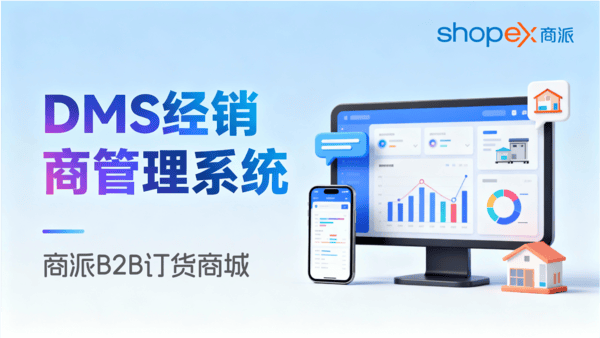
商派B2B订货商城与DMS经销商管理一体化方案驱动品牌渠道业务增长
Sou Hu Cai Jing· 2025-12-17 08:37
Core Insights - The article discusses the launch of ShopeX, a B2B ordering and DMS (Distributor Management System) integrated solution by Shangpai, aimed at brand manufacturers and distribution companies, facilitating the transition from offline to online business models [2] Group 1: Solution Features - The solution is built on a microservices and middle-platform architecture, creating a full-link B2B business loop that includes capabilities such as account verification, pricing strategies, credit terms, order fulfillment, inventory management, payment processing, marketing, customer operations, data analysis, and standardized API integration [2][4] - Key functionalities include front-end collaboration tools for self-ordering, bulk imports, and model searches, enhancing order efficiency and accuracy [4] - The system supports complex B2B transaction scenarios, including standard and customized transactions, electronic contracts, and various payment methods, ensuring a closed loop for financial and invoice flows [4] Group 2: Industry Applications and Impact - In the home appliance sector, a well-known international brand utilized the B2B ordering mall and OMS business middle platform to automate order processing, achieving significant improvements in operational efficiency and customer experience [6] - A leading energy company partnered with Shangpai to create a B2B distribution ordering platform, automating various review processes and reducing manual operations by 80%-100%, with nearly 90% of orders being automatically approved [6] - In the home furnishings industry, a high-end brand implemented a DMS platform that connected hundreds of distributors and stores, achieving full visibility of inventory and sales data, and facilitating a rapid deployment within 21 days [7] Group 3: Security and Compliance - The solution incorporates a multi-layered security framework and has received various certifications, including ISO9001 and ISO27001, to meet the security and compliance needs of medium to large enterprises [8] Group 4: Future Trends - The industry is shifting from management control to empowering services, with companies leveraging digital platforms to provide marketing tools, data dashboards, and financial services, aiming for differentiated operational systems [9] - Shangpai's B2B (DMS) solution offers a digital foundation that accommodates complex processes, deep system integration, and quantifiable business value, supporting companies in achieving high-quality growth in an era where channel management and digitalization are paramount [9]
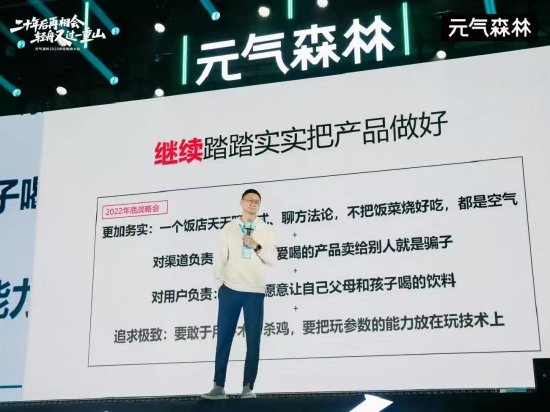
元气森林唐彬森:坚定相信中国饮料市场的潜力,相信中国人能吃得更好、喝得更好
Xin Lang Cai Jing· 2025-11-18 08:51
Core Insights - Yuanqi Forest achieved a 26% year-on-year growth in overall performance, maintaining double-digit growth for three consecutive years [3][5] - The founder, Tang Binsen, emphasized six principles for the company's future, focusing on product quality, partnerships, and the potential of the Chinese beverage market [3][4][7] Group 1: Company Performance - Yuanqi Forest's sales growth outpaced the market by four times, indicating strong market positioning [5] - The product portfolio has become more diverse and stable, including sugar-free and low-sugar options, aligning with future trends in branding, functionality, and health [5][9] Group 2: Strategic Principles - The company will continue to adhere to six principles: creating meaningful products, reducing sugar content, ensuring product quality, and enhancing product aesthetics [7][8] - Emphasis on digitalizing the supply chain and improving product management to enhance operational efficiency [5][9] Group 3: Market Outlook - The company remains optimistic about the potential of the Chinese beverage market, believing that consumers will increasingly seek healthier options [8][9] - The beverage industry is expected to evolve with new product introductions, presenting opportunities for strong companies to thrive [9][10]
经销商分级管理:数商云B2B平台赋能家具企业核心渠道建设
Sou Hu Cai Jing· 2025-10-17 08:54
Core Insights - The Chinese furniture industry is undergoing structural adjustments, with domestic retail sales increasing by 21.4% year-on-year from January to May 2025, while revenue from large enterprises and export value decreased by 3.9% and 8.2% respectively, highlighting the need for improved channel efficiency [2] Group 1: Value Reconstruction of Dealer Management - Traditional dealer management relies on subjective assessments, leading to inefficiencies; a data-driven dynamic grading system has been implemented, resulting in a reduction of dealers from 2,300 to 1,800 and a 15% increase in channel coverage [3] - Resource allocation has shifted from a broad approach to a targeted strategy, with one soft furniture company reducing marketing costs from 12% to 9% while increasing customer reach by 40% and shortening new product launch cycles by 35% [4] Group 2: Technological Innovations of the B2B Platform - The platform utilizes a distributed microservices architecture to support dealer grading, with key metrics including monthly sales, market share, and inventory turnover rates; A-level dealers receive 15% quarterly rebates, while D-level dealers receive only 8% [5] - Blockchain technology has been integrated to address data falsification issues, resulting in an 83% reduction in data disputes and a 50% increase in policy execution efficiency for an export-oriented furniture company [6] Group 3: Core Application Scenarios - The platform offers diagnostic tools that help identify channel inefficiencies; for instance, a solid wood furniture company improved regional profit margins by 7 percentage points by adjusting dealer distribution [7] - A dynamic incentive mechanism has been established, providing comprehensive support to A-level dealers, which led to an average annual output of over 5 million yuan per store for an office furniture company [8] - A risk warning system has been implemented, allowing a children's furniture company to identify financial risks six months in advance, preventing losses exceeding 20 million yuan [9] Group 4: Industry Case Studies - A listed furniture company reduced its dealer count by 25% while achieving an 18% increase in sales and halving the new product launch cycle from 180 days to 90 days [15] - An export-oriented furniture company implemented a cross-border dealer grading standard, resulting in a 22% reduction in overseas channel costs and a 65% increase in sales in Southeast Asia [17] Group 5: Future Trends and Challenges - The industry is moving towards deep AI applications for risk prediction, IoT integration for real-time inventory monitoring, and the establishment of a dealer growth academy to enhance digital operational capabilities [17]

格力电器(000651):新团队新面貌,高股息高价值
EBSCN· 2025-04-09 14:00
Investment Rating - The report maintains a "Buy" rating for Gree Electric Appliances with a target price of 54.10 CNY [4][6] Core Views - Gree Electric Appliances is characterized by strong defensive attributes due to its high dividend yield of 6.6% and low foreign sales ratio of approximately 12% [2][4] - Recent operational changes, including board restructuring and digital channel reforms, are expected to drive performance improvements post tariff tensions [3][4] Summary by Sections Investment Highlights - The company’s expected dividend yield for 2025 is 6.6%, based on a projected net profit of 32.9 billion CNY and a cash dividend payout ratio of 50% [2] - Gree's foreign revenue contribution remains low, with only about 12% from international markets, minimizing exposure to global trade tensions [2] Operational Changes - The board has undergone a restructuring with younger management taking key positions, indicating a shift towards a more dynamic leadership [3] - The planned share buyback by the distributor, Jinghai Huilian, reinforces the company's value proposition, confirming the attractiveness of its low stock price and high dividend yield [3] - The company is advancing its digital transformation, enhancing sales channel efficiency through the establishment of digital technology companies and nationwide promotion of a cloud-based system [3] Financial Projections - The report forecasts Gree's net profit for 2024-2026 to be 30.3 billion CNY, 32.9 billion CNY, and 36.4 billion CNY respectively, with corresponding P/E ratios of 8, 8, and 7 [4][5] - Revenue projections for 2024-2026 are estimated at 199.3 billion CNY, 216.9 billion CNY, and 232.8 billion CNY, reflecting a growth trajectory despite a slight decline in 2024 [5][10]
