新兴市场

Search documents
中企出海,从单点收购到创新溢出
21世纪经济报道· 2026-03-12 00:14
Core Viewpoint - The article emphasizes the significant trend of Chinese enterprises expanding overseas, driven by government policies and the need for global market optimization, with projections indicating a direct investment of $174.4 billion by 2025, reflecting a 7.1% year-on-year growth [1]. Group 1: Historical Context of Chinese Enterprises Going Abroad - Before 2008, state-owned enterprises primarily led overseas expansion, focusing on acquiring resources to meet domestic demand [3]. - Post-2008 financial crisis, Chinese companies capitalized on depreciated overseas assets, initiating a wave of outbound investments, including resource acquisitions and manufacturing sector mergers [3]. - The launch of the Belt and Road Initiative in 2015 accelerated overseas investments, with a shift from single acquisitions to systematic layouts aligned with national strategies [3]. Group 2: Current Trends and Characteristics - In recent years, Chinese enterprises have actively sought global layouts, with a fundamental change in the structure and quality of outbound investments following the GDP per capita surpassing $10,000 in 2019 [4]. - The current phase is characterized by technology premium, brand output, and global resource allocation, positioning Chinese companies as emerging forces in promoting economic globalization [4]. Group 3: Competitive Advantages - The international competitiveness of Chinese enterprises has significantly improved due to "innovation premium," with China holding a complete range of industrial categories and excelling in traditional and high-tech sectors [6]. - Chinese companies have led the global green transition, with firms like BYD and CATL establishing "Chinese industrial clusters" in key regions [6]. - The rapid iteration and optimization capabilities within China's large domestic market create a unique "innovation ecosystem," enhancing competitiveness in international markets [7]. Group 4: Opportunities in Emerging Markets - The changing international landscape provides "era dividends" for Chinese enterprises, with emerging markets experiencing rapid economic growth and increasing demand for infrastructure and durable consumer goods [9]. - The Regional Comprehensive Economic Partnership (RCEP) has deepened the integration of Chinese enterprises with ASEAN, which has become a primary destination for outbound investments [9]. - Africa presents significant opportunities for investment in infrastructure and traditional manufacturing, alongside new energy and digital communication sectors [10]. Group 5: Systematic Support for Outbound Expansion - The large-scale overseas expansion of Chinese enterprises reflects a profound "capability spillover," necessitating government support to ensure stability and sustainability [12]. - The establishment of a national overseas comprehensive service platform aims to provide one-stop public services for thousands of overseas enterprises, marking a new phase in institutional support for outbound investments [12]. - The Chinese government is actively shaping a favorable institutional environment for global engagement, transitioning from a rule-taker to a rule-maker in global economic governance [12].


Emerging Markets Have Become a Fixed-Income Darling. The War in Iran Could Change That.
Barrons· 2026-03-09 08:00
Core Viewpoint - The continuation of the bull run in emerging markets is contingent upon the impact of rising oil prices on the global economy [1] Group 1 - The rise in oil prices poses a potential threat to the global economy, which could influence investor sentiment in emerging markets [1]

韩国,拟100万亿韩元救市!
证券时报· 2026-03-04 10:28
Core Viewpoint - The South Korean stock market has experienced significant declines due to escalating tensions in the Middle East, prompting the government to consider a market stabilization plan of 100 trillion KRW (approximately 47 billion RMB) to mitigate the impact on the economy and financial markets [1][5]. Group 1: Market Performance - On March 4, the South Korean stock market saw major indices drop over 10%, with the KOSDAQ index triggering a circuit breaker [1]. - The KOSPI index closed at 5,093.54, down 12.06%, while the KOSDAQ index closed at 978.44, down 14% [2]. - This marked the second consecutive day of significant declines, with the KOSPI index falling 7.24% on March 3 [3]. Group 2: Government Response - The Chairman of the Financial Services Commission, Lee Eog-weon, stated that the government is closely monitoring the stock market and will actively utilize the 100 trillion KRW stabilization plan if volatility increases [5]. - An emergency financial market response team has been established to monitor market conditions continuously [5]. - The government aims to support the real economy and minimize losses for small and medium-sized enterprises affected by the Middle East situation [6]. Group 3: Broader Market Impact - The South Korean stock market is the largest loser amid the escalating Middle East tensions, with major tech stocks like Samsung Electronics and SK Hynix leading the declines [5]. - Other emerging markets in Asia also faced significant drops, with Thailand's benchmark index falling 8% and triggering a trading halt [9]. - Analysts warn that the ongoing conflict in Iran could lead to increased energy costs, significantly impacting emerging markets, including South Korea [11].

哥伦比亚比索从周四的大幅下跌中反弹,上涨1.8%,领跑新兴市场。
Xin Lang Cai Jing· 2026-02-27 14:47
Core Insights - The Colombian peso rebounded from a significant decline on Thursday, increasing by 1.8%, leading among emerging markets [1] Group 1 - The Colombian peso's recovery indicates a positive shift in its performance compared to other emerging market currencies [1] - The 1.8% increase reflects a notable recovery after a period of substantial depreciation [1] - This rebound positions the Colombian peso as a leader in the emerging market currency space [1]
芯朋微:2025年净利润1.86亿元,同比增长67.34%
Xin Lang Cai Jing· 2026-02-27 10:43
Core Viewpoint - Chipone Microelectronics reported a significant increase in both revenue and net profit for the fiscal year 2025, indicating strong growth driven by emerging markets and new product categories [1] Group 1: Financial Performance - The total operating revenue for the fiscal year 2025 reached 1.143 billion yuan, representing a year-on-year growth of 18.47% [1] - The net profit for the same period was 186 million yuan, showing a substantial year-on-year increase of 67.34% [1] Group 2: Growth Drivers - Revenue growth was primarily fueled by emerging markets, including sectors such as servers, communications, industrial motors, optical storage, and new energy vehicles, which saw an approximate growth of 50% [1] - New product categories, including DC-DC converters, drivers, digital PMICs, power devices, and power modules, contributed to a significant revenue increase of around 39% [1]

每日投行/机构观点梳理(2026-02-26)
Jin Shi Shu Ju· 2026-02-26 10:27
Group 1 - Bank of America predicts gold prices may reach $6,000 per ounce within the next 12 months, while silver prices could exceed $100 per ounce again this year despite current demand concerns from solar panel manufacturers [1] - Citigroup analysts indicate that emerging markets are expected to be the most favored trading markets this year, with major asset management firms investing in emerging market stocks and bonds, betting on strong global economic growth and a weaker dollar [1] - ING suggests that investors looking to avoid volatility in the U.S. stock market due to AI developments may find European government bonds attractive, as they offer relatively stable yields amid rising U.S. market volatility [1] Group 2 - JPMorgan forecasts that the Bank of Thailand will maintain its policy interest rate at 1% until 2027 to preserve policy space amid rising uncertainties, with the Thai economy expected to accelerate further due to political stability post-election [2] - CITIC Securities reports that Zimbabwe's ban on lithium exports is likely to lead to a significant increase in lithium prices, as the country is projected to account for 12% of global lithium resource output by 2026 [3] - Huatai Securities notes that the U.S. designation of phosphate-based agricultural inputs as strategic resources could impact market prices, particularly if demand increases due to supply stability concerns [3] Group 3 - CITIC Securities believes that the non-ferrous metals bull market is far from over, suggesting that investors should hold positions but avoid blindly chasing prices, with opportunities arising during market corrections [4][5] - CICC reports that recent policy adjustments in Shanghai may help stabilize housing prices in key cities, as the supply-demand structure shows positive changes [5][6] - Galaxy Securities indicates that the real estate industry may see overall valuation recovery as housing demand is expected to be released, leading to a healthier market development [6][7]




每日机构分析:2月26日
Xin Hua Cai Jing· 2026-02-26 09:34
Group 1: Emerging Markets and Investment Trends - Citigroup analysts indicate that major asset management firms, managing over $20 trillion in assets, are buying stocks, local currency bonds, and credit products in emerging markets, betting on global economic growth and a weaker dollar benefiting these markets. Despite market turbulence due to concerns over AI disrupting various sectors, emerging market assets have performed well, with the MSCI Emerging Markets Index rising by 0.7% [1] - The trading volume of related thematic ETFs has surged, reflecting a shift in sentiment as developed markets face increased uncertainty due to policy unpredictability and fiscal concerns, leading to a spike in bond yields in the US, Japan, and Germany [1] Group 2: Gold Market Outlook - ANZ has reinforced its bullish stance on gold, citing expectations of the Federal Reserve restarting rate cuts in Q2 (possibly June) and again in Q4, which will support gold prices. Additionally, escalating US-Iran tensions are expected to revive gold's safe-haven demand [2] - Economic risks persist, with markets yet to fully absorb the impact of US tariff increases, and concerns over AI-driven stock market gains exacerbating financial risks. In this uncertain environment, gold remains an attractive hedge against market risks [2] - Following a recent round of profit-taking, investor positions are no longer crowded, leaving ample room for establishing new long positions in gold [2] Group 3: Monetary Policy Insights - Goldman Sachs notes that the nomination of new Bank of Japan policy committee members may reduce the likelihood of an interest rate hike in April or June, as the nominees have historically advocated for aggressive fiscal expansion and accommodative monetary policy [3] - ING forecasts that the Bank of Korea will resume rate hikes in 2027, with the possibility of an earlier tightening cycle starting in Q4 2026 if economic growth and inflation exceed expectations. The GDP growth forecast for South Korea in 2026 is set at 2.2%, above the central bank's latest prediction of 2.0% [3] Group 4: New Zealand Economic Outlook - A business survey indicates that New Zealand companies are facing rising costs, with 79% of respondents expecting costs to increase in the next three months, the highest level since 2023. Additionally, 53% of companies anticipate raising prices, and 84% expect to pay higher wages in the coming year [4] - Despite the Reserve Bank of New Zealand's confidence in controlling price pressures, economists and investors are concerned that without interest rate hikes this year, inflation may not significantly ease [4]
花旗:新兴市场有望成为今年最受青睐的交易市场
Jin Rong Jie· 2026-02-26 04:23
Core Insights - Major global asset management firms, managing over $20 trillion in assets, are increasing their investments in emerging market stocks, local currency bonds, and credit products, betting on strong global economic growth and a weaker dollar benefiting these markets [1][1][1] - Despite recent market volatility due to concerns over artificial intelligence disrupting various sectors, emerging market assets have shown strong performance [1][1][1] - The MSCI Emerging Markets Index reached a historical high, rising by 0.7% on Thursday, indicating a shift in investor sentiment towards emerging markets amid uncertainty in developed markets [1][1][1] Market Trends - The trading volume of related thematic ETFs has surged significantly, reflecting a growing interest in emerging markets [1][1][1] - Developed markets are facing increased uncertainty due to policy unpredictability and fiscal concerns, leading to a rise in bond yields in the US, Japan, and Germany [1][1][1]
传音控股或第二季度登陆港交所 募资规模或达10亿美元
Zhi Tong Cai Jing· 2026-02-24 06:15
Core Viewpoint - Transsion Holdings, known as the "King of Mobile Phones in Africa," is set to launch a non-deal roadshow (NDR) for its Hong Kong listing on March 12, with an expected transaction size of approximately $500 million to $1 billion, aiming for a listing on the Hong Kong Stock Exchange in the second quarter of 2026 [1] Group 1 - Transsion Holdings submitted its prospectus to the Hong Kong Stock Exchange on December 2, 2025, with CITIC Securities as the sole sponsor and JPMorgan as the financial advisor [1] - The company is recognized as a leading smart terminal and mobile internet service provider, focusing on emerging markets in Africa, South Asia, and the Middle East [1] - Transsion has established competitive barriers in its target markets through highly localized technological innovations and a multi-brand strategy [1] Group 2 - According to Frost & Sullivan, Transsion is the largest mobile phone provider in emerging markets, holding a market share of 24.1% based on projected mobile phone sales in 2024 [1] - In its traditional stronghold, the African market, Transsion's market share has reached 61.5%, while it also ranks first in the emerging Asia-Pacific and Middle Eastern markets [1]

关税裁决逆转风险偏好 新兴市场ETF单日吸金4.3亿创流入规模新高
智通财经网· 2026-02-23 23:36
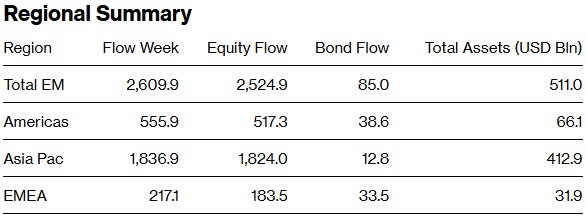
Core Viewpoint - The recent ruling by the U.S. Supreme Court against President Trump's global tariff policy has led to a significant inflow of funds into emerging market equity ETFs, indicating a renewed demand for risk assets in the market [1] Fund Inflows and Market Trends - The Avantis Emerging Markets Equity ETF experienced a net inflow of $429.5 million on the day of the Supreme Court ruling, marking the largest single-day inflow since May 13, pushing its total assets to a historical peak of $20.3 billion [1] - Year-to-date, emerging market equity ETFs have attracted over $35 billion in net inflows, with various emerging market indices hovering near historical highs [2] - Active management funds have captured nearly 15% of the inflows this year, as investors seek expertise to navigate uncertainties in developing markets [3] Regional Insights - In the emerging market ETF space, passive strategies have historically dominated, accounting for over 90% of total assets, but there is a growing interest in active management due to dissatisfaction with traditional index compositions [3] - Latin American markets, particularly Argentina, Colombia, and Brazil, are seeing increased investor interest, with the MSCI Emerging Markets Latin America Index reaching an eleven-year high [3] - The iShares MSCI Korea ETF led the inflows in the last week, attracting $694.7 million, driven by strong demand for Asian semiconductor stocks [4][9] Overall Market Data - Total assets in emerging market ETFs increased from $500.8 billion to $511.0 billion, with equity ETFs expanding by $2.52 billion and bond funds growing by $85 million [5] - The MSCI Emerging Markets Index closed at 1567.23 points, reflecting a 0.8% increase from the previous week, with no single country recording outflows [6]