劳动力供给

Search documents
美国就业数据能带来宽松交易机会吗?-兴业证券
Sou Hu Cai Jing· 2026-01-27 16:38
Group 1 - The core viewpoint of the report is that the U.S. labor market has transitioned from a post-pandemic state of supply-demand imbalance to a more balanced state, with current employment performance showing signs of weakness [1][15][18] - The unemployment rate increased from 4.1% in mid-2025 to 4.4% by the end of 2025, primarily due to an increase in labor supply rather than layoffs [1][18] - Labor force participation rates have rebounded, particularly among youth and immigrants, but the sustainability of this influx is questionable [1][22][27] Group 2 - On the supply side, the increase in unemployment is attributed to a rise in labor supply, with the labor force participation rate stabilizing in the first half of 2025 and then increasing in the second half [18][22] - The demand side faces cooling pressures, with companies absorbing tariff costs and compressing labor costs, leading to a preference for lower-paid workers and increased part-time positions [2][43] - Government funding constraints are limiting personnel expansion, and job mobility among job seekers has decreased, indicating a decline in confidence [2][43][44] Group 3 - The report suggests that if employment continues to weaken and inflation remains manageable, the Federal Reserve may increase the weight of employment risk in its monetary policy decisions, potentially reopening avenues for easing [2][43] - The current market anticipates that the Federal Reserve will implement less than two rate cuts in 2026 [2][43][31] - The labor market's response to economic conditions is critical, with the potential for a loosening of monetary policy if employment data shows further deterioration [2][43][31]



美联储古尔斯比:移民政策导致劳动力供给状况波动不定。
Sou Hu Cai Jing· 2025-09-23 12:53
Group 1 - The core viewpoint is that immigration policies have led to fluctuations in labor supply conditions [1] Group 2 - The Federal Reserve's Goolsbee highlights the impact of immigration on labor market dynamics [1]
“唱反调者”坚称:美联储今年仍有按兵不动的理由!
Jin Shi Shu Ju· 2025-08-13 09:20
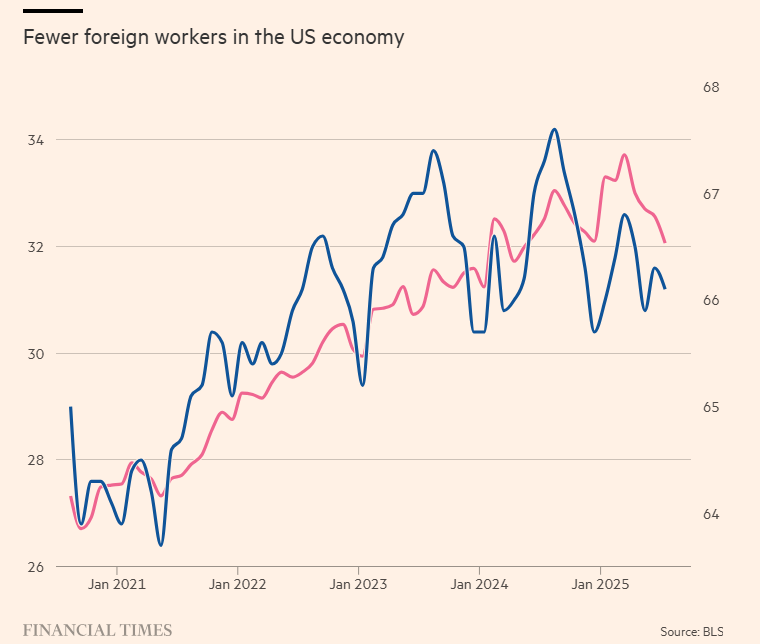
Core Viewpoint - The Federal Reserve Chairman Jerome Powell downplayed the likelihood of a rate cut in September, indicating that current economic performance does not show signs of restrictive policies dragging down growth [2] Group 1: Economic Indicators - The July non-farm payroll data fell short of expectations, with significant downward revisions for May and June, indicating weaker labor demand than previously thought [2] - The unemployment rate slightly increased in July, leading the forward rate market to fully absorb expectations for a September rate cut [2] - Analysts are questioning the prediction that the federal funds rate will remain unchanged for the rest of the year, with the outcome largely dependent on upcoming economic data releases [2][3] Group 2: Labor Market Dynamics - Concerns about restrictive immigration policies are prevalent among analysts, as the U.S. economy relies heavily on foreign labor, and recent immigration restrictions have led to a decrease in the labor supply [3] - The ratio of job vacancies to unemployed individuals has returned to pre-pandemic levels, suggesting that the labor market is not excessively loose [3] - The participation rate of foreign-born workers has significantly declined since March, indicating a tightening labor supply [4] Group 3: Future Projections - Capital Economics forecasts a slight increase in the unemployment rate to 4.3% by year-end, which may justify the Fed's decision to maintain interest rates [5] - Analysts from Bank of America believe that the current economic situation could be characterized as either recession or stagflation, with a notable decline in labor force due to immigration restrictions [5] - The upcoming non-farm payroll report on September 5 and comments from the Federal Reserve at the Jackson Hole conference will be critical in shaping future rate decisions [7]