
医药集中带量采购

Search documents
事关看病报销,这两个“钱袋子”别搞混了
Xin Hua Wang· 2026-02-14 13:28
Core Viewpoint - Recent rumors regarding the depletion of personal medical insurance accounts and its impact on reimbursement have been clarified by health insurance departments in various regions, stating that the balance of personal accounts does not affect the reimbursement benefits provided by the pooled fund [2][12]. Group 1: Understanding the Two Funds - The rumors stem from a misunderstanding of the two components of employee medical insurance: the pooled fund and the personal account [14]. - The pooled fund serves as a "public pool" for medical reimbursements, funded by contributions from all insured individuals, covering ordinary outpatient services, chronic disease treatments, and hospitalization costs, with strict reimbursement ratios [15][17]. - The personal account functions as a "personal wallet" for out-of-pocket expenses, such as purchasing medications at designated pharmacies and covering personal costs after reimbursement [4][17]. Group 2: Policy Upgrades - In January of this year, the National Healthcare Security Administration and the Ministry of Finance announced an upgrade to the personal account system, expanding the scope of inter-provincial mutual assistance, breaking geographical restrictions, and enhancing family support functions [6][18]. - This policy upgrade is expected to benefit more individuals and significantly reduce the medical burden on insured persons [7][18]. Group 3: Common Misconceptions and Official Actions - The applicable beneficiaries of the inter-provincial mutual assistance include close relatives of the insured, such as spouses, parents, children, and grandparents [18]. - The funds from personal accounts can be used for personal medical expenses incurred by close relatives, including costs at designated medical institutions and pharmacies [9][18]. - The Central Cyberspace Administration, in collaboration with the National Healthcare Security Administration, is actively combating misinformation related to medical insurance, focusing on three main types of violations: fabricating false information, inciting public anxiety, and misleading the public by associating non-collective procurement products with collective procurement [20].


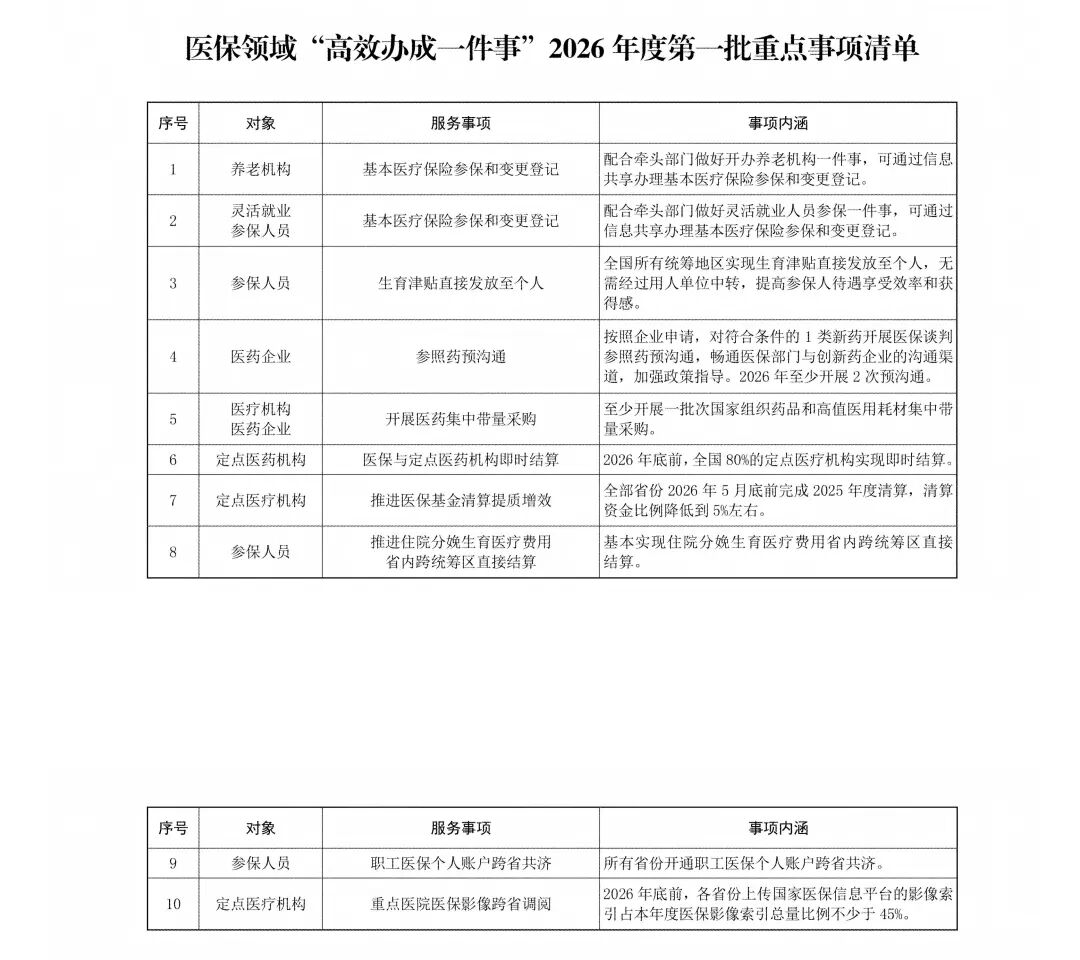
国家医保局发布2026年度第一批重点事项清单 医药集中带量采购、医保即时结算等在列
Xin Lang Cai Jing· 2026-02-11 10:16
Core Viewpoint - The National Healthcare Security Administration (NHSA) has released a list of key tasks for the healthcare sector for 2026, emphasizing the opening of cross-province mutual aid for employee medical insurance personal accounts across all provinces [1][3]. Group 1: Cross-Province Mutual Aid - All provinces will open cross-province mutual aid for employee medical insurance personal accounts, allowing funds to cover medical expenses for the insured's close relatives [1][3]. - As of early January 2026, 337 coordinated areas have launched healthcare wallets to facilitate cross-province mutual aid [1][3]. Group 2: Key Tasks for 2026 - By the end of 2026, 80% of designated medical institutions nationwide are expected to achieve instant settlement [4][6]. - At least one batch of national organized drug and high-value medical consumables centralized procurement will be conducted [4][6]. - The direct settlement of maternity medical expenses for inpatient childbirth across coordinated areas within the province will be basically realized [4][6]. Group 3: Additional Services - Maternity allowances will be directly issued to individuals without needing to go through employers, enhancing the efficiency and satisfaction of insured individuals [2][6]. - Key hospitals will enable cross-province retrieval of medical imaging under the healthcare insurance system, with at least 45% of imaging indexes uploaded to the national healthcare information platform by the end of 2026 [3][7].
一批制造公众用药焦虑,引导购买高端医疗保险的账号被依法处置
Bei Jing Shang Bao· 2026-02-06 12:16
Core Viewpoint - The recent actions by the Central Cyberspace Administration and the National Medical Insurance Administration aim to address and rectify false information related to centralized drug procurement, which has been misleading the public and creating unnecessary anxiety regarding medication choices [1] Group 1: Regulatory Actions - The Central Cyberspace Administration and the National Medical Insurance Administration have collaborated to tackle online misinformation regarding drug procurement [1] - A number of social media accounts have been identified and dealt with for spreading false narratives, including claims about "imported drugs collectively exiting China" [1] - Specific accounts, such as "成都XXX" on Weibo and "琼波XX" on Douyin, have been noted for distorting national policies and inciting public anxiety about original and generic drugs [1] Group 2: Impact on Public Perception - The misinformation has been aimed at creating a divide between original and generic drugs, which could lead to public confusion and anxiety regarding medication [1] - Some accounts have been found to promote the purchase of health products and high-end medical insurance, as well as directing the public to specific online platforms for drug purchases [1] - The actions taken against these accounts reflect a broader effort to protect public health and ensure accurate information dissemination in the pharmaceutical sector [1]
中央网信办通报一批网上虚假不实信息典型案例
Ren Min Ri Bao· 2026-02-05 22:21
Core Viewpoint - The Central Cyberspace Administration of China, in collaboration with the National Healthcare Security Administration, is actively addressing false and misleading information related to centralized drug procurement, taking legal actions against accounts that spread anxiety and misinformation [1] Group 1: False Information and Misinformation - Accounts have been identified that fabricate false information regarding the quality of drugs and medical supplies involved in centralized procurement, aiming to attract traffic [1] - Some accounts distort national policies and create false narratives to incite public anxiety regarding original and generic drugs, leading to the promotion of health products and high-end medical insurance [1] - There are instances where non-procurement products are deliberately associated with procurement to mislead the public, damaging the credibility of the procurement process [1]
一批账号造谣“进口药退出中国”“集采器械质量差”!被处置
Nan Fang Du Shi Bao· 2026-02-05 07:10
Core Viewpoint - The central government is actively addressing the spread of false information related to centralized drug procurement, which is crucial for public health and safety [1][2]. Group 1: Regulatory Actions - The Central Cyberspace Administration of China, in collaboration with the National Medical Insurance Administration, has taken measures to rectify online misinformation regarding centralized drug procurement [1]. - Several accounts have been identified and penalized for spreading false information that undermines the credibility of centralized procurement policies [2]. Group 2: Misinformation Tactics - Certain accounts have been found to fabricate negative information about the quality of drugs and medical supplies associated with centralized procurement to attract attention [1][2]. - Some accounts are misleading the public by associating non-procurement products with centralized procurement, thereby damaging the trust in the procurement system [2]. Group 3: Public Awareness - The authorities emphasize the importance of rational and scientific perspectives on drug procurement and urge the public to avoid spreading rumors [2].
“心血管XXX主任”、“成都XXX”、“麻辣XXX”等账号,被处置
券商中国· 2026-02-05 06:11
Core Viewpoint - The article discusses the recent actions taken by the Central Cyberspace Administration and the National Medical Insurance Administration to address false information related to centralized procurement of pharmaceuticals and medical supplies, emphasizing the importance of accurate information in this sector [1][2]. Group 1: Actions Against Misinformation - Several social media accounts have been identified for spreading false information that stigmatizes centralized procurement policies to gain traffic, including accounts on platforms like Xiaohongshu and Douyin [1]. - Accounts have been found to incite public anxiety by distorting national policies and spreading false claims, such as the alleged collective withdrawal of imported drugs from China, which aims to create a sense of urgency among the public [2]. - Certain accounts have been misleadingly associating non-procurement products with procurement policies, thereby damaging the credibility of the procurement system [2]. Group 2: Public Awareness and Responsibility - The article highlights the significance of the centralized procurement policy for the public's interests and warns that the fabrication and dissemination of false information regarding this policy will face strict penalties [2]. - The authorities urge the public to adopt a rational, objective, and scientific perspective on pharmaceutical procurement, encouraging them not to spread rumors or believe in misinformation [2].
多个账号被处置!“心血管XXX主任”“护帮X学长”“药圈XX”等,涉嫌制造焦虑、煽动情绪,误导公众
Xin Lang Cai Jing· 2026-02-05 04:46
Core Viewpoint - The central government is actively addressing the spread of false information related to centralized drug procurement, aiming to protect public interest and maintain the integrity of the procurement policy [2]. Group 1: False Information and Misleading Accounts - Several social media accounts, including those on Xiaohongshu and Douyin, have been identified for fabricating false information about the quality of drugs and medical supplies related to centralized procurement, in order to gain traffic [3]. - Accounts on Weibo and Douyin have distorted national policies by spreading false claims such as "imported drugs collectively exiting China," inciting public anxiety regarding original and generic drugs, and promoting specific health products and high-end medical insurance [4]. - Other accounts have deliberately misled the public by associating non-procurement products with procurement, claiming poor quality for items like medical gloves and infusion bags, which are not part of the centralized procurement, thereby undermining public trust in the policy [5]. Group 2: Regulatory Actions and Public Awareness - The central authorities have taken legal actions against the identified accounts to curb the spread of misinformation and protect the integrity of the centralized procurement policy [3][4][5]. - The government agencies are urging the public to approach the centralized drug procurement process with a rational, objective, and scientific mindset, discouraging the spread of rumors and misinformation [5].

污名集采、制造焦虑!中央网信办、国家医保局处置一批账号
Zhong Guo Xin Wen Wang· 2026-02-05 04:34
Group 1 - The central government, through the Cyberspace Administration and the National Healthcare Security Administration, is addressing false information related to centralized drug procurement, taking action against accounts that spread anxiety and misinformation [1][2] - Several social media accounts have been identified for creating false narratives about the quality of procured drugs and medical supplies, aiming to attract traffic and mislead the public [1][2] - Accounts have also been found to distort national policies, claiming that imported drugs are collectively exiting China, which incites public anxiety and promotes unnecessary purchases of health products and high-end medical insurance [1][2] Group 2 - Certain accounts have been misleadingly associating non-procured products with centralized procurement, damaging the credibility of the procurement process by falsely claiming that medical devices like gloves and infusion bags are of poor quality [2] - The government emphasizes that the drug and medical supply procurement policy is crucial for public welfare, and spreading false information will lead to severe penalties [2]
国家组织高值医用耗材联合采购办公室:开展泌尿介入类医用耗材等集中带量采购工作
Zheng Quan Shi Bao Wang· 2025-12-22 10:27
Core Viewpoint - The announcement by the National Organization for High-Value Medical Consumables Joint Procurement Office initiates a centralized bulk procurement process for drug-coated balloons and urological intervention medical consumables, aiming to standardize and institutionalize the procurement process across the country [1] Group 1: Procurement Process - The centralized bulk procurement is guided by the National Healthcare Security Administration and eight other departments, emphasizing the need for a systematic and regular approach to medical consumables procurement [1] - Representatives from various provinces will form a joint procurement office to represent public medical institutions and participating social medical institutions in the procurement process [1] Group 2: Implementation - The Tianjin Medical Procurement Center is designated to handle the daily operations and specific implementation of the procurement process [1]
东宝生物: 2023年包头东宝生物技术股份有限公司向不特定对象发行可转换公司债券2025年跟踪评级报告
Zheng Quan Zhi Xing· 2025-06-20 10:17
Core Viewpoint - The company maintains a stable credit rating outlook while facing challenges such as declining revenue and net profit due to changes in downstream industry policies and market fluctuations [3][5][6]. Company Overview - The company, Baotou Dongbao Biotechnology Co., Ltd., has acquired full ownership of Qingdao Yiqing Biotechnology Co., Ltd., enhancing its vertical integration in the gelatin and hollow capsule industries [3][5]. - The company specializes in the research, production, and sales of gelatin, collagen, hollow capsules, and related products, with a focus on expanding its market presence [5][20]. Financial Performance - For 2024, the company reported total assets of 25.92 billion, total liabilities of 6.26 billion, operating income of 1.88 billion, and net profit of 0.19 billion [3][4]. - The company's revenue and net profit have shown a year-on-year decline due to price reductions in gelatin products and inventory destocking by customers [5][16]. - The operating cash flow remains positive, indicating a stable cash position despite the revenue decline [24]. Industry Environment - The gelatin and collagen industries are experiencing increased regulatory scrutiny, leading to market consolidation and heightened competition among manufacturers [11][12]. - The hollow capsule market is closely tied to the pharmaceutical industry, with growing demand driven by increased health awareness and changing medication habits among consumers [14][15]. Production and Capacity - The company has a gelatin production capacity of 13,500 tons per year, with a utilization rate of 72.07% in 2024, reflecting a decrease from the previous year [16][17]. - The hollow capsule production capacity has increased to 360 billion capsules per year, with a production volume of 304.42 billion capsules in 2024 [21][22]. Risks and Challenges - The company faces risks related to the realization of returns from ongoing projects and the potential for underutilization of production capacity [6][23]. - High equity pledge rates among major shareholders pose a risk of forced liquidation, which could impact the company's financial stability [7][20].
