单一行政权理论

Search documents
IC平台:国会听证关注美联储独立性 财长出席回应
Sou Hu Cai Jing· 2026-02-05 02:30
Core Viewpoint - The independence of the Federal Reserve is under scrutiny as U.S. Treasury Secretary Becerra acknowledges presidential influence over Fed decisions, raising concerns about the stability of the U.S. financial system [1][3]. Group 1: Federal Reserve Independence - The Federal Reserve's independence, established by the Federal Reserve Act of 1913, is crucial for ensuring monetary policy is insulated from direct political control, aligning decisions with economic fundamentals and public interest [3]. - Becerra's recent comments indicate a shift in stance, recognizing presidential influence while previously asserting that the president would not interfere with the Fed's independence [3]. Group 2: Political Pressure and Investigations - Over the past year, the executive branch has exerted pressure on the Federal Reserve, including calls for interest rate cuts and attempts to remove Fed officials, with the Justice Department investigating Fed Chair Powell [3][4]. - Powell has stated that the investigation stems from the Fed's refusal to yield to political pressure, highlighting the ongoing conflict between the executive branch and the central bank [3]. Group 3: Economic Implications - Economists warn that a loss of Fed independence could undermine market confidence in the U.S. economy and financial system, with potential repercussions for global markets [4]. - Becerra's stance on a strong dollar contrasts with the executive branch's preference for a weaker dollar, complicating policy coordination as the dollar index has fallen over 9% in the past year [3].

美财长贝森特称总统有权对美联储决策表达立场 重申支持强美元政策
Sou Hu Cai Jing· 2026-02-04 23:50
Core Viewpoint - The U.S. Treasury Secretary, Becerra, emphasized the President's right to express opinions on the Federal Reserve's decision-making process, raising concerns about the independence of the Fed's monetary policy [1][2]. Group 1: Federal Reserve Independence - Becerra stated that while the President and Congress members have the right to express their views on the Fed's policies, the Fed should maintain its monetary policy independence, which is built on public trust and accountability [1]. - Becerra previously highlighted the importance of the Fed's independence, suggesting that the President should not intervene arbitrarily, yet he criticized the Fed for not adequately protecting the interests of the public regarding inflation [2]. Group 2: Political Pressure and Accountability - The past year saw President Trump exerting pressure on the Fed to lower the benchmark interest rate and attempting to remove Fed Governor Cook over alleged mortgage fraud, which Cook denied [1]. - The Department of Justice is investigating Fed Chair Powell's testimony regarding the costs of the Fed's headquarters renovation, with Powell indicating that the threat of criminal charges is a consequence of the Fed's refusal to yield to political pressure [1]. Group 3: Renovation Costs and Public Trust - Powell defended the $2.5 billion renovation project of the Fed's headquarters, stating that the nearly century-old building requires expensive structural repairs and is under independent oversight [2]. - Becerra mentioned that the Fed's handling of inflation has significantly impacted American wage earners, which has affected public trust in the institution [2]. Group 4: Currency Policy - Becerra affirmed support for a strong dollar policy, contrasting with Trump's preference for a weaker dollar, which typically enhances U.S. export competitiveness [2].
美财长称总统有权“干预”美联储 始终支持强美元政策
Zhi Tong Cai Jing· 2026-02-04 22:28
Group 1 - The U.S. Treasury Secretary, Becerra, stated that the President has the right to influence the Federal Reserve's decision-making process, raising concerns about the independence of the Fed's monetary policy [1][2] - Becerra emphasized the importance of the Fed's independence, which is based on public trust, and mentioned that it should be held accountable [1][2] - Economic experts warned that any erosion of the Fed's independence could undermine market confidence in the U.S. economy and financial system [2] Group 2 - Becerra acknowledged differing opinions within the Trump administration regarding the applicability of the "unitary executive theory" to the Federal Reserve, which suggests that presidential powers should be exclusive [2] - The independence of the Federal Reserve has been a cornerstone of the U.S. financial system since the Federal Reserve Act of 1913 [2] - Becerra's recent comments contrasted with his previous stance that the President would not interfere with the Fed's independence, as he criticized the Fed for its handling of inflation and mentioned cost overruns in the Fed's headquarters renovation project [2] Group 3 - Becerra discussed the dollar's performance, noting that the dollar index fell by over 9% last year, while asserting support for a strong dollar policy [3] - This position on a strong dollar conflicts with President Trump's preference for a weaker dollar, which is typically seen as beneficial for U.S. export competitiveness [3]
美联储独立性遭特朗普“组合拳”,市场为何不买账?
Jin Shi Shu Ju· 2025-11-05 09:26
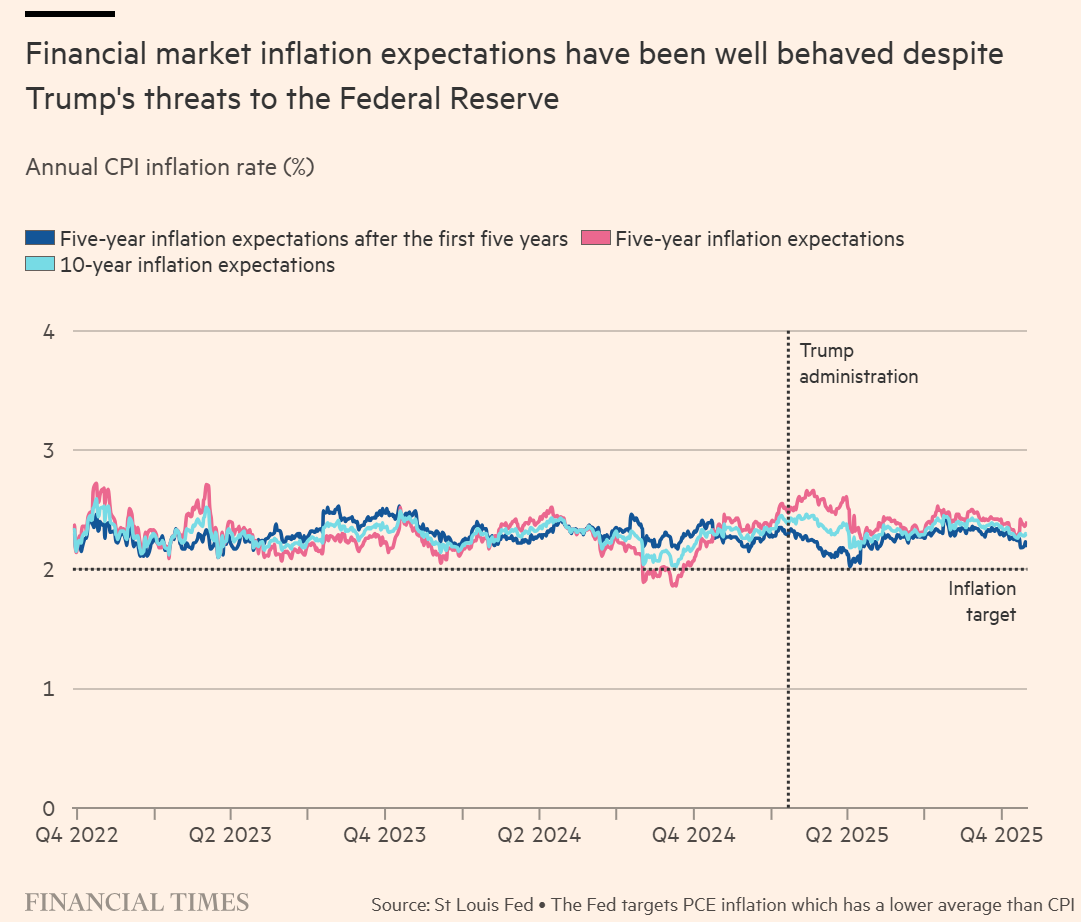
Core Viewpoint - The Federal Reserve is under significant pressure from President Trump, who has made threats against its leadership and called for interest rate cuts to alleviate government debt costs, raising concerns about the independence of the central bank [1][2]. Group 1: Economic Perspectives - Economists are divided on the issue of the Federal Reserve's independence, with some supporting the view that its past decisions indicate an overreach of independence that should be constrained [2]. - John Cochrane argues that if the Federal Reserve is to operate independently, it must have a more limited mission and a stronger accountability mechanism [2]. - In contrast, Larry Summers contends that complaints about the Federal Reserve's overreach are not among the top issues facing the U.S., suggesting that threats from the Trump administration could be more damaging [2]. Group 2: Market Reactions - Despite concerns from economists, financial markets have remained calm, with expectations for the federal funds rate showing a significant decline due to Trump's rhetoric during his first term [3][6]. - Research indicates that the market perceives Trump's threats as potentially leading to interest rate cuts by the Federal Reserve, although the long-term influence of presidential rhetoric is limited [3][6]. Group 3: Legal and Institutional Concerns - The U.S. Supreme Court has indicated that it will treat the Federal Reserve differently from other government agencies, which has provided some reassurance to markets and economists [7]. - However, legal experts express concern that the Court's reasoning lacks a solid foundation, suggesting that the Federal Reserve's security may not be as robust as previously thought [7]. Group 4: Public Perception - There is growing partisanship in public attitudes towards the Federal Reserve, with Trump's attacks undermining its legitimacy among Republicans [8]. - Scholars note that the legitimacy of the Federal Reserve, which is crucial for its acceptance in a democratic society, is increasingly being questioned due to these partisan divides [8].