
原油供应中断风险

Search documents
高盛:油价已经将伊朗供应中断计入预期,委内瑞拉增供预期扩散
Hua Er Jie Jian Wen· 2026-01-16 04:34
高盛称,全球原油市场"先把风险写进去了",已经将伊朗供应中断计入预期。 高盛指出,这相当于把"油价风险溢价"与"潜在供应缺口"的映射关系摆到台面上:当前涨幅对应的,并 非极端断供,而是一个被市场认为可能持续的中断量级。 期权市场:70美元区间的概率上调 期权市场的定价更加明确地反映了这种担忧。 1月16日,据追风交易台消息,高盛在最新研报中称,布伦特原油今年以来上涨近6美元/桶至66美元/桶 以上,在其定价框架下,这一涨幅相当于市场已将未来12个月持续70万桶/日的伊朗相关供应中断计入 价格。 研报还指出,期权市场数据进一步印证了这一风险溢价:布伦特原油3个月远期合约到期时触及70美元 区间的概率从两周前的不到7%大幅升至15%,高于80美元/桶的概率仍偏低,为5%。 高盛还特别指出,供给端的另一条线索是,委内瑞拉增供预期在发酵。同时,重质油相对轻质油的品质 价差扩大约2美元/桶,与其"年末委内瑞拉重油产量增加30万桶/日"的假设一致。 伊朗风险:现货价格已在"对照"70万桶/日的中断 报告指出,全球原油市场正在计入与伊朗相关的显著供应中断风险: 布伦特升至66美元/桶以上、年初至今上涨近6美元/桶,结合其定 ...

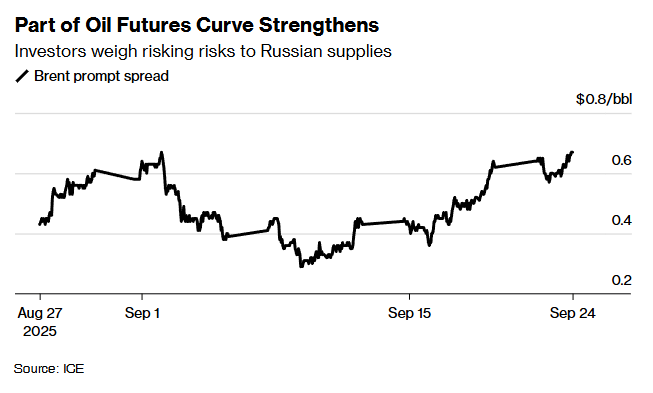
市场担忧俄罗斯原油供应中断风险 油价延续涨势
Zhi Tong Cai Jing· 2025-09-24 04:36
特朗普周二在纽约联合国大会的演讲中表示,中国和印度仍在持续购买俄罗斯原油,"但不可原谅的 是,即便是北约国家也并未大幅削减对俄罗斯能源和能源产品的采购"。与此同时,在乌克兰无人机对 包括管道设施在内的俄罗斯能源基础设施发动一连串袭击后,俄罗斯正考虑限制一些公司的柴油出口。 本月以来,原油价格整体变化不大,因交易员在看空的基本面前景与长期的地缘政治紧张之间权衡。在 供应方面,伊拉克正敲定协议,以恢复其库尔德斯坦地区原油出口,此前该地区出口已暂停两年。此举 可能将约23万桶/日的供应重新带回国际市场,加剧潜在供应过剩。在美国,一份行业报告显示,上周 原油库存下降380万桶,但馏分油库存增加。 随着美国总统特朗普加大了对俄罗斯的指责力度,交易员正密切关注这个OPEC+成员国可能出现的原 油供应中断,油价延续了过去一周以来的涨势。截至发稿,布伦特原油期货涨0.25%,报67.80美元/ 桶;WTI原油期货涨0.30%,报63.58美元/桶。 分析公司Xanalysts的创始人兼首席执行官Mukesh Sahdev表示,俄罗斯柴油出口的减少对原油构成"利 多",因为这可能意味着其他地区的炼油厂需要加大炼油力度来平衡市场 ...

大越期货原油早报-20250715
Da Yue Qi Huo· 2025-07-15 03:17
1. Report Industry Investment Rating - Not provided in the given content 2. Core View of the Report - The short - term oil price will fall and fluctuate, with the short - term operating range of SC2508 crude oil between 515 and 525, and long - term observation is recommended. The market's reaction to Trump's threat of imposing a 100% tariff on Russia was relatively calm as the 50 - day buffer period provided sufficient negotiation time. Meanwhile, the EU's warning of counter - measures in the trade dispute has increased concerns about the demand side of crude oil [3]. 3. Summary by Relevant Catalogs 3.1 Daily Prompt - **Fundamentals**: The EU accused the US of resisting a trade agreement, and Trump announced new weapons for Ukraine and threatened sanctions on Russia. Goldman Sachs raised its oil price forecast for the second half of 2025 due to supply interruption risks, falling OECD oil inventories, and Russian production cuts. Overall, it is neutral [3]. - **Basis**: On July 14, the spot price of Oman crude oil was $72.33 per barrel, and that of Qatar Marine crude oil was $72.01 per barrel, with a basis of 13.96 yuan per barrel, indicating that the spot price was higher than the futures price, which is bullish [3]. - **Inventory**: The API crude oil inventory in the US for the week ending July 4 increased by 7.128 million barrels (expected to decrease by 2.6 million barrels), the EIA inventory increased by 7.07 million barrels (expected to decrease by 2.071 million barrels), and the Cushing area inventory increased by 0.464 million barrels. As of July 14, the Shanghai crude oil futures inventory remained unchanged at 4.517 million barrels, which is bearish [3]. - **Disk**: The 20 - day moving average was flat, and the price was near the average, which is neutral [3]. - **Main Position**: As of July 8, the main position of WTI crude oil was long, with a decrease in long positions; the main position of Brent crude oil was long, with an increase in long positions, which is neutral [3]. 3.2 Recent News - The EU accused the US of resisting a trade agreement to avoid punitive tariffs threatened by Trump starting from August 1. Trump said he was open to further discussions, and EU officials will go to the US for negotiations. Trump threatened to impose a 100% tariff on Russia if a peace agreement is not reached within 50 days, and announced an agreement to transport weapons to Ukraine with NATO. The market reaction was calm [5]. 3.3 Long - Short Concerns - **Bullish factors**: The intensification of the Russia - Ukraine conflict [6]. - **Bearish factors**: OPEC+ has increased production for three consecutive months, the trade relationship between the US and other economies remains tense, and Iran and Israel have ceased fire [6]. - **Market driver**: Short - term geopolitical conflicts drive up the price, and mid - to long - term prices await the peak summer demand season [6]. 3.4 Fundamental Data - **Futures market**: The settlement price of Brent crude oil decreased from $68.80 to $68.30, a decrease of 0.73%; WTI crude oil decreased from $67.00 to $62.36, a decrease of 6.93%; SC crude oil increased from 503.7 to 506.4, an increase of 0.54%; Oman crude oil increased from $68.70 to $69.78, an increase of 1.57% [7]. - **Spot market**: The price of UK Brent Dtd decreased from $71.28 to $70.91, a decrease of 0.52%; WTI decreased from $67.00 to $66.50, a decrease of 0.75%; Oman crude oil in the Pacific Rim increased from $69.84 to $70.03, an increase of 0.27%; Shengli crude oil in the Pacific Rim increased from $66.72 to $67.07, an increase of 0.52%; Dubai crude oil in the Pacific Rim increased from $69.70 to $69.85, an increase of 0.22% [9]. 3.5 Position Data - **WTI crude oil**: As of July 8, the net long position decreased by 25,319 to 209,374 [16]. - **Brent crude oil**: As of July 8, the net long position increased by 55,630 to 222,347 [19].
【期货热点追踪】SC原油跌超8%,因供应中断的担忧缓解
Jin Shi Shu Ju· 2025-06-25 01:11
Group 1 - The core viewpoint of the articles indicates a significant decline in oil prices due to reduced geopolitical risks in the Middle East, particularly following a ceasefire announcement between Israel and Iran [1][2][4] - As of the latest reports, SC crude oil futures fell over 8%, with other oil products like fuel oil and LPG also experiencing notable declines [1] - The market is reacting to the potential for increased U.S. oil production as President Trump encourages the energy sector to ramp up drilling to stabilize prices [2][4] Group 2 - Analysts from various institutions express differing views on the future of oil prices, with some predicting a return to fundamental pricing if geopolitical tensions ease, while others foresee continued volatility due to ongoing conflicts [3][4] - The upcoming OPEC+ meeting on July 6 is expected to influence production decisions, with speculation that Saudi Arabia may continue to increase output amid market share competition [2][3] - The current geopolitical situation remains fluid, with analysts noting that any missteps could lead to renewed tensions and impact oil prices significantly [2][4]