
去风险政策

Search documents
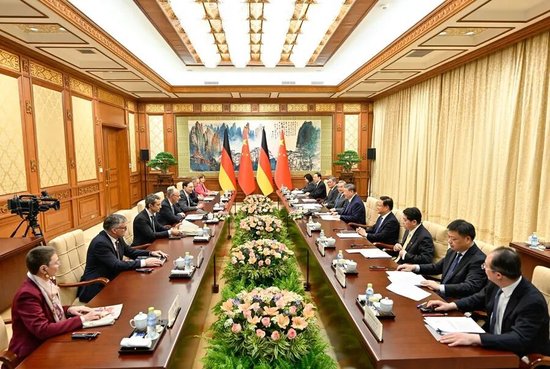
默茨此访有深意
Xin Lang Cai Jing· 2026-02-26 11:13
Core Insights - German Chancellor Merz's visit to China marks a significant diplomatic engagement, following visits from other European leaders, indicating a renewed interest in strengthening Sino-German relations [1][14] - The visit reflects a shift in Germany's approach towards China, moving away from labeling it as a "systemic rival" and instead seeking a balanced partnership [3][17] - Economic cooperation is prioritized, with Germany recognizing the need for reliable partners amid rising geopolitical tensions and trade challenges from the U.S. [4][18] Group 1: Diplomatic Context - Merz's visit is his first since taking office and comes after a postponed trip in October, highlighting internal policy disagreements within the German government regarding China [3][16] - The visit aims to recalibrate Germany's China policy, focusing on economic needs and stability in bilateral relations [4][18] - The geopolitical landscape, including U.S. tariffs on European allies, has prompted Germany to seek stronger economic ties with China [4][18] Group 2: Economic Cooperation - The visit included meetings with Chinese leaders and visits to German companies operating in China, emphasizing the importance of economic and technological collaboration [7][20] - A large business delegation accompanied Merz, indicating strong interest from German companies in deepening trade relations with China [7][21] - Current trade figures show that Sino-German trade exceeds $200 billion, with over 5000 German companies operating in China, underscoring the mutual benefits of cooperation [8][22] Group 3: Future Opportunities - The alignment of Germany's new development strategies in technology and innovation with China's 14th Five-Year Plan presents new avenues for collaboration [11][24] - Both countries are focusing on green and digital transformations, which could lead to complementary advantages in various sectors, particularly in electric vehicles [11][25] - Merz's visit aims to address trade imbalances and overcapacity issues, emphasizing the need for German companies to adapt and collaborate effectively with China [11][25] Group 4: Strategic Recommendations - Germany should maintain a consistent and stable policy towards China, based on comprehensive dialogue and understanding [12][26] - It is crucial to convert the agreements reached during high-level meetings into actionable policies and projects to reinforce bilateral trust [12][26] - Germany's approach to China should remain independent of external pressures, particularly from third countries, to foster a constructive relationship [12][26]

报告称“不确定性”成为当前在欧中企运营“最大梗阻” 中方回应
Zhong Guo Xin Wen Wang· 2025-11-14 08:17
Group 1 - The core viewpoint of the article highlights that "uncertainty" has become the biggest obstacle for Chinese enterprises operating in Europe, as reported by the EU Chamber of Commerce in China [1] - 81% of surveyed Chinese companies believe that the current business environment in Europe has increased uncertainty, while 90% feel that the EU's "de-risking" policies and economic security strategies are damaging business operations and market confidence [1] - Over 40% of Chinese enterprises reported experiencing differential treatment in Europe, indicating a trend of protectionism and discriminatory measures against Chinese businesses [1] Group 2 - The Chinese government emphasizes that Chinese enterprises have been actively contributing to the EU's economic growth and green transition, and it calls for dialogue and cooperation to address differences and promote fair competition [2] - The "14th Five-Year Plan" has been approved, outlining a blueprint for China's economic development over the next five years, which is expected to create more opportunities for China-EU cooperation [2] - The Chinese side urges the EU to adhere to its commitments to market openness and fair competition, and to create a predictable market environment for Chinese investments in Europe [2]
马社:不出海就出局”成时髦口号,但盲目出海恐陷入“一出海就出局”的困境
Feng Huang Wang Cai Jing· 2025-06-29 07:17
Core Viewpoint - The "2025 China Enterprises Going Global Summit" aims to provide a high-end platform for Chinese companies to address challenges and explore win-win transformation paths in the context of global industrial chain restructuring [1] Group 1: Challenges Faced by Chinese Enterprises Going Global - Domestic industry competition is intensifying, leading many companies to consider overseas investment as a necessity, encapsulated in the phrase "not going global means going out" [3] - Many enterprises lack sufficient knowledge about target countries, investment methods, and associated risks, which can lead to disastrous outcomes if they venture abroad unprepared [3][4] - The limited and fragmented information sources available to companies often mislead them, as they rely on informal networks for insights about foreign markets [4] Group 2: New and Traditional Risks - The current geopolitical landscape presents significant risks, including political risks from globalization protectionism and unilateralism, which disrupt international trade rules and structures [4][5] - Geopolitical conflicts, such as the Russia-Ukraine war and Middle East tensions, pose additional risks that could severely impact global economic activities [5] - The shift towards digital and green economies has led to increased trade protectionism, particularly against Chinese electric vehicles, complicating the investment landscape for Chinese firms [5] Group 3: Recommendations for Risk Management - Companies should maintain confidence in their internationalization efforts, as historical data shows that China's overseas investment has exceeded $2.9 trillion, with over $3 trillion in signed engineering contracts [6] - It is crucial for enterprises to enhance their international operational capabilities and risk management strategies, including thorough market research and compliance management [6] - Accelerating digital transformation is essential for building intelligent risk control systems, allowing companies to better manage uncertainties in overseas investments [6] - Comprehensive support services for Chinese enterprises, especially small and medium-sized ones, are urgently needed to facilitate healthy and orderly foreign investment [6]
