
可持续交通体系

Search documents
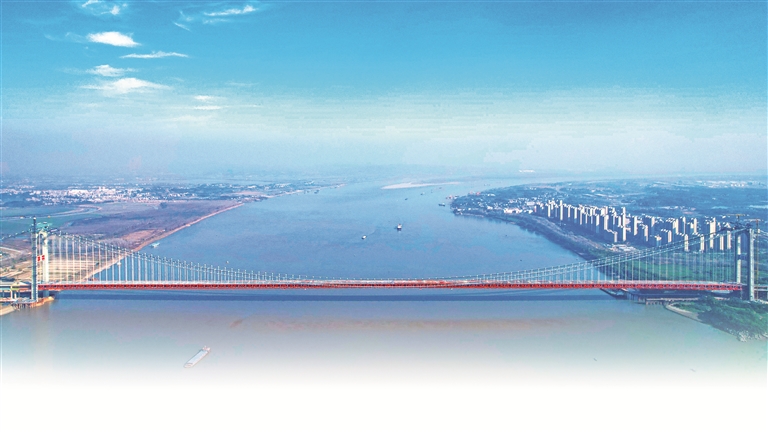
走近大国工程 | 飞虹跨江 天堑通途探访世界最大跨径四主缆悬索桥—燕矶长江大桥
Zhong Yang Ji Wei Guo Jia Jian Wei Wang Zhan· 2025-12-22 00:01
Core Viewpoint - The construction of the Yanqi Yangtze River Bridge represents a significant achievement in China's transportation infrastructure, emphasizing the importance of building a sustainable and efficient transportation system to support high-quality economic development [3][21]. Group 1: Project Overview - The Yanqi Yangtze River Bridge is the world's largest cable-stayed bridge with a main span of 1860 meters and is expected to be completed by 2026 [3][5]. - The bridge features a dual-layer design with the upper layer for a six-lane expressway and the lower layer for a four-lane urban expressway, enhancing regional traffic efficiency [3][21]. - The bridge will serve as a critical link between the cities of Ezhou and Huanggang, facilitating a logistics hub with the nearby Ezhou Huahu International Airport [3][6]. Group 2: Engineering Innovations - The bridge's design includes a unique "different curvature four main cable" structure, which optimizes load distribution and enhances structural safety [7][21]. - The main towers are notably lower than typical designs, with the north tower at 195 meters and the south tower at 184 meters, yet they support a significant main span [5][10]. - The construction team utilized advanced technologies, including intelligent monitoring systems and custom-built lifting equipment, achieving a remarkable installation speed of one beam per day [12][15][17]. Group 3: Construction Challenges - The project faced significant technical challenges due to the innovative design, requiring extensive data analysis and feasibility studies to ensure safety and efficiency [13][18]. - The construction team developed new methods to address the unique demands of the bridge's structure, including a custom ice-making machine to manage concrete temperatures during summer [18][21]. - The project has successfully transitioned to the construction of the bridge deck and auxiliary structures, with a focus on ensuring timely completion by 2026 [21][22].

威海东部“五位一体”海运大通道建设全面推进
Da Zhong Ri Bao· 2025-12-15 08:41
Core Viewpoint - The construction of the "Weihai Eastern 'Five-in-One' Maritime Corridor" aims to enhance maritime traffic safety, protect the marine environment, and boost the maritime comprehensive service industry in Weihai, with the project being included in the pilot projects for building a strong transportation country in Shandong Province [1][2]. Project Background - Weihai's eastern waters are a crucial maritime passage with over 120,000 commercial ship movements annually and a cargo volume exceeding 1 billion tons, serving as a key hub for the Bohai Economic Circle and supporting the coordinated development of the Beijing-Tianjin-Hebei region [2]. - The project aligns with President Xi Jinping's emphasis on building a sustainable transportation system, focusing on safety, convenience, efficiency, greenness, and economy [2]. Overall Goals - The project focuses on three main breakthroughs: ensuring safety, protecting the marine environment, and enhancing maritime comprehensive service levels [3]. Construction Content - The pilot project includes the establishment of three demonstration zones: a comprehensive governance demonstration zone for maritime safety, a green low-carbon "waste-free navigation zone," and a "maritime comprehensive service zone," encompassing ten key tasks [4]. Current Progress - A coordination mechanism has been established involving multiple government departments, with significant achievements in improving maritime safety regulations and enhancing the "co-governance" model for commercial and fishing vessels [5][6]. - The project has implemented measures to strengthen safety and service guarantees for Sino-Korean passenger and cargo routes, including streamlined customs processes and enhanced safety management [6][14]. Specific Measures - The Weihai Maritime Bureau has developed a "Safety Navigation Guide" for the Chengshan Cape waters, which serves as a comprehensive reference for maritime safety and regulatory compliance [11][12]. - The establishment of a maritime fuel supply base in Shidao aims to enhance the region's maritime service capabilities, with plans for infrastructure upgrades and expansion of fuel supply operations [13]. Future Outlook - The Weihai Eastern maritime corridor is expected to become a model for safe, green, and efficient maritime transport, contributing to the high-quality development of national maritime logistics [7][15].
奋力迈向交通强国(奋勇争先,决战决胜“十四五”)
Ren Min Ri Bao· 2025-07-27 22:02
Group 1 - The article highlights the rapid advancements in China's transportation system, showcasing innovations in high-speed rail, logistics, and infrastructure development [1][2] - In 2023, China completed the construction of 3,113 kilometers of new railway lines and increased highway mileage by 53,500 kilometers, enhancing service capabilities [1] - The transportation sector has seen a significant increase in efficiency, with over 1.8 billion people traveling across regions daily, indicating a surge in market vitality [1][2] Group 2 - China's transportation technology has evolved from quantitative accumulation to qualitative leaps, with major projects like the world's longest highway tunnel and the fastest high-speed train [2] - By the end of 2024, more than one-third of provinces will have high-speed rail access between cities, and over two-thirds will have expressway access between counties [2] - The logistics costs for the entire society are projected to decrease by approximately 400 billion yuan in 2024, with transportation costs accounting for about 280 billion yuan of that reduction [3] Group 3 - The article emphasizes the importance of international connectivity, with maritime routes reaching over 100 countries and regions, and the operation of the China-Europe Railway Express exceeding 110,000 trips [4] - The civil aviation sector has expanded its international routes to 83 countries and 213 cities, enhancing global trade and cooperation [4] - The Ministry of Transport aims to build a first-class transportation system to support national modernization and contribute to global supply chain stability [4]