
品牌复苏

Search documents
大和:升李宁(02331)目标价至27港元 维持首选股 重申“买入”评级
智通财经网· 2026-03-23 08:38
Core Viewpoint - Daiwa has raised its revenue forecast for Li Ning (02331) for the next two years by 4% to 7% due to strong brand momentum, but has extended the profit margin recovery timeline, resulting in a downward adjustment of core earnings per share by 3% to 5% [1] Group 1: Revenue and Profit Forecast - Revenue forecasts for Li Ning have been increased by 4% to 7% for the next two years, reflecting strong brand performance [1] - The target price has been raised from HKD 24 to HKD 27, based on a projected price-to-earnings ratio of 20 times for 2026, close to its five-year average [1] - The net profit margin guidance remains unchanged at a high single-digit percentage, which is considered reasonable as the priority should be to rebuild brand appeal [1] Group 2: Market Performance and Sentiment - Li Ning's performance in the second half of last year exceeded market expectations, leading to the largest single-day stock price increase in recent years [1] - The company’s cash net assets account for approximately 40% of its market value, indicating market perception of execution risk [1] - The management has indicated that retail sales in the first quarter of this year recorded a high single-digit percentage year-on-year growth, with the annual sales guidance raised to high single-digit growth, marking the strongest revenue expansion since 2022 [1] Group 3: Investment Recommendation - Daiwa maintains a "Buy" rating for Li Ning, considering the risk-reward profile attractive based on current trends [1] - The report suggests that the revenue growth story for Li Ning is confirmed in the short term, with most of the upside potential yet to be realized [1]

锅圈创始人杨明超,亲任河南宋河酒业董事长
Sou Hu Cai Jing· 2026-02-10 13:34
Core Viewpoint - The appointment of Yang Mingchao, founder of Guoquan, as the chairman of Songhe Liquor Industry marks the beginning of a new era for the company, indicating a significant leadership change and strategic direction under his management [1][4]. Group 1: Leadership Changes - Yang Mingchao has officially joined Songhe Liquor as chairman and director, indicating a shift in the company's governance [1]. - Several executives at Songhe Liquor are from Guoquan, including Wang Shuiyun, who became the legal representative and general manager of Songhe Liquor in October 2025, and Li Jinzhi, who is now the legal representative of Songhe Liquor's subsidiary [6]. Group 2: Corporate Structure and Ownership - Guoquan holds a controlling stake of 51.81% in Songhe Liquor, making it the parent company [5]. - A significant merger and restructuring process is underway, with Guoquan and Songhe Liquor expected to complete the transfer of operational management by November 2025 [4]. Group 3: Business Developments - Guoquan has announced a procurement plan for up to 200 million yuan in liquor products from Songhe, aimed at daily operations and customer sales [7]. - The launch of "Songhe Liquor Delivery" marks a new retail initiative, with the first store opening in Zhengzhou on January 17, 2026, and plans to establish over 2,000 stores by the end of that year [8].
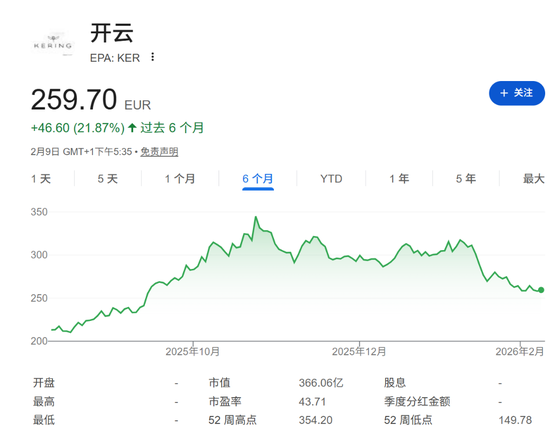
开云集团欧股狂飙14%,核心品牌Gucci销售超预期,公司寄望2026年实现复苏
Xin Lang Cai Jing· 2026-02-10 08:36
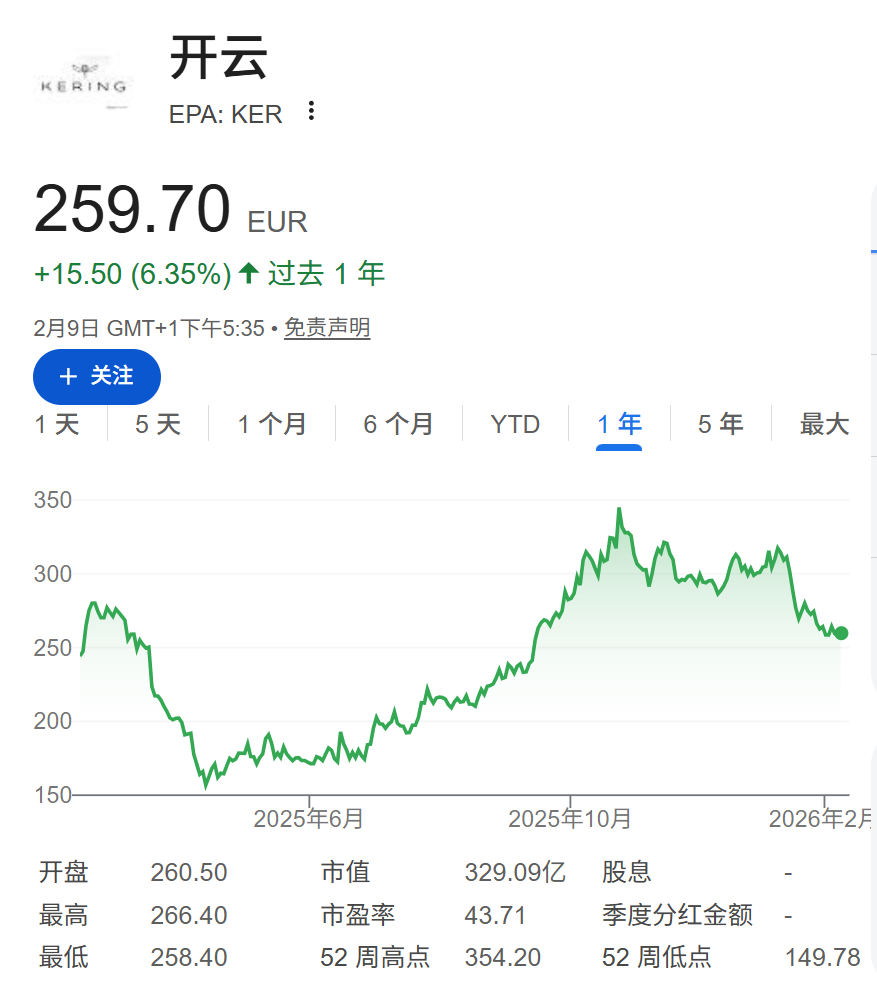
Core Viewpoint - Kering Group's fourth-quarter sales decline was less severe than market expectations, with new CEO Luca de Meo striving to stabilize the luxury giant facing scrutiny due to Gucci's ongoing poor performance [1][7] Sales Performance - Kering reported fourth-quarter sales of €3.9 billion, a year-on-year decline of 3% after currency adjustments, better than the anticipated 5% drop [1][7] - Gucci's sales fell by 10%, marking the tenth consecutive quarter of decline, yet this was an improvement over the expected 12% decrease [1][7] - The positive sales trend has led to a 14% increase in Kering's stock, the largest rise since 2020 [1][7] Challenges and Strategic Direction - Despite the better-than-expected performance, Kering faces significant challenges, including high debt and a substantial drop in profitability [1][5] - The company is undergoing a transformation under de Meo, who aims to restore profit margins and restructure the business [1][8] - Kering's operating free cash flow fell by 35% to €2.3 billion, indicating a notable decline in cash generation capability [4][11] Profitability Concerns - Kering's annual operating profit was €1.63 billion, less than one-third of the 2022 level, with the overall operating margin plummeting from 28% three years ago to 11% [5][13] - Gucci's profit margin dropped from 36% to 16%, highlighting the widening gap between Kering and competitors like LVMH, which maintained a 22% profit margin [5][13] Future Outlook - Kering's management remains cautiously optimistic about recovery, with 2025 seen as a foundational year, suggesting a potential turnaround by 2026 [6][14] - The market has regained some confidence since de Meo's appointment, with stock prices rebounding by approximately 50%, but investors await detailed revival plans [6][14]

营收降10%利润跌4成!Gucci深陷寒冬,开云集团寄望2026年翻身
Hua Er Jie Jian Wen· 2026-02-10 06:42
Core Viewpoint - Kering Group is facing its most severe profit crisis in a decade, with flagship brand Gucci experiencing ten consecutive quarters of revenue decline, and the group's annual operating profit plummeting by more than two-thirds compared to three years ago, resulting in a profit margin drop to 11% [1][6] Group 1: Financial Performance - Kering reported fourth-quarter sales of €3.9 billion, a year-on-year decline of 3% after currency adjustment, which was better than the analyst expectation of a 5% drop [1][4] - Gucci's revenue fell by 10%, slightly better than the market expectation of a 12% decline, marking the brand's tenth consecutive quarter of revenue decrease [1][4] - The group's annual operating profit was €1.63 billion, less than one-third of the 2022 level, with an overall operating profit margin dropping from 28% three years ago to 11% [6] Group 2: Brand Challenges - Gucci's troubles began in 2022 after the departure of former star designer Alessandro Michele, leading to a continuous decline in sales [5] - The brand's profit margin has decreased from 36% to 16%, highlighting the significant challenges Kering faces compared to competitors like LVMH, which achieved a 22% profit margin [6] Group 3: Strategic Outlook - Kering's management remains cautiously optimistic about future recovery, suggesting that 2025 will lay the groundwork for a turnaround, with a potential significant change expected by 2026 [7] - Since the appointment of CEO Luca de Meo in June last year, Kering's stock price has increased by approximately 50%, but investors are still awaiting detailed revival plans [7]
大和:李宁复苏势头正在推进 重申“买入”评级
Zhi Tong Cai Jing· 2026-01-16 07:19
Core Viewpoint - Daiwa's report indicates that Li Ning (02331) has shown better-than-expected operational data for the last quarter of the previous year, slightly exceeding revenue guidance, with a net profit margin expected to approach 10% [1] Group 1: Financial Performance - Li Ning's management suggested that revenue for 2025 may slightly exceed previous guidance of flat year-on-year growth, with a strong net profit margin projected in the high single digits, nearing 10% [1] - Daiwa believes that the recovery momentum for Li Ning is progressing, reaffirming its position as a preferred stock in the Chinese sportswear sector [1] Group 2: Market Outlook - The report anticipates a turnaround in Li Ning's performance this year, supported by increased brand popularity, new product launches, and store openings [1] - Based on a forecasted 18 times price-to-earnings ratio for 2026, Daiwa maintains a target price of HKD 24 and a "Buy" rating for Li Ning [1]
苹果CEO库克增持300万美元耐克股票,押注耐克复苏?
Nan Fang Du Shi Bao· 2025-12-25 06:19
Core Viewpoint - Nike reported a 1% year-over-year revenue growth to $12.43 billion for Q2 of FY2026, while net profit decreased by 32% to $792 million, exceeding market expectations [2] Financial Performance - Revenue for the Nike brand increased by 1% to $12.1 billion, with North America being a key support, showing a 9% growth to $5.633 billion [7] - The Greater China market faced challenges, with revenue declining by 17% to $1.423 billion, although inventory decreased significantly, providing room for new product launches [7] - Converse brand revenue fell by 30% to $300 million, with declines across all regional markets [7] - Direct-to-consumer sales revenue was $4.6 billion, down 8% year-over-year, while wholesale revenue was $7.5 billion, up 8% [7] Market Confidence - Nike's stock price surged by 4% to $59.6, with a market capitalization of approximately $88.1 billion, driven by confidence from Apple CEO Tim Cook's significant stock purchase [2][4] - Cook's investment of nearly $3 million in Nike stock is viewed as a public endorsement of the brand's resilience and long-term growth potential [5] Strategic Initiatives - Nike's CEO Elliott Hill stated that the company is in a "mid-stage recovery," focusing on the "Win Now" plan, which includes team restructuring, strengthening partnerships, and optimizing product offerings [9] - The company is prioritizing recovery in key markets, particularly China, and is taking decisive actions to accelerate development in lagging areas [9] - Recent marketing efforts during the Asian Games, including collaborations with local athletes, have resonated well with audiences, showcasing the brand's cultural integration [9] Historical Context - The previous quarter's results showed a 1% revenue increase to $11.7 billion, with net profit down 31% to $700 million, indicating a turnaround from a 12% revenue decline in the fourth quarter of FY2025 [11]


瑞银:上调裕元集团(00551)目标价至18.4港元 料第四季销售均价可提升
智通财经网· 2025-12-01 07:36
Core Viewpoint - UBS reports that Yue Yuen Industrial Holdings Limited (00551) management indicated an improvement in the profit margin of its OEM business in Q3 compared to H1, attributed to reduced overtime, increased worker familiarity with orders, and stabilization of U.S. tariff policies [1] Group 1 - The management expects some orders to be advanced to Q4 production [1] - UBS forecasts a year-on-year decline in Yue Yuen's Q4 sales volume, but an increase in average selling price [1] - Looking ahead to next year, UBS anticipates a potential recovery for certain brands, which could positively impact Yue Yuen's sales [1] Group 2 - Strong holiday sales performance could enhance brand confidence, benefiting Yue Yuen's sales and attracting new brand clients [1] - UBS raised the target price for Yue Yuen from HKD 18 to HKD 18.4, maintaining a "Buy" rating [1]
纺织服装行业2025年三季报总结:品牌复苏方向明确,制造端关注订单修复
Shenwan Hongyuan Securities· 2025-11-17 07:15
Investment Rating - The report maintains a positive outlook on the textile and apparel industry, indicating a "Buy" rating for the sector in 2025 [2][5]. Core Insights - The report highlights a clear recovery direction for brands, with a focus on order restoration in the manufacturing sector. The domestic demand is showing a steady recovery, while external demand is under short-term pressure due to export declines [4][5]. - The retail performance of brands has been improving since the third quarter, with monthly growth rates gradually increasing from a low of 1.8% in July to 6.3% in October. The fourth quarter is expected to continue this trend due to seasonal demand and consumption promotion policies [5][13]. Summary by Sections 1. Industry Overview - Domestic demand is on a steady recovery path, with retail sales in the textile and apparel sector growing by 3.5% year-on-year to 1205.3 billion yuan from January to October 2025. The overall retail sales for the same period increased by 4.3% to 41.2 trillion yuan [4][13]. - Export pressures are evident, with textile and apparel exports in October 2025 amounting to $22.26 billion, a year-on-year decline of 12.6% [4][16]. 2. Hong Kong Sports Sector - The sports sector experienced a slight weakening in sales in Q3 2025, with brands like Anta and FILA showing low single-digit growth. However, other brands saw growth rates between 45-50% [4][24]. - Li Ning's overall sales decreased in Q3, while its youth brand maintained double-digit growth. Xtep showed stable performance with low single-digit growth in its main brand [4][24]. 3. Textile Manufacturing - The manufacturing sector faced disruptions due to tariffs in Q3 2025, with companies like Huayi and Yueyuan reporting revenue declines of 0.3% and 6.1%, respectively. However, a gradual recovery is expected as tariff impacts stabilize [4][29]. - The upstream textile sector showed steady growth, with companies like Weixing and Xin'ao reporting revenue increases of 1% year-on-year [4][29]. 4. Men's and Women's Apparel - Men's apparel showed stable revenue growth, but increased marketing and channel expansion costs pressured profits. Women's apparel is showing signs of recovery, with brands like Ge Li Si experiencing significant profit improvements [4][22]. - The report notes that women's apparel companies generally saw single-digit revenue declines, but the rate of decline has narrowed compared to 2024 [4][22]. 5. Children's Apparel - Children's apparel brands reported steady revenue growth, but increased expenses led to weaker profit performance. Companies like Semir and Jiama reported revenue growth of 5% and 3%, respectively, but faced significant profit declines [4][22]. 6. Home Textiles - The home textile sector showed varied performance, with brands like Luolai and Shuixing exceeding expectations due to successful product launches. Luolai's revenue grew by 6% year-on-year, while Shuixing's grew by 11% [4][22]. 7. Investment Analysis - The report suggests that improving domestic demand is a key investment theme for 2025, with a focus on high-quality domestic brands and recovery opportunities in the textile manufacturing sector. Recommended stocks include sports brands like Bosideng, Anta, and Li Ning, as well as home textile companies like Luolai and Shuixing [4][5].
Think It's Too Late to Buy Nike? Here's the Biggest Reason Why There's Still Time
The Motley Fool· 2025-09-05 07:45
Core Insights - Nike has faced significant challenges in recent years but is showing signs of recovery and potential growth [1][6] - The company has made strategic changes in leadership and is focusing on innovation and brand rebuilding [4][10] Financial Performance - For the fiscal year, Nike's revenue decreased by 10% to $46.3 billion, and net income fell by 44% to $3.2 billion [8] - In the fourth quarter, revenue dropped 12% to $11.1 billion, with net income down 86% to $211 million [8] - The company anticipates a mid-single-digit revenue decline for the first quarter, with additional cost pressures from tariffs estimated at $1 billion [9] Competitive Advantages - Nike maintains a strong roster of high-profile sponsors and is recognized as the most valuable brand in sportswear [10][11] - The brand's legacy products, such as the Air Force 1 and Air Jordan, continue to have significant consumer appeal [11][12] Growth Potential - If Nike can return to its previous profit levels, it has the potential to recover its stock price, which is currently over 50% lower than its peak in 2021 [6][14] - The footwear and apparel market has grown since 2021, providing a favorable environment for Nike's recovery [13][14]

“织”道系列7:运动制造6月跟踪:运动鞋服订单增速分化,景气弱化趋势放缓
Changjiang Securities· 2025-08-12 23:30
Investment Rating - The industry investment rating is "Positive" and maintained [7] Core Insights - The report indicates that the order growth for footwear and apparel manufacturing has been recovering since Q3 2023 due to the end of inventory destocking by overseas brands. However, it is expected that order growth will begin to slow down on a month-on-month basis in 2025 due to weak terminal retail performance [2][4][32] - The current situation shows a divergence in order growth for sports shoes and apparel, with a slowdown in the weakening trend of the industry. The recovery of Nike is crucial, as its operational recovery could lead to an overall industry rebound and improve order intake for manufacturers [2][4][32] Summary by Sections Manufacturing Orders - In June, the order growth for sports shoes and apparel showed divergence, with specific companies reporting varied performance. For instance, Yu Yuan Group's manufacturing revenue increased by 9.4% year-on-year, while Feng Tai's revenue decreased by 3.1% year-on-year. Overall, the order growth has been maintaining recovery since Q3 2023, but is expected to slow down in 2025 due to weak terminal retail [5][29][32] Market Strategy - The textile manufacturing sector is expected to return to fundamental investment logic as tariffs on Southeast Asia have largely been resolved. The report suggests focusing on quality manufacturers like Crystal International and Huali Group, as well as brands with high earnings elasticity post-tariff adjustments [6][33] - In the A-share market, brands are anticipated to shift to a destocking cycle in Q3, increasing the probability of industry improvement. Recommended stocks include Hailan Home and Robam Life, which are expected to benefit from this transition [6][34] Export Trends - In June 2025, China's apparel exports grew by 0.8% year-on-year, while Vietnam's apparel exports increased by 16.0%. However, footwear exports from China and Vietnam showed a decline of 4.0% and 3.3% year-on-year, respectively, indicating a mixed performance in the export market [26][28]