品牌策略调整

Search documents
耐克在华失速 高层坦言需调整策略
Zhong Guo Jing Ying Bao· 2025-12-28 04:57
Core Viewpoint - Nike is facing significant challenges in the Greater China market, necessitating a strategic overhaul to enhance brand differentiation and adapt to local consumer insights [1][3]. Financial Performance - For Q2 of FY2026 (September-November 2025), Nike reported total revenue of $12.427 billion, a year-on-year increase of approximately 1%, while net profit fell to $0.792 billion, a decline of 32% [1]. - Revenue from the Greater China region was $1.423 billion, down about 17% year-on-year, with direct sales (Nike Direct) declining by 18% and digital sales (Nike Digital) dropping by 36% [1]. - Earnings before interest and taxes (EBIT) in the Greater China region halved, decreasing by 49% [1]. Challenges Faced - Nike's management highlighted several ongoing challenges in the Greater China market, including decreased foot traffic, lower sell-through rates, and aging channel inventory [2]. - The brand's frequent discounting in digital channels has weakened its market influence, leading to increased discount rates, higher return rates, and rising costs associated with inventory clearance [2]. - In the fiscal quarter ending August 31, 2025, revenue in the Greater China region also declined to $1.512 billion, a 10% year-on-year drop [2]. Strategic Adjustments - Nike is implementing various measures in the Chinese market, including store upgrades, a focus on sports, reduced promotions, self-service inventory clearance, and adjusted purchasing plans [2]. - Total inventory has decreased by double digits compared to the previous year, with a 20% reduction in inventory items [2]. - Despite a 35% year-on-year drop in sales during the "Double 11" shopping festival, management indicated this was in line with their expectations [2]. Organizational Changes - Nike is undergoing a structural transformation, eliminating the positions of Chief Technology Officer and Chief Commercial Officer, while creating a new Chief Operating Officer role [3]. - The new COO will oversee end-to-end operations, including the technology department, and regional leaders will report directly to the CEO [3]. - The company is reducing manpower in stores and enhancing the management of product displays and retail presentation [3]. Competitive Landscape - The decline in Nike's performance in China is attributed to increasing competition, with local brands capturing approximately 60% of the market share among the top 20 brands [5]. - The 2025 version of a report by McKinsey and WFSGI indicates that traditional sports brands have lost 3% of market share from 2019 to 2024, while challenger brands are rising through targeted cultural marketing and omnichannel strategies [5]. - Local brands like Anta and Li Ning are gaining traction by investing in R&D and aligning closely with Chinese cultural symbols, creating a new consumer paradigm that emphasizes quality, cultural recognition, and price advantages [6]. Market Dynamics - The rise of domestic sports brands and the outdoor market is exerting pressure on Nike's market position [6]. - Local brands are perceived to better understand consumer psychology, focusing on product performance, unique design, and alignment with consumer values [6]. - Nike's recent product strategy has been criticized for being rigid, with a tendency towards luxury pricing, which contrasts with the more competitively priced offerings from local brands [6].

华熙生物回应旗下德玛润品牌关闭线上渠道
Xin Lang Cai Jing· 2025-11-20 03:37
Core Viewpoint - Huaxi Biological's Demarun brand has been reported to close its Tmall flagship store and other online channels, which is part of the company's strategy to focus on its core business and major brand layout to enhance overall operational efficiency and resource allocation [1] Group 1 - The adjustment of Demarun's online channels is aimed at improving operational efficiency and resource allocation [1] - Future planning for the Demarun brand will be coordinated based on market and business development conditions [1] - The company emphasizes that all business operations are normal and that brand strategy adjustments are aimed at long-term healthy development [1]

莱珀妮前三季度销售额有机下滑7.2%,母公司下调全年业绩指引
Xin Jing Bao· 2025-11-13 04:09
Core Insights - The high-end skincare brand La Prairie continues to face declining sales in the first three quarters of the year, with a reported organic decline of 7.2% to €348 million [2][3] - Beiersdorf's overall sales for the first three quarters reached approximately €7.5 billion, with an organic growth of 2%, a slowdown compared to the previous year's 6.5% [1][2] - The CEO of Beiersdorf, Vincent Warnery, indicated that the consumer goods segment is expected to achieve an organic growth of about 2.5% for the full year [1][6] Sales Performance - Beiersdorf's consumer goods segment generated sales of €6.3 billion in the first three quarters, with an organic growth of 2% [1] - The NIVEA brand, as a core brand, experienced only 0.6% organic growth in the first three quarters, with a decline of 0.4% in the third quarter [2] - La Prairie's sales have been under pressure, with a significant decline in the first quarter of 17.5% due to challenges in the travel retail sector [3] Brand Performance - The Derma brand, which includes Eucerin, showed strong performance with an organic growth of 12.3% to €1.145 billion in the first three quarters [2][3] - The medical health brands, including Hansaplast and Elastoplast, achieved an organic growth of 8.8%, driven primarily by wound care products [3] - NIVEA is undergoing strategic adjustments in the Chinese market, shifting from mass-market to high-end skincare, which has started to yield positive results [5] Market Dynamics - Beiersdorf's consumer goods business saw organic growth across major markets, with Europe being the largest market, growing by 1.2% to €2.809 billion [4] - The Americas market recorded sales of approximately €1.693 billion, with an organic growth of 2.2% [4] - The Asia/Africa/Australia market had the highest growth rate, with an organic increase of 2.9% to €1.749 billion [4] Future Outlook - Beiersdorf has adjusted its full-year sales growth forecast for the consumer goods segment to approximately 2.5%, down from the previous expectation of 3%-4% [6] - The company anticipates a slight increase in the EBIT margin for ongoing operations, expected to be slightly above the previous year's level of 13.9% [6]


“一觉醒来涨5000元”!有人在门店排队3小时,网友:赚到了
Sou Hu Cai Jing· 2025-08-27 14:42
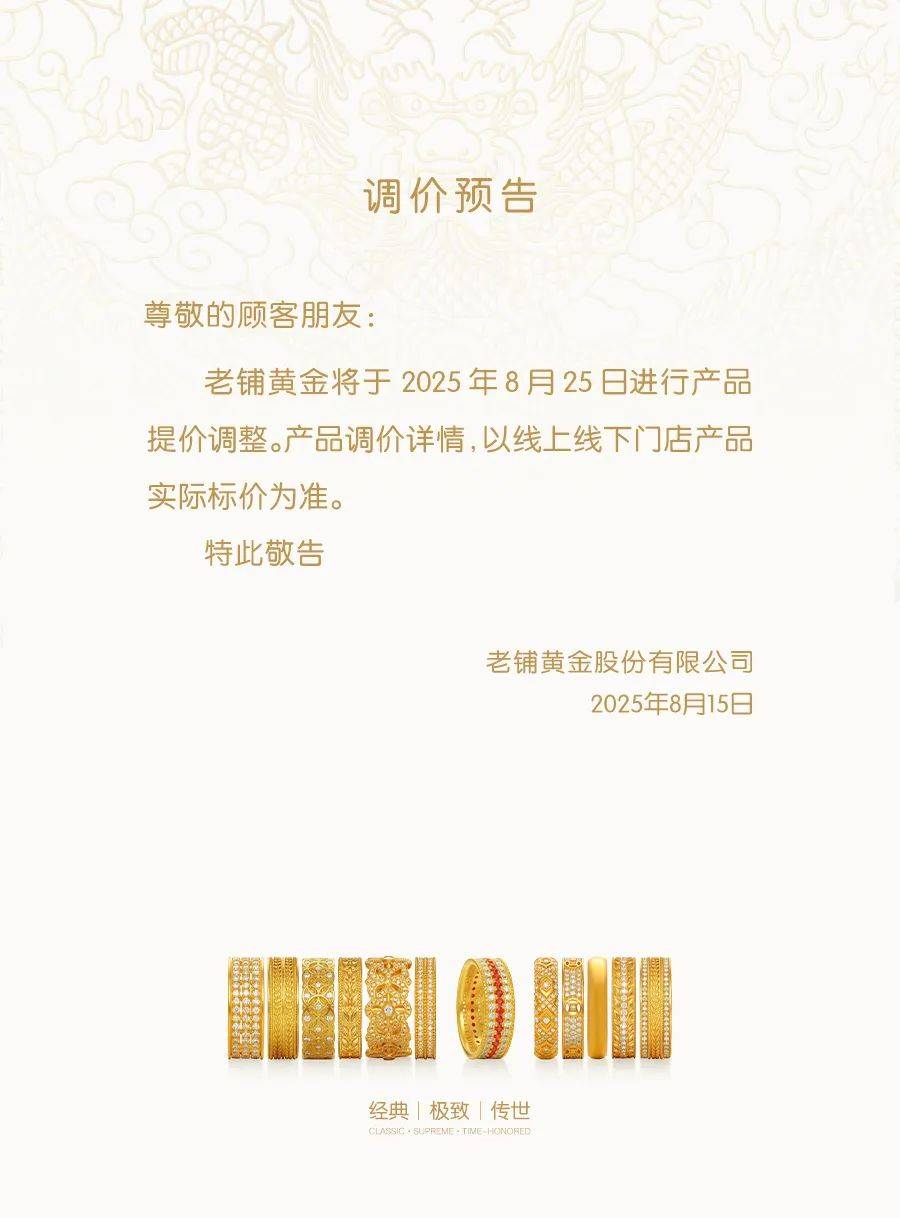
Core Viewpoint - The price of Lao Pu Gold has increased significantly, with most products in their JD and Tmall flagship stores seeing a price rise of approximately 1,000 to 3,000 yuan, reflecting an increase of 5% to 13% [2][32]. Group 1: Price Adjustment Details - On August 25, Lao Pu Gold implemented a price adjustment, with a prior announcement made on August 15 [4][32]. - The price increase led to a surge in customer traffic, with reports of long queues at various stores, including a wait time of up to two hours in Beijing [5][8][13]. - Customers expressed satisfaction with their purchases made just before the price hike, with some claiming to have saved over 5,000 yuan [24]. Group 2: Market and Brand Strategy - The price adjustment is attributed to fluctuations in gold prices, with the World Gold Council reporting a nearly 26% increase in gold prices in the first half of 2025 [34]. - Lao Pu Gold's pricing strategy aligns with high-end consumer goods, involving regular price adjustments and a focus on high-quality, personalized service for high-net-worth clients [35]. - The brand is enhancing its luxury image by offering exclusive services and high-priced products in upscale shopping venues, similar to established luxury jewelry brands [35].
塌房!Prada,又摊上事了!
21世纪经济报道· 2025-03-14 03:34
Core Viewpoint - Prada is facing a significant brand crisis due to the controversy surrounding its global ambassador, Kim Soo-hyun, which has led to a rapid decline in its stock price and raised concerns about its endorsement strategy [2][4][6]. Group 1: Brand Crisis and Stock Impact - Kim Soo-hyun's involvement in a scandal has resulted in Prada terminating its contract with him to mitigate brand damage [2][5]. - Following the scandal, Prada's stock price dropped over 11% within five trading days, indicating heightened sensitivity to celebrity endorsements [4][6]. - The brand has experienced a series of endorsement crises, leading to a perception of a "endorsement curse" that affects its reputation and financial performance [3][5]. Group 2: Endorsement Strategy and Market Position - Analysts suggest that Prada's reliance on high-profile celebrities for endorsements has made its stock price more volatile compared to competitors, necessitating a shift towards a more stable endorsement strategy [7]. - The luxury market is increasingly favoring ambassadors who align with brand values rather than just popularity, as indicated by consumer preferences [7]. - Despite attempts to diversify its ambassador roster, including signing athletes and artists, Prada's financial performance has not shown significant improvement [8][10]. Group 3: Financial Performance and Growth Challenges - Prada's retail sales growth has stagnated, with a reported increase of only 4% in 2024, returning to pre-pandemic growth rates [8]. - The brand's struggles are compounded by a lack of product innovation and operational efficiency, which have hindered its ability to attract younger consumers [9]. - The CEO highlighted challenges in the Chinese market, where growth has been inconsistent, emphasizing the need for a strategic overhaul in product offerings [9][10]. Group 4: Future Outlook and Strategic Adjustments - Prada is seeking to adjust its brand strategy by enhancing cultural activities and reinforcing its brand identity, moving away from reliance on individual designer influence [10]. - The company must focus on reconnecting with its core brand values to navigate the current crisis and improve its market position [10].