商业航天成本重构

Search documents
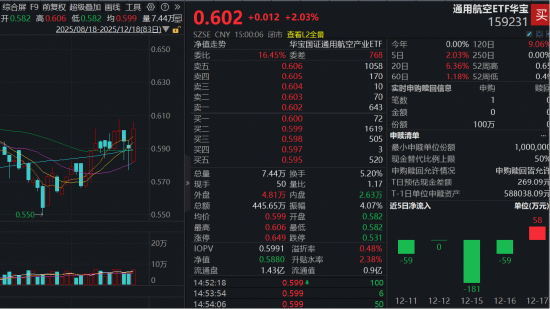
商业航天、卫星互联网强势领涨!重仓航空航天的通用航空ETF(159231)大涨超2%
Xin Lang Cai Jing· 2025-12-18 11:49
Core Viewpoint - The A-share market shows a divergence with the Shanghai Composite Index slightly rising while the ChiNext Index declines, driven by strong performances in the aerospace and satellite internet sectors, particularly through the General Aviation ETF Huabao (159231) which rose by 2.03% [1][8]. Group 1: Market Performance - The General Aviation ETF Huabao (159231) has shown a strong technical pattern, breaking above all moving averages and forming a "one bullish engulfing candle covering two bearish candles" pattern, indicating a potential key phase in its upward movement [1]. - Among the 50 constituent stocks, 70% experienced gains, with Tianyin Electromechanical hitting a 20% limit up at one point and closing up by 16.53%, while Aerospace Huanyu and Zhongke Xingtong rose by over 14% and 10% respectively [3][9]. Group 2: Commercial Aerospace Insights - A report from Huaxi Securities indicates a significant cost restructuring in the global commercial aerospace launch sector, where traditional rockets have hardware manufacturing costs constituting about 67%, while emerging commercial rockets reduce this to around 24% through reusable designs, creating a sustainable model [4][9]. - Companies like SpaceX have established a continuous optimization model characterized by increased reuse, higher launch frequency, and reduced unit costs, while Chinese commercial aerospace firms are making rapid technological advancements and cost reductions [4][9]. Group 3: Satellite Industry Developments - According to a report from Kaiyuan Securities, low Earth orbit satellite constellations are becoming a new battleground for major powers, with the satellite industry market space targeting trillions, as the competition for frequency resources accelerates the transition from the "investment incubation period" to the "profit realization period" [5][10]. - The satellite manufacturing and launch segments of the supply chain are expected to benefit first from this peak in network formation, indicating a favorable environment for investment in the satellite industry [5][10]. Group 4: General Aviation ETF Overview - The General Aviation ETF Huabao (159231) and its linked funds comprehensively cover 50 constituent stocks across various sectors, including low-altitude economy, large aircraft, military aircraft, commercial aerospace, satellite navigation, and drones, with the aerospace sector accounting for over 37% of the index [6][11]. - The ETF is positioned as a strategic tool for investing in the Chinese aerospace industry chain, focusing on technological barriers and core commercial aspects, benefiting from both domestic demand and military trade [6][11].





华西证券:商业航天向复用成本模式转型 国产企业呈系统化追赶态势
智通财经网· 2025-12-18 07:24
Group 1 - The core viewpoint is that the commercial aerospace industry is transitioning from a one-time manufacturing model to a reusable cost model, with Chinese companies making significant technological breakthroughs and cost reductions [1] - The global commercial aerospace launch sector is undergoing a profound cost restructuring, with traditional rockets relying on one-time hardware manufacturing accounting for approximately 67% of costs, while emerging commercial rockets reduce hardware costs to about 24% through reusable designs [1] - The cost breakdown of rockets shows that boosters account for 60% of total costs, second stages for 20%, fairings for 10%, and launch operations for 10%, indicating a trend towards cost optimization in both domestic and international commercial aerospace companies [1] Group 2 - Launch service providers directly benefit from cash income generated by single launch fees and high-frequency tasks, with increased launch frequency and larger contract amounts leading to greater profit elasticity in the launch segment [2] - The demand for launch services and complete rocket delivery is directly correlated with the number of launch tasks, benefiting from the overall increase in launch demand [2] - The global and Chinese aerospace launch markets are exhibiting a monopolistic characteristic, with launch service providers exerting control over upstream supply chain production layouts due to their established order dominance [3]

华西证券:全球商业航天价值重构 从一次性制造到可复用模式的转型
Zhi Tong Cai Jing· 2025-12-18 02:49
Group 1 - The commercial aerospace sector is undergoing a transformation from one-time manufacturing to a reusable cost model, with companies like SpaceX leading the way in reducing unit costs through increased reuse and launch frequency [1][2] - Traditional rockets primarily rely on one-time hardware manufacturing, which accounts for approximately 67% of costs, while emerging commercial rockets have reduced hardware cost share to around 24% through reusable designs [2] - The cost structure of rockets includes boosters at 60%, second stages at 20%, fairings at 10%, and launch operations at 10%, indicating a significant shift towards optimizing costs in the industry [2] Group 2 - The increase in launch frequency and larger contract sizes directly benefits launch service providers and complete rocket manufacturers, leading to significant cash flow from single launch fees and high-frequency tasks [3] - The demand for launch services is expected to grow, with revenue directly correlating to the number of launch missions, benefiting from the overall increase in launch volume [3] - High-value components like boosters and fairings require higher reliability and maintenance, driving indirect demand for related parts and repair services [3] Group 3 - The launch market for 2024-2025 is expected to exhibit an absolute oligopoly, with dominant players gaining control over the supply chain through order monopolization [4] - Downstream giants possess pricing power, potentially forcing upstream companies to adapt their production strategies to align with the supply chain restructuring initiated by these major players [4] - Investment recommendations include companies involved in rocket manufacturing and space computing, such as航天动力, 超捷股份, and 顺灏股份, among others [4]
运力之争,全球商业航天价值重构
HUAXI Securities· 2025-12-17 12:39
Investment Rating - The report provides a "Buy" rating for the industry, predicting that the stock price will outperform the Shanghai Composite Index by 15% or more within six months [56]. Core Insights - The global commercial space launch sector is undergoing a profound cost restructuring, shifting from a one-time manufacturing model to a reusable cost model. Traditional rockets have a hardware manufacturing cost share of about 67%, while emerging commercial rockets reduce this to around 24% through reusable designs [3][27]. - The launch market from 2024 to 2025 is expected to exhibit an absolute oligopoly, with launch service providers monopolizing orders and exerting control over the supply chain [5][42]. Summary by Sections 1. Cost Structure of Commercial Rockets - The cost breakdown of rockets shows that the first stage accounts for 60-70% of total costs, with engines being the most significant component, comprising over 50% of the first stage cost [13][27]. - The Falcon 9 rocket's cost structure indicates that the marginal cost of reuse is significantly lower than that of traditional rockets, with costs dropping to approximately $2,720 per kilogram in reusable mode [27][28]. 2. Industry Chain Benefits from Launch Volume - Launch service providers benefit directly from increased launch frequency and larger contracts, with revenue correlating to the number of launch tasks [4][35]. - The demand for reusable components and high-frequency replacement parts is expected to grow, driven by the need for higher reliability and maintenance of reusable systems [36]. 3. Investment Recommendations - Beneficiary stocks include companies involved in rocket manufacturing and space computing, such as Aerospace Power, Superjet, and West Materials, among others [6][52][53].