商品大牛市

Search documents
商品距离“大牛市”,还差一场经济衰退?
Hua Er Jie Jian Wen· 2026-01-30 10:08
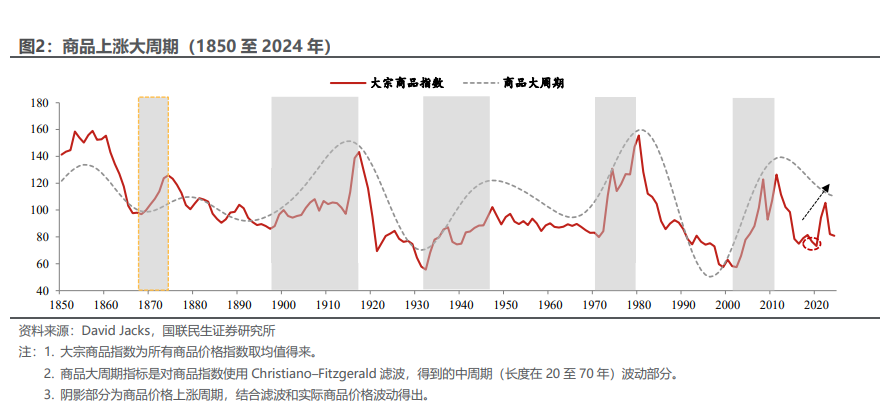
Core Viewpoint - The recent surge in prices of commodities like copper, gold, and silver has reignited market speculation about a "super cycle" in commodities, but the current cycle may not have completed necessary steps for a true bull market [1][19]. Group 1: Historical Context of Commodity Bull Markets - Historically, true commodity bull markets often begin not in prosperity but from economic lows, culminating during periods of economic overheating or recession [1][5]. - A review of commodity price trends since 1850 identified five typical commodity bull cycles, which average about 11.8 years in duration, with real commodity prices rising approximately 79% after adjusting for inflation [2][6]. - Key historical starting points for these cycles include 1897, 1932, 1971, 2002, and 2020, each corresponding to significant economic downturns [7][8]. Group 2: Current Market Dynamics - The current commodity price increase appears to be more of a "precious metals market" rather than a comprehensive commodity bull market driven by real demand [9][10]. - The breadth of commodity price increases has been insufficient compared to previous bull markets, with precious metals outperforming while energy, agricultural products, and some industrial metals lag behind [13][19]. Group 3: Structural Factors Influencing Commodity Prices - Three long-term variables are identified as critical for determining commodity pricing: war, technological revolutions, and emerging demand [10][16]. - Wars do not universally boost commodity prices; they can suppress demand and prices unless they lead to significant destruction of demand [11][12]. - Technological revolutions typically coincide with commodity bull markets, but the current technological advancements, particularly in AI, are still in early stages and have not yet led to a significant demand surge [16][17]. - Emerging demand from new buyers has historically been a prerequisite for commodity bull markets, but there is currently no equivalent to the demand surge seen with China's entry into the WTO [17][18]. Group 4: Conclusion and Future Outlook - The current commodity cycle likely began in 2020, supported by a long-term depreciation of the dollar, but lacks critical elements such as concentrated geopolitical conflicts, clear emerging demand, and a genuine economic recession to validate the cycle [19][20]. - A recession may serve as a crucial test for the current commodity price trends, determining whether they can transition from a structural rally to a full bull market [20].

LSEG跟“宗” | 相对白银铂金现在是历史性最低水平 提防加息周期重启时间表
Refinitiv路孚特· 2025-12-24 06:02
Core Viewpoint - The article discusses the recent trends in the precious metals market, particularly focusing on the shifts in fund positions as reported by the CFTC, highlighting the recovery of net long positions in palladium and the significant rise in silver prices, while also addressing the implications of potential interest rate changes by the Federal Reserve [2][27]. Group 1: Fund Positions and Market Trends - As of December 9, 2023, funds have increased their net long positions in various metals, with palladium finally recovering to a net long position after 164 weeks of being net short [2][7]. - Silver prices have surged by 132% this year, while the gold-silver ratio has dropped from 90.84 to 64.6, indicating a strong demand for physical silver [2][27]. - The net long position in silver has only increased by 66% year-to-date, suggesting that the rise in price is primarily driven by physical demand rather than speculative trading [2][27]. Group 2: Price Comparisons and Historical Context - Platinum has also seen a significant increase of 120% this year, but its valuation relative to silver is at a historical low, with one ounce of platinum currently able to exchange for only 29 ounces of silver [2][27]. - The article notes that historically, one ounce of platinum could be exchanged for over 60 ounces of silver, indicating that platinum is currently undervalued compared to silver [2][27]. Group 3: Federal Reserve and Economic Implications - The market is beginning to speculate on the possibility of the Federal Reserve starting to raise interest rates in 2027, despite current low probabilities [2][27]. - The article emphasizes the importance of monitoring the Federal Reserve's actions, particularly regarding interest rate changes, as they could significantly impact the ongoing commodity bull market [2][27]. - The likelihood of a rate cut in March 2024 has increased to 47%, and the probability for April has risen to 64.6%, indicating a shift in market expectations [26][27].