
商品ETF

Search documents
基金双周报:ETF市场跟踪报告-20260323
Ping An Securities· 2026-03-23 07:26
1. Report Industry Investment Rating No information about the industry investment rating is provided in the content. 2. Core Viewpoints of the Report - The performance of ETF products in the past two weeks was poor. Among domestic major broad - based ETFs, CSI A50 had the smallest decline, and among industry and theme products, new energy theme ETFs had the largest increase [2][9]. - In the past two weeks, among domestic major broad - based ETFs, the net inflow of funds into Science and Technology Innovation 50, SSE 50, CSI 500, and SSE - SZSE 300 ETFs ranked among the top [2][9]. - The net outflow of funds from major broad - based ETFs in the past two weeks slowed down. The funds of SSE - SZSE 300, SSE 50, and CSI 500 ETFs turned into net inflow, the net outflow of funds from CSI 1000/CSI 2000 and Science and Technology Innovation/ChiNext ETFs slowed down, and the net outflow of funds from A - series ETFs accelerated [10]. - In 2025, the technology theme ETF had a large cumulative net inflow of funds. Since this year, the technology and cyclical theme ETFs have had a large net inflow of funds. In the past two weeks, the inflow of funds into pharmaceutical, military, and new energy ETFs slowed down, the funds of dividend, consumption, and other large - manufacturing ETFs turned into net inflow, and the funds of cyclical, financial real - estate, and technology ETFs turned into net outflow [15]. - Since 2025, the credit bond ETF has had a large net inflow of funds, followed by the treasury bond ETF. In the past two weeks, the short - term financing ETF's funds turned into net inflow, the local government bond ETF's funds accelerated net inflow, the convertible bond ETF's funds turned into net outflow, the credit bond and treasury bond ETF's funds accelerated outflow, and the net outflow of funds from the policy - financial bond ETF slowed down [15]. - The daily average trading volume of pharmaceutical and new energy ETFs increased significantly in the past two weeks, the daily average trading volume of consumption and financial real - estate ETFs increased, and the daily average trading volume of other large - manufacturing, military, technology, and cyclical ETFs decreased [18]. - As of March 20, 20 new ETFs were newly established in the market in the past two weeks, with a total issuance share of 6715 million, all of which were stock ETFs. Compared with the end of 2025, the scale of commodity ETFs, industry + dividend ETFs, and QDII - ETFs increased by 32.78%, 13.10%, and 2.11% respectively, while the scale of bond ETFs and broad - based ETFs decreased by 12.51% and 43.21% respectively [22]. - As of March 20, Huaxia Fund had the largest on - exchange ETF scale, reaching 70.3557 billion yuan; the ETF management scale of Guotai Fund has expanded by more than 2.7 billion yuan since the beginning of this year [23]. 3. Summary According to the Directory 3.1 ETF Market Review - **Performance and Fund Flow**: As of March 20, the performance of ETF products in the past two weeks was poor. Among domestic major broad - based ETFs, CSI A50 had the smallest decline, and among industry and theme products, new energy theme ETFs had the largest increase. In the past two weeks, among domestic major broad - based ETFs, the net inflow of funds into Science and Technology Innovation 50, SSE 50, CSI 500, and SSE - SZSE 300 ETFs ranked among the top. The inflow of funds into pharmaceutical, military, and new energy ETFs slowed down, the funds of dividend, consumption, and other large - manufacturing ETFs turned into net inflow, the funds of cyclical, financial real - estate, and technology ETFs turned into net outflow. For bond ETFs, the short - term financing ETF's funds turned into net inflow, the local government bond ETF's funds accelerated net inflow, the convertible bond ETF's funds turned into net outflow, the credit bond and treasury bond ETF's funds accelerated outflow, and the net outflow of funds from the policy - financial bond ETF slowed down [2][9][15]. - **Product Structure Distribution**: As of March 20, 20 new ETFs were newly established in the market in the past two weeks, with a total issuance share of 6715 million, all of which were stock ETFs. Compared with the end of 2025, the scale of commodity ETFs, industry + dividend ETFs, and QDII - ETFs increased by 32.78%, 13.10%, and 2.11% respectively, while the scale of bond ETFs and broad - based ETFs decreased by 12.51% and 43.21% respectively [22]. - **Fund Manager Scale Distribution**: As of March 20, Huaxia Fund had the largest on - exchange ETF scale, reaching 70.3557 billion yuan; the ETF management scale of Guotai Fund has expanded by more than 2.7 billion yuan since the beginning of this year [23]. 3.2 Classification - based ETF Tracking - **Technology Theme ETF**: Products tracking the Hang Seng Technology Index had the highest net inflow of funds in the past two weeks, while products tracking the Hong Kong Stock Connect Internet Index had a net outflow of funds [29]. - **Dividend Theme ETF**: Products tracking the Dividend Low - Volatility Index had the highest net inflow of funds in the past two weeks, while products tracking the Guoxin Hong Kong Stock Connect Central Enterprise Dividend Index had a net outflow of funds [31]. - **Consumption Theme ETF**: Products tracking the S&P 500 Consumer Select Index had a relatively high premium rate; ETFs tracking the CSI Agriculture Index had the highest net inflow of funds in the past two weeks, while products tracking the CSI 800 Consumption Index had a net outflow of funds [34]. - **Pharmaceutical Theme ETF**: ETFs tracking the CSI Medical Index had the highest net inflow of funds in the past two weeks, while products tracking the medical device index had a net outflow of funds [36]. - **Large - Manufacturing Theme ETF**: Products tracking the power index had the highest net inflow of funds in the past two weeks, while products tracking the CS Battery Index had a net outflow of funds [39]. - **QDII ETF**: Products tracking the Hang Seng Technology Index had the highest net inflow of funds in the past two weeks, while ETF products tracking the Hang Seng China Enterprises Index had a net outflow of funds [42]. 3.3 Popular Theme ETF Tracking - **AI Theme ETF**: The average return of AI theme products in the past two weeks was - 2.89%, and the funds had a net outflow of 4.218 billion yuan. The products with a relatively high proportion of AI - themed stocks were those tracking the Hong Kong Stock Connect Internet, Hang Seng Internet Technology, CS Artificial Intelligence, etc. [48][53]. - **Robot Theme ETF**: The average return of robot theme products in the past two weeks was - 6.81%, and the funds had a net outflow of 488 million yuan. The products with a relatively high proportion of robot - themed stocks were those tracking the robot and robot industry [55][56]. - **New Energy Theme ETF**: The average return of new energy theme products in the past two weeks was 3.27%, and the funds had a net inflow of 1.126 billion yuan. The products with a relatively high proportion of new - energy - themed stocks were those tracking new energy batteries, CS batteries, etc. [58][59]. - **Satellite and Commercial Space Theme ETF**: The average return of satellite and commercial space theme products in the past two weeks was - 9.35%, and the funds had a net outflow of 661 million yuan. The products tracking satellite communication, satellite industry, and Guozheng Aerospace had such characteristics [60][64]. - **Commodity ETF**: The average return of commodity ETFs in the past two weeks was - 0.89%, and the funds had a net inflow of 6.011 billion yuan. Products tracking gold, non - ferrous metal futures, etc. were included. Since the beginning of this year, gold ETFs have had a large net inflow of funds, with a large net outflow on February 3 [65][70]. - **Central Huijin, Guoxin, and Chengtong Holdings ETF**: As of the middle of 2025, the scale of ETFs held by Central Huijin, Guoxin, and Chengtong was 39.1336 billion shares in total; in the past two weeks, the funds had a net outflow of 2.3474 billion yuan [73].
昨日股票ETF资金净流出近300亿元
Zhong Guo Ji Jin Bao· 2026-01-30 05:50
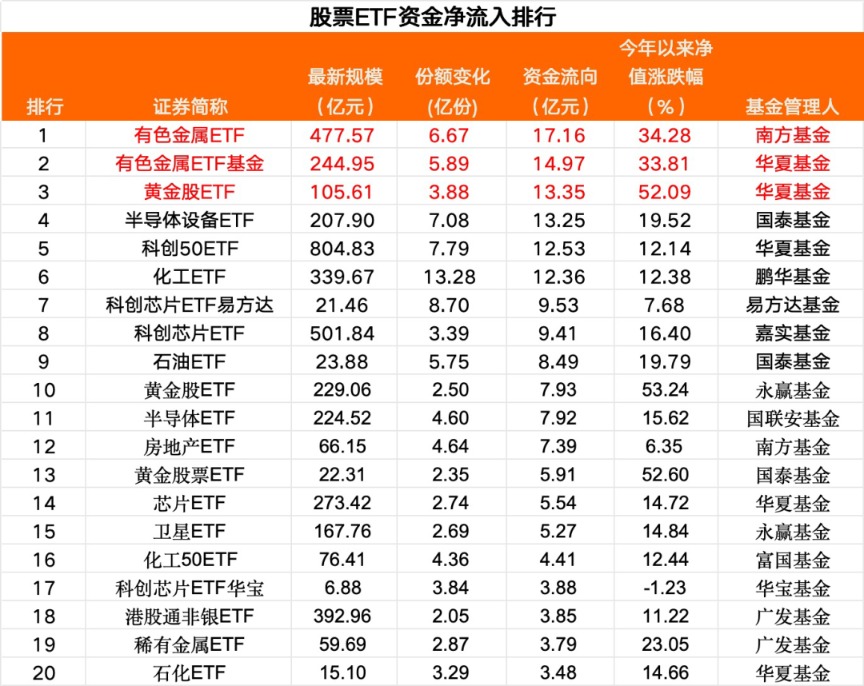
Core Viewpoint - The A-share market experienced fluctuations on January 29, with mixed performance across the three major indices and a total market turnover of 3.26 trillion yuan, indicating some capital withdrawal from the market [1] Group 1: ETF Fund Flows - The total net outflow from stock ETFs (including cross-border ETFs) was approximately 298.64 billion yuan on January 29, with significant outflows from broad-based ETFs [2][5] - Six ETFs had a net outflow exceeding 50 billion yuan, with one ETF alone seeing a net outflow of over 100 billion yuan [1][3] - Since the beginning of 2026, stock ETFs have faced cumulative net outflows exceeding 750 billion yuan due to severe "blood loss" in broad-based ETFs [1] Group 2: Sector Performance - Despite the overall net outflow, 61 stock ETFs recorded net inflows exceeding 1 billion yuan, with the gold and non-ferrous metal sectors leading the inflows [2] - The industry-themed ETFs and commodity ETFs saw net inflows of 221.41 billion yuan and 53.9 billion yuan, respectively, while broad-based ETFs had a net outflow of 520.18 billion yuan [2] - Specific ETFs such as the SGE Gold 9999 index saw a net inflow of 40.52 billion yuan, while the CSI 300 index ETF had the highest net outflow at 316.28 billion yuan [2] Group 3: Fund Management Insights - Leading fund companies like E Fund and Huaxia Fund have seen significant inflows in their ETF products, with E Fund's Sci-Tech Chip ETF and Gold ETF recording net inflows of 9.36 billion yuan and 3.55 billion yuan, respectively [5] - Huaxia Fund's non-ferrous metal ETF and gold stock ETF also saw substantial inflows of 14.97 billion yuan and 13.35 billion yuan [5] Group 4: Market Outlook - Analysts expect the A-share and Hong Kong markets to maintain high trading activity levels, driven by a stable macroeconomic policy and positive expectations for economic indicators [6] - Despite uncertainties in global geopolitical dynamics and domestic economic challenges, the valuation levels of A-share and Hong Kong equity assets remain attractive compared to major global indices [6]

这一方向,大举加仓!
Zhong Guo Ji Jin Bao· 2026-01-07 05:39
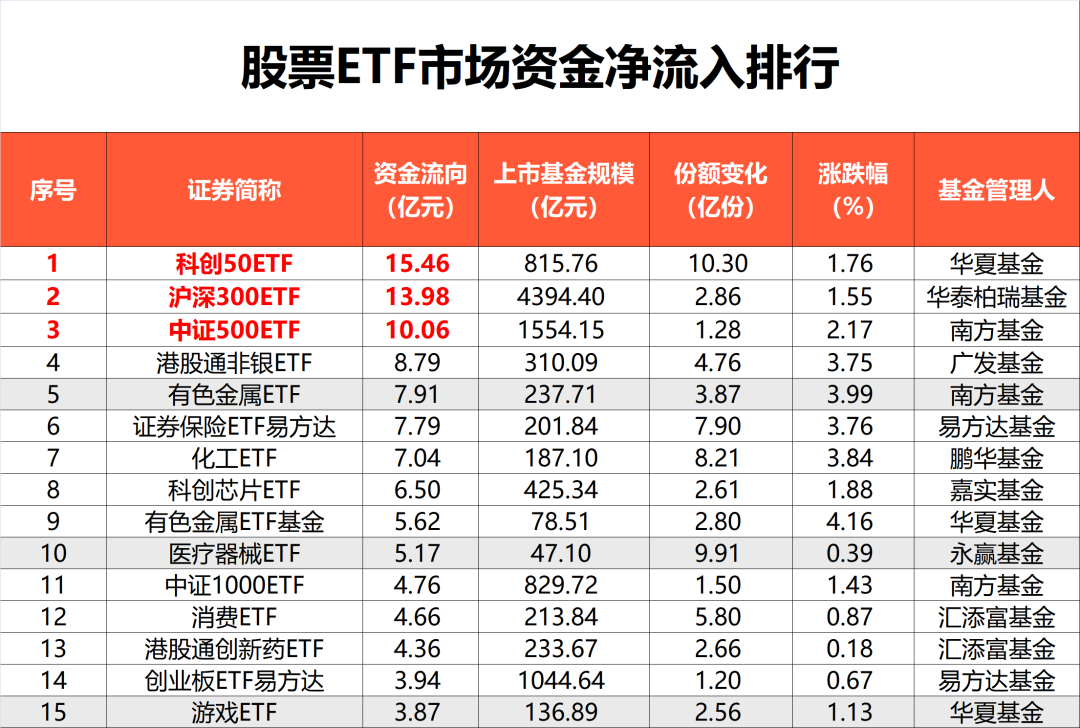
Core Viewpoint - The stock ETF market experienced a net inflow of nearly 4.2 billion yuan, driven by broad-based ETFs as the market surged, with significant interest in sectors like brain-computer interfaces, finance, and commercial aerospace [1][2]. Group 1: Market Performance - On January 6, the Shanghai Composite Index achieved a record 13 consecutive days of gains, marking the longest streak in history [1]. - The stock ETF market saw a net inflow of 4.176 billion yuan, with broad-based ETFs and commodity ETFs leading the inflows at 3.863 billion yuan and 2.912 billion yuan, respectively [2]. Group 2: ETF Inflows - The top-performing ETFs included the Sci-Tech 50 ETF with a net inflow of over 1.546 billion yuan, followed by the CSI 300 ETF and the CSI 500 ETF, each with inflows exceeding 1 billion yuan [4]. - Major fund companies like E Fund and Huaxia Fund reported significant inflows into their ETFs, with E Fund's total ETF scale reaching 880.19 billion yuan after an increase of 16.63 billion yuan [5]. Group 3: ETF Outflows - Certain ETFs, particularly in the securities sector, experienced notable outflows, with the Securities ETF and Broker ETF seeing net outflows of over 1.765 billion yuan and 1.370 billion yuan, respectively [6][9]. - The ChiNext 50 ETF also faced a net outflow of over 922 million yuan, indicating a shift in investor sentiment despite the overall market rally [7]. Group 4: Market Outlook - Analysts from Bosera Fund suggest that the A-share market may experience a "spring awakening" due to improved US-China relations and supportive growth policies, with a focus on technology growth sectors [10]. - Huazhong Fund anticipates a strong performance for the A-share market in 2025, driven by liquidity and thematic rotations, while emphasizing the importance of policy-driven growth and recovery in earnings [10].
11.18犀牛财经早报:A股公司年末忙着资产出售 报道称瑞银总部考虑迁往美国
Xi Niu Cai Jing· 2025-11-18 01:32
Group 1: Commodity ETFs Growth - The total scale of commodity ETFs in the market has increased by over 200% this year, reaching a total of 229.99 billion yuan with a net inflow of 102.02 billion yuan as of November 14 [1] - The primary driver of this growth is the performance of gold ETFs, with leading products like Huaan Gold ETF growing from 1.2 billion yuan at inception to 87.38 billion yuan, a more than 70-fold increase [1] - The rise in commodity prices has created a profit-making effect that attracts capital into commodity ETFs, which offer a low-threshold and transparent investment tool for ordinary investors [1] Group 2: Asset Sales by A-Share Companies - Nearly 250 A-share companies have announced asset sales since October, reflecting a significant increase compared to previous years [1] - Companies are selling assets to focus on core businesses, accelerate capital recovery, or improve annual performance due to unsatisfactory results in the first three quarters [1] - The urgency of asset sales is influenced by new delisting regulations that pressure companies to meet financial data standards, although there are uncertainties in completing these sales by year-end [1] Group 3: Lithium Battery Industry and Energy Storage - The energy storage market has surged since Q3, driving rapid demand for lithium battery materials, with prices for lithium hexafluorophosphate, lithium iron phosphate, and lithium carbonate significantly increasing [2] - Phosphate lithium batteries dominate the new energy storage sector, accounting for over 97% of installed capacity [2] - The energy storage boom is seen as a new growth driver for lithium demand, indicating that this trend may just be beginning [2] Group 4: Major Contracts and Stock Price Catalysts - Nearly 70 A-share companies have signed significant contracts or strategic cooperation agreements since October, which are viewed positively by the market and tend to boost stock prices [3] - The mechanical equipment and power equipment sectors have the highest number of companies involved in these contracts, with notable projects like a 6.16 billion yuan contract for a large-scale energy storage project [3] Group 5: Hong Kong-listed Automakers' Q3 Reports - Xpeng Motors, Leap Motor, and Geely Auto reported their Q3 results, with Xpeng's losses narrowing significantly, Leap continuing to be profitable, and Geely's profits increasing substantially [4] - The automotive industry is expected to face a critical phase next year, with companies needing strong profitability to survive [4] - All three companies expressed optimism about the market outlook and plans to accelerate overseas expansion despite the upcoming reduction in new energy vehicle purchase tax incentives [4]
四大证券报精华摘要:11月18日
Xin Hua Cai Jing· 2025-11-17 23:59
Group 1: Automotive Industry Performance - Several Hong Kong-listed automotive companies, including XPeng Motors, Leap Motor, and Geely, reported their Q3 earnings, indicating a positive outlook for the market in 2025 [1] - XPeng Motors significantly reduced its losses, Leap Motor continued to be profitable, and Geely's profits saw a substantial increase [1] - Geely's CEO emphasized that the automotive industry is entering a critical phase where strong profitability will be essential for survival [1] - All three companies expressed confidence in their ability to handle the impact of the reduction in new energy vehicle purchase tax incentives and plan to accelerate their overseas market expansion [1] Group 2: Insurance Asset Allocation Trends - As of Q3 2025, insurance funds continued to grow, with an increase in equity asset holdings while the proportion of fixed-income assets decreased [2] - The total stock investment balance for life and property insurance companies reached 3.62 trillion yuan, showing both scale and proportion growth compared to Q2 [2] - The bond allocation ratio for life insurance companies decreased quarter-on-quarter, along with a decline in bank deposit allocations [2] Group 3: Tax Revenue and Market Activity - From January to October 2025, the national general public budget revenue was 18.65 trillion yuan, a year-on-year increase of 0.8% [3] - The stamp duty revenue reached 3.781 billion yuan, with securities transaction stamp duty contributing 1.629 billion yuan, reflecting an 88.1% year-on-year growth [3] Group 4: Market Liquidity and Central Bank Actions - Recent factors such as tax payments and the maturity of interbank certificates have led to a temporary tightening of liquidity in the interbank market [4] - The weighted average price of DR001 rose by 13.9 basis points to 1.5119%, while DR007 increased by 5.63 basis points to 1.5236% [4] - The central bank has responded by increasing liquidity through reverse repos, showing signs of stabilization in the funding environment [4] Group 5: Asset Management and AI Sector Debate - Major asset management firms have shown divergent strategies regarding investments in AI leader Nvidia, indicating a heated debate over the AI sector's future [5] - Some institutions argue that overseas AI stocks are overvalued and present risks, while others believe that the sector has not yet reached a typical bubble state [5] Group 6: Energy Storage and Lithium Battery Industry - The energy storage market's growth has significantly boosted the demand for lithium battery materials, with prices for key materials like lithium hexafluorophosphate and lithium carbonate rising sharply [6] - Phosphate lithium batteries dominate the new energy storage market, accounting for over 97% of installed capacity [6] - Industry insiders suggest that energy storage is becoming a new growth driver for lithium demand, indicating that this trend may just be beginning [6] Group 7: Corporate Contracts and Market Reactions - Nearly 70 A-share listed companies have signed significant contracts or strategic cooperation agreements since October, which are viewed positively by the market [7][8] - The companies involved span 18 industries, with machinery, power equipment, and construction decoration leading in the number of contracts signed [8] Group 8: Overseas Institutional Research Trends - In November, 509 overseas institutions conducted research on 109 listed companies, with a focus on the electronics and machinery sectors [9] - The electronics sector had 22 companies researched, while the machinery sector had 15, followed by power equipment, pharmaceuticals, and computing industries [9] Group 9: Semiconductor Industry Consolidation - The electronic components distribution sector has seen increased merger and acquisition activity, indicating a trend towards consolidation in the semiconductor industry [10] - Recent acquisitions by companies like Yichuang Electronics and Ying Tang Zhikong highlight the growth momentum and integration trends within the global electronic supply chain [10] Group 10: Growth of Commodity ETFs - The total scale of commodity ETFs has seen explosive growth this year, with net inflows of 1020.23 billion yuan, bringing the total scale to 2299.87 billion yuan, a 203.92% increase from the beginning of the year [11] Group 11: New Index Launches - The China Securities Index Company has launched two new indices aimed at reflecting the performance of major Asian markets, enhancing the diversity of investment options [12] - A total of 713 new indices have been released this year, marking a 16.50% increase compared to the previous year [12] Group 12: Mergers and Acquisitions in A-shares - The A-share market has seen a rise in merger and acquisition activities, with 4044 deals reported this year, a 4.01% increase year-on-year [12] - Major asset restructurings have also increased by 44.12%, indicating a shift from quantity to quality in the M&A landscape [12]