国家创新驱动发展战略

Search documents
资本市场铺就科创企业“晋级”阶梯
Zheng Quan Ri Bao· 2026-01-28 16:22
Group 1 - The core viewpoint of the article highlights the successful "upgrading" of 33 companies from the 2024 Cheetah Enterprises list, with 9 going public, 2 becoming unicorns, 19 entering the gazelle category, and 3 being acquired, showcasing the effectiveness of the capital market's "growth ladder" in supporting the transition from startup to maturity [1] - The A-share market has shown positive trends, driven by strong support from the technology growth sector, leading to an influx of hard technology companies attracting significant capital attention [1][2] - The three exit strategies—successful IPOs, upgrades to unicorn or gazelle status, and acquisitions—reflect different developmental needs and strategic choices of companies, indicating a multi-tiered capital market that meets the critical demands of tech innovation enterprises at various stages [1] Group 2 - The capital market has been guiding private equity funds to invest early, in smaller amounts, for the long term, and in hard technology, providing essential initial funding for early-stage tech companies and solidifying the foundation for unicorn cultivation [2] - The "upgrading" of Cheetah Enterprises reflects a closed loop of capital circulation in tech innovation, where smooth exit channels like IPOs and acquisitions provide key pathways for private equity funds and investors to realize value and returns [2] - Recent measures to optimize the exit environment for private equity funds, such as pilot programs for fund share transfers and adjustments to lock-up periods, aim to enhance long-term investment orientation and improve exit efficiency, thereby establishing a solid institutional foundation for a virtuous cycle of tech investment [2] Group 3 - The concentration of upgraded Cheetah Enterprises in sectors like biotechnology and artificial intelligence indicates that market funds are accurately flowing into key core technology areas prioritized by the state [3] - The collective "upgrading" of Cheetah Enterprises demonstrates the strong support of the capital market for technological innovation and highlights the increasingly clear and effective pathways for capital markets to serve the development of new productive forces [3] - The article asserts that the logic of investing in early-stage tech innovation in the Chinese capital market is valid, with clear profit logic and smooth exit pathways encouraging more social capital to become active participants in tech innovation investments [3]
中国硬科技资产何以“走红”A股市场
Zheng Quan Ri Bao· 2025-12-18 15:43
Core Viewpoint - The surge in hard technology assets on the A-share market reflects a growing market consensus on China's independent innovation capabilities and long-term growth value, driven by national strategic directions and policy guidance [1][2]. Group 1: Market Trends - Muxi Co., Ltd. officially listed on the Sci-Tech Innovation Board on December 17, with a first-day increase of 693%, indicating high market enthusiasm [1]. - Other semiconductor companies, such as Moer Thread, also experienced significant first-day gains, exceeding 400% [1]. - A number of hard technology companies from strategic emerging industries have entered the A-share market this year, with many seeing their stock prices multiply on the first day [1]. Group 2: Driving Forces - The rise of hard technology assets aligns with national strategic directions and policy guidance, emphasizing the importance of core technology innovation for ensuring national industrial chain security [2]. - The Chinese government has set clear goals for technological self-reliance and innovation, focusing on new-generation information technology, new energy, and new materials during the 14th Five-Year Plan [2]. - The capital market ecosystem is maturing, with institutional investors increasing their long-term market participation, enhancing the ability to discover and price quality technology assets [3]. Group 3: Valuation Logic - The valuation logic for technology assets is undergoing structural changes, with a shift from past profitability to future technological influence, reflecting a forward-looking approach by capital [4]. - This revaluation is not detached from the fundamentals of companies but aims to optimize the allocation of innovative resources within the capital market [4]. - The ongoing comprehensive reforms in the capital market are expected to further guide funds towards hard technology companies with core technologies and independent innovation capabilities [4].
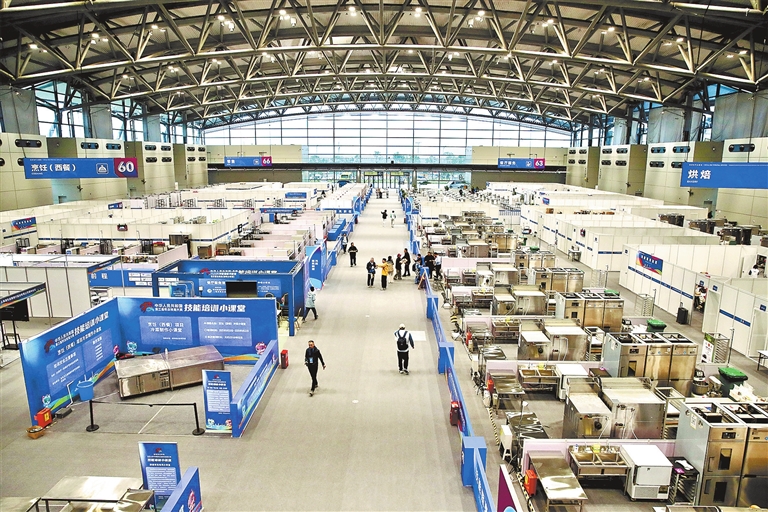
第三届全国技能大赛今日在郑开幕 技能英才 中原竞技
He Nan Ri Bao· 2025-09-18 23:37
Core Points - The third National Skills Competition is being held in Zhengzhou, featuring 3,420 participants from 35 delegations across the country, marking it as the largest and most comprehensive national vocational skills event in China [2][3] Group 1: Event Overview - The competition is organized by the Ministry of Human Resources and Social Security and hosted by the Henan Provincial Government, with support from various local and industry bodies [2] - The event includes 106 competition projects, with over 50% focusing on intelligent manufacturing, high-end equipment, digital technology, and new energy, aligning with national innovation strategies [3] Group 2: Participation and Demographics - A total of 3,420 competitors and 3,275 judges are participating, showcasing a diverse range of skills from both young talents and experienced professionals [5] - The average age of participants is 24, with 77% under 30 years old, indicating a strong presence of younger competitors [5] - High-education participants include 13 PhDs, 286 Master's, and 843 Bachelor's degree holders, making up 33% of all competitors, particularly in advanced technology fields [5] Group 3: Competition Structure and Activities - The competition adopts a "competition-exhibition-performance" model over five days, featuring 106 projects across 28 exhibition halls [6] - Special activities include a national achievements exhibition, skills training experiences, and a forum aimed at enhancing skill awareness among the public, especially youth [6]

科创债为科创企业发展再添新动力
Zheng Quan Ri Bao· 2025-09-01 02:33
Core Viewpoint - The introduction of the "Science and Technology Innovation Bonds" (referred to as "Sci-Tech Bonds") is a significant initiative by the exchange bond market to support the national innovation-driven development strategy and industrial transformation [1][2] Group 1: Importance of Sci-Tech Bonds - The establishment of a market mechanism for Sci-Tech Bonds is crucial for promoting a high-level circulation of "technology-industry-finance" and better serving the national innovation-driven development strategy [1] - The number of technology innovation enterprises in China is increasing, playing a vital role in the transition from old to new growth drivers, thus providing strong support for high-quality economic development [1] Group 2: Challenges Faced by Enterprises - Despite the growth of technology innovation enterprises, they still face funding shortages during their development or transformation processes [1] - The timely introduction of Sci-Tech Bonds has alleviated the funding challenges faced by these enterprises, acting as a beneficial support mechanism [1] Group 3: Flexibility and Efficiency of Fund Utilization - The funds raised through Sci-Tech Bonds can be utilized flexibly for various purposes, including R&D investment, project construction, mergers and acquisitions, operations, and equity contributions [2] - Sci-Tech Bonds allow for the replacement of prior investments, enhancing the efficiency of fund utilization and enabling precise support for the technology innovation sector [2] Group 4: Impact on Technology Innovation - By addressing the funding difficulties of enterprises, Sci-Tech Bonds effectively guide various financial resources towards the technology innovation sector, thereby energizing the development of Sci-Tech enterprises [2] - The issuance of Sci-Tech Bonds is becoming an important means to promote technological innovation and high-quality economic development, with significant growth potential and prospects [2]

《深圳市中央引导地方科技发展资金管理办法》发布 扩大经费使用范围 丰富项目资助方式
Shen Zhen Shang Bao· 2025-07-17 16:40
Core Viewpoint - The Shenzhen Municipal Science and Technology Innovation Bureau and the Shenzhen Municipal Finance Bureau have released the "Management Measures for Central Guidance Funds for Local Science and Technology Development," aligning with national policies to enhance funding usage and project support methods [1][2]. Group 1: Management Measures Overview - The "Management Measures" consists of seven chapters and 33 articles, covering general principles, management responsibilities, support directions, project organization, fund usage, budget performance, and supervision [1][2]. - Central guidance funds are intended to support Shenzhen in implementing national innovation-driven development strategies and optimizing the regional innovation environment [1]. Group 2: Funding Support and Usage - The revised funding support methods include direct subsidies, post-subsidies, and reward-based subsidies for major technology tasks, regional innovation system construction, and basic research [2]. - For technology achievement transfer and transformation, funding will utilize risk compensation, post-subsidies, and venture capital guidance [2]. - The science and technology department can delegate project management and fund supervision to affiliated institutions as needed [2]. Group 3: Fund Management Regulations - The "Management Measures" implements a "negative list" management approach to regulate fund usage [3].
深创投左丁:打造“创新三角” 探索科技成果转化新路径
Zheng Quan Shi Bao Wang· 2025-06-18 12:06
Core Insights - Shenzhen Venture Capital (深创投) aims to create an "Innovation Triangle" to explore new pathways for technology transfer, emphasizing the importance of collaboration between academia, industry, and investment [1][2][3] Group 1: Technology Transfer in the Greater Bay Area - The Greater Bay Area is identified as the optimal testing ground for technology transfer, benefiting from multiple trillion-level industrial clusters and a conducive environment for artificial intelligence development [1] - The region's combination of traditional and emerging industries facilitates the rapid application of new technologies, materials, and processes developed by universities and research institutions [1] Group 2: Role of Venture Capital - Venture capital is highlighted as the best partner for technology transfer, effectively bridging the gap between early-stage innovations and market readiness, despite the high risks and long cycles involved [2] - The Greater Bay Area is a hub for venture capital, leading the nation in fund size and investment volume, which has significantly supported the commercialization of advanced technologies [2] Group 3: Contribution of Universities and Research Institutions - Universities and research institutions in the Greater Bay Area are crucial sources of technology transfer, with their output being characterized by originality and market adaptability [2] - The region's high marketization and active open economy create a favorable environment for these institutions to drive both innovation and market application [2] Group 4: Importance of the Technology Manager Academy - The establishment of the Technology Manager Academy at Shenzhen Technology University is significant for cultivating specialized international talent in technology transfer, enhancing the overall efficiency of the innovation system [3] - This initiative aims to facilitate the movement of technology from laboratories to markets, aligning with national innovation-driven development strategies [3]
中央政治局会议再提创新推出债券市场“科技板” 释放哪些信号?
2 1 Shi Ji Jing Ji Bao Dao· 2025-04-25 08:25
Core Viewpoint - The Central Political Bureau of the Communist Party of China emphasizes the introduction of a "Technology Board" in the bond market to enhance financial support for technological innovation and address funding challenges faced by tech enterprises [1][2][8]. Group 1: Introduction of the Technology Board - The "Technology Board" in the bond market aims to bridge the funding gap for tech companies by providing tailored financing options [2][8]. - The initiative is expected to be formalized soon, with significant implications for financial and strategic development in the tech sector [2][3]. Group 2: Key Support Mechanisms - The Technology Board will support three main entities: financial institutions, tech companies, and private equity firms, allowing them to issue innovation bonds [3][4]. - It will facilitate the issuance of medium to long-term bonds for growing and mature tech firms to enhance R&D investment and project development [3][4]. Group 3: Financial Innovation and Risk Management - The introduction of innovative financing tools, such as convertible bonds and dynamic clauses, is suggested to improve the assessment of non-financial assets and enhance risk pricing accuracy [4][8]. - The board will implement risk-sharing mechanisms to lower the cost of bond issuance and attract more market participants [3][7]. Group 4: Strategic Importance - Establishing the Technology Board is seen as a critical breakthrough in the financial support system for technological innovation, promoting the transformation of scientific achievements and aligning with national innovation strategies [8][10]. - It aims to create a comprehensive financial ecosystem that supports the entire lifecycle of tech enterprises, addressing the mismatch between short-term debt and long-term investments [8][9]. Group 5: Regulatory Support - The China Securities Regulatory Commission (CSRC) plans to enhance support for tech enterprise bond issuance by streamlining registration processes and promoting asset securitization [10]. - Specific measures include optimizing the development of tech innovation bonds and integrating quality tech bonds into benchmark trading categories [10].