
乡村振兴战略

Search documents
清远农商银行再添一位副行长,张淼云任职资格获批
Nan Fang Du Shi Bao· 2026-02-26 11:09
Core Insights - The appointment of Zhang Miaoyun as the new vice president of Qingyuan Rural Commercial Bank has been approved by the National Financial Regulatory Administration, enhancing the bank's executive team [1][2] Company Overview - Qingyuan Rural Commercial Bank, established in 1951 and restructured in 2012, has a registered capital of 1.461 billion yuan. As of March 2025, the bank's total assets reached 44.5 billion yuan, with deposits of 34.3 billion yuan and loans of 27.1 billion yuan, maintaining a strong market share in the region [1] - The bank has contributed a total of 2.633 billion yuan in taxes since its restructuring, making it the financial institution with the most employees and the widest service coverage in Qingyuan [1] Financial Performance - According to the 2024 Annual Information Disclosure Report, the bank achieved an operating income of 891 million yuan and a net profit of 390 million yuan by the end of 2024 [1] Shareholding Structure - As of the end of 2024, the bank's total share capital is approximately 1.461 billion shares, with 3,369 shareholders. Legal entities hold 59.58% of the shares, while individual shareholders hold 40.42% [1] - The top five legal shareholders include Qingyuan Henghao Trading Co., Ltd. (6.99%), Qingyuan Desheng Investment Group Co., Ltd. (6.58%), Qingyuan Victory Copper Material Co., Ltd. (6.32%), Qingyuan Qiaoshun Real Estate Development Co., Ltd. (5.21%), and Qingyuan New Century Real Estate Development Co., Ltd. (5.10%) [2] Management Changes - The bank has recently completed a series of personnel adjustments in its core management team, with the establishment of a new board of directors and the appointment of senior management personnel [2] - The current executive structure consists of one president and four vice presidents, with the new appointment of Zhang Miaoyun expected to strengthen the management team and enhance operational efficiency [2]


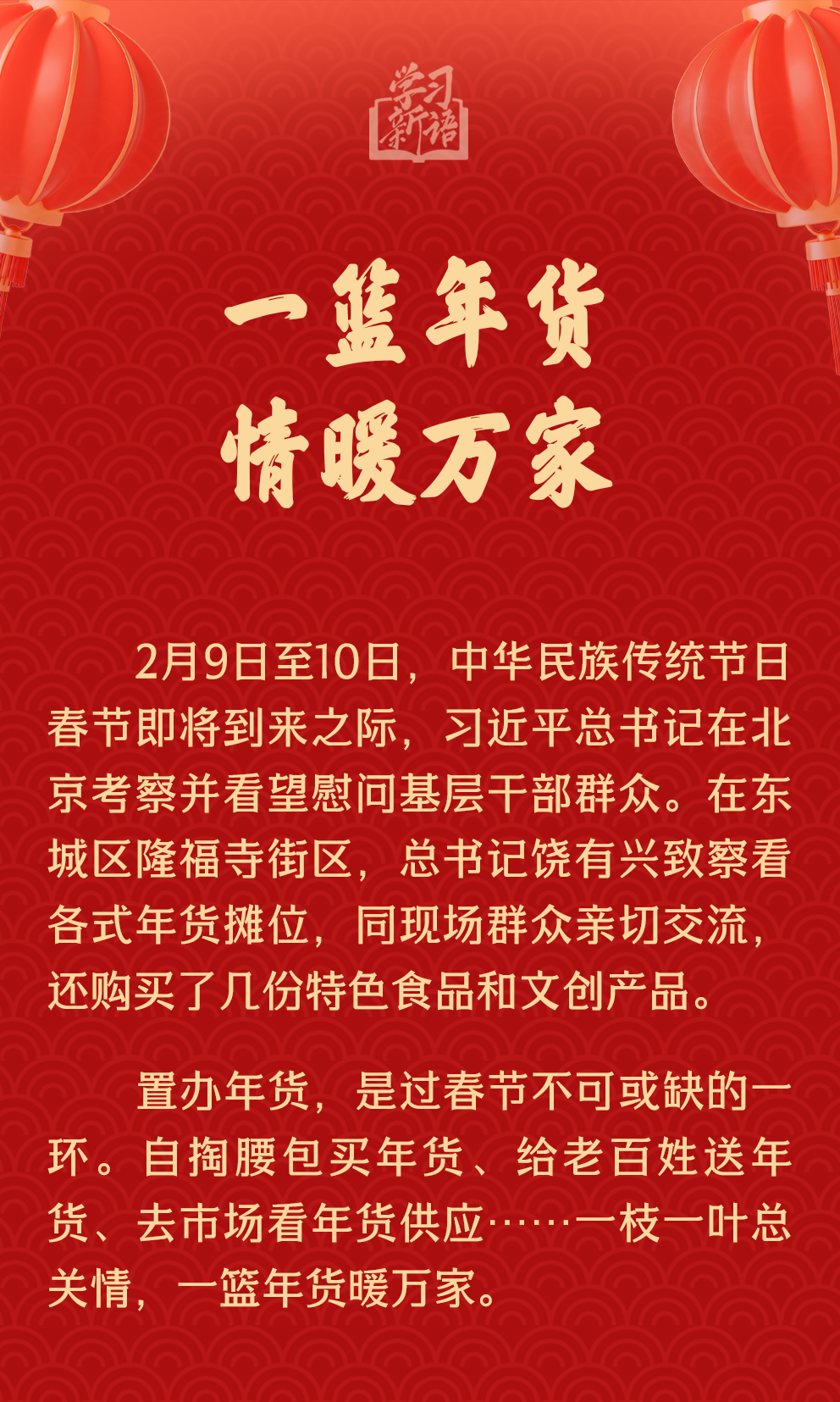
学习新语丨一篮年货 情暖万家
Xin Hua She· 2026-02-12 13:44
Core Viewpoint - The article highlights the importance of traditional Chinese New Year preparations, emphasizing the role of local governments in ensuring the supply of goods and services for the holiday season, as well as the cultural significance of these practices [2][6][11]. Group 1: Government Actions and Responsibilities - Local governments are urged to ensure the supply of essential goods during the festive season, focusing on quantity, variety, and quality to guarantee consumer confidence [11][47]. - The government is committed to supporting rural development and improving the living standards of farmers as part of the rural revitalization strategy [20][21]. Group 2: Cultural Significance and Community Engagement - The article illustrates the personal engagement of the General Secretary with the community during New Year preparations, showcasing the purchase of local specialties and cultural products [4][9][12]. - Emphasis is placed on the importance of preserving traditional culture and promoting local cultural industries to a global audience [15]. Group 3: Market Supply and Consumer Confidence - The General Secretary's visits to various markets highlight the focus on ensuring sufficient supply and safety of food products during the New Year [41][46]. - The operational model of certain supermarkets is noted for its effectiveness in connecting farmers with consumers, ensuring mutual benefits [43].
满载喜与盼 归乡赴春约
Xin Hua She· 2026-02-10 00:00
Group 1 - The article highlights the launch of a free return train service for workers from Hubei Jingmen, facilitating their journey back home for the Lunar New Year, with over 800 passengers on board [1] - Passengers express gratitude for the convenience of high-speed rail, which significantly reduces travel time from over 20 hours to just 6.5 hours [1] - Conversations among passengers shift from financial topics to discussions about family, education, and local development, indicating a deeper connection to their roots [1] Group 2 - The article emphasizes the rapid development of the hometown, with improved infrastructure and increased job opportunities, as noted by passengers like Chen Changfeng [2] - A "mobile spring recruitment fair" is held on the train, providing access to nearly 26,000 job openings in Jingmen, showcasing local government efforts to encourage employment [2] - The return of workers is linked to the broader trend of rural revitalization and the rise of the central region, with many individuals considering returning to contribute their skills and experience to their hometowns [3]
新春走基层|满载喜与盼 归乡赴春约
Xin Lang Cai Jing· 2026-02-09 18:14
Group 1 - The article highlights the launch of a free return train service for workers from Hubei Jingmen, facilitating their journey back home for the Lunar New Year, marking a significant development in local transportation and community support [1][2] - The return train service has transformed the travel experience for many, reducing travel time from over 20 hours on traditional trains to just 6.5 hours on high-speed trains, showcasing advancements in regional infrastructure [1] - The article emphasizes the positive changes in the hometown's development, including improved roads and increased job opportunities, which are encouraging many workers to consider returning home for employment [2][3] Group 2 - The return train also served as a platform for a "mobile job fair," providing access to approximately 26,000 job openings in Jingmen, indicating a proactive approach by local authorities to attract returning workers [2] - The narrative reflects a growing trend of individuals wanting to leverage their skills and experiences gained in larger cities to contribute to their hometowns, aligning with broader national strategies for rural revitalization and regional development [3] - The emotional connection to home and the desire for a better quality of life are evident among the returning workers, highlighting the importance of community ties and local development in shaping their future decisions [3]
2026年广东省职工生态健步行活动在广州举行
Nan Fang Ri Bao Wang Luo Ban· 2026-02-09 09:14
Core Viewpoint - The event "Healthy Steps Welcoming the New Spring" in Guangdong aims to promote ecological awareness and support local agriculture through a combination of sports, culture, and tourism initiatives [1] Group 1: Event Overview - The event took place at the Huangpu Water Sound Reservoir Trail and Leisure Wetland Park in Guangzhou, attracting nearly 1,000 model workers and employee representatives [1] - Two circular routes of 5 kilometers and 10 kilometers were set up, connecting various ecological points such as Rainbow Steps and Forest Oxygen Bar, with multiple supply stations and medical points available [1] Group 2: Agricultural Support and Community Engagement - The event featured a marketplace called "Agricultural Support and Workers' Fair," showcasing 50 booths with local specialty agricultural products from various regions, including sweet potatoes from Wengyuan and red tea from Yingde [1] - Notable products included those recommended by local mayors, representing both local culture and the achievements of the "Hundred Million Project" [1] Group 3: Strategic Importance - This initiative is part of the "Guangdong Workers' Cultural and Sports Exchange" provincial demonstration project series, integrating sports with cultural, ecological, and tourism elements [1] - The event not only creates new cultural and sports activity scenarios for workers but also contributes to regional development and supports the implementation of the "Hundred Million Project" and rural revitalization strategies [1]
化肥保供稳价,利好行业长期基本面,石化ETF(159731)价值可期
Mei Ri Jing Ji Xin Wen· 2026-02-09 05:45
Group 1 - The core viewpoint of the news highlights the significant inflow of funds into the petrochemical ETF (159731), which has reached a total of 1.447 billion yuan over the past 20 trading days, with the latest share count at 1.73 billion and total scale at 1.748 billion yuan, both hitting record highs since inception [1] - The National Development and Reform Commission has issued a notice to ensure the supply of fertilizers for the 2026 spring plowing and the entire agricultural production year, focusing on stabilizing fertilizer production and circulation, enhancing storage management, and regulating the market [1] - The chemical fertilizer and pesticide industry is deemed crucial for national food security and rural revitalization, with government policies expected to provide a stable development environment and drive transformation and upgrades in the sector [1] - The recovery of major chemical product prices and demand is anticipated as the domestic and international economies improve, benefiting leading companies in the chemical industry that have established significant scale advantages and strengthened their core competitiveness through R&D investments [1] Group 2 - The petrochemical ETF (159731) and its linked funds (017855/017856) closely track the CSI Petrochemical Industry Index, with the basic chemical industry accounting for 60.02% and the oil and petrochemical industry for 32.43%, allowing participation in the profit recovery of downstream chemical products [2] - The long-term narrative for the industry is improving due to the optimization of industry structure and adjustments in supply and demand [2]
常态化帮扶关键在精准
Jing Ji Ri Bao· 2026-02-07 22:09
Core Viewpoint - The central government emphasizes the establishment of a normalized assistance policy system to ensure the continuity and stability of support measures, which is crucial for consolidating and expanding the achievements of poverty alleviation efforts [1]. Group 1: Implementation of Normalized Assistance - The normalized assistance will be integrated into the rural revitalization strategy, providing a solid institutional guarantee for long-term mechanisms [1]. - The transition period for poverty alleviation has been completed, but assistance work must continue to address ongoing risks of poverty due to various challenges faced by farmers [1]. Group 2: Precision in Assistance - The year 2026 marks the beginning of normalized assistance, with a focus on improving the precision and timeliness of monitoring and support [2]. - It is essential to identify those in need of assistance promptly and implement differentiated support measures based on their specific circumstances [2]. - For those with labor capacity, the emphasis will be on development-oriented assistance, while those without will receive comprehensive social security measures to ensure basic living standards [2]. Group 3: Focus on Underdeveloped Areas - Assistance efforts will prioritize underdeveloped regions, helping them improve development conditions and leverage local resources for growth [2]. - The government will continue to provide concentrated support in terms of finance, land, and talent to key counties in rural revitalization [2]. Group 4: Coordination and Effectiveness - The implementation of normalized assistance requires high levels of coordination and should not be relaxed [3]. - Effective mechanisms from the poverty alleviation period will be maintained, including multi-level leadership and collaboration between regions [3]. - The focus will remain on addressing the practical difficulties faced by the population to prevent large-scale returns to poverty [3].
中央一号文件解读|再次聚焦农村,“适应人口变化趋势”有何深意?
Xin Lang Cai Jing· 2026-02-04 10:17
Group 1 - The core viewpoint of the article emphasizes the shift in China's rural policies from passive responses to proactive adaptations in light of demographic changes, particularly focusing on the integration of urbanization and rural revitalization strategies [1][4] - The 2026 Central Document No. 1 marks a significant change by making population dynamics a prerequisite for rural land use planning, indicating a move towards a more systematic approach to rural governance [2][4] - The document introduces a new path of "regional promotion of rural revitalization," replacing the previous "village classification construction" approach, reflecting a deeper understanding of the new characteristics of rural populations [2][3] Group 2 - As of the end of 2025, China's total population is approximately 1,404.89 million, showing a slight decrease of about 3.39 million from the previous year, with urban population reaching 953.80 million, an increase of about 10.30 million, while rural population decreased to 451.09 million, down by approximately 1.37 million [3] - The urbanization rate has risen to 67.89%, an increase of 0.89 percentage points year-on-year, indicating a steady upward trend in urbanization, which is a key structural indicator of China's modernization process [3][5] - The ongoing trend of rural population decline and aging, coupled with regional disparities, presents new challenges for rural development, necessitating a strategic response through the rural revitalization initiative [3][4] Group 3 - The 2026 Central Document No. 1 acknowledges the long-term trend of population movement to cities while attempting to maintain rural vitality to avoid widespread "hollowing" and disorder [4][5] - The document's focus on optimizing rural land use and determining construction priorities based on population trends signifies a proactive approach to rural planning, rather than assuming population stability or return [5] - The strategy suggests a rational choice for a transitional period, where resources will be allocated based on the viability of villages, with some areas receiving concentrated investment while others may gradually exit high-intensity construction sequences [5]
韩文秀:常态化帮扶各项配套政策正在抓紧制定出台
Xin Hua Cai Jing· 2026-02-04 05:36
Core Viewpoint - The central government emphasizes the importance of long-term poverty alleviation and the need for continuous support measures to prevent large-scale poverty reoccurrence, integrating these efforts into rural revitalization strategies [1]. Group 1: Dynamic Management of Support - The support system will implement dynamic management for beneficiaries, ensuring that all rural populations at risk are monitored and assisted, with a focus on early detection and intervention [1]. - A classification management system will be established for previously identified poverty alleviation beneficiaries, continuing support for those at risk of falling back into poverty [1]. Group 2: Precision and Efficiency in Support Methods - The approach to assistance will prioritize precision and efficiency, avoiding blanket policies and instead focusing on enhancing internal motivation and sustainable development [2]. - Employment support will be strengthened through organized labor output and the utilization of various employment channels to stabilize job opportunities [2]. Group 3: Regional Focus on Support - Key rural revitalization counties will be identified as units for assistance, with 160 national and several provincial key counties receiving concentrated support in finance, land, and talent [2]. - Policies will aim to improve infrastructure, public services, and county economic development to help underdeveloped areas reduce poverty and increase income [2]. Group 4: Stability of Support Policies - The government will maintain stable financial input and resource allocation for poverty alleviation, avoiding abrupt changes in funding [3]. - Effective mechanisms from the poverty alleviation period will continue to be implemented, ensuring a robust support policy framework [3].
中央农办:防止返贫致贫监测帮扶覆盖全体农村人口,有风险就纳入帮扶
Xin Lang Cai Jing· 2026-02-04 04:02
Group 1 - The core viewpoint of the news is the emphasis on the importance of consolidating and expanding the achievements of poverty alleviation as a long-term task, integrating normalized assistance into the rural revitalization strategy [1] - The Central Document No. 1 for this year outlines specific arrangements for the transition to a new phase of normalized assistance, with supporting policies being developed [1] - Dynamic management will be implemented for assistance targets to prevent poverty and ensure that monitoring covers all rural populations, allowing for early detection and intervention [1] Group 2 - A classification management system will be established for previously impoverished populations based on comprehensive assessments, with continued assistance for those at risk of falling back into poverty [1] - The mechanism for identifying and responding to risks will be improved to ensure timely support, with a focus on early detection and intervention [1] - Once risks are eliminated, a dynamic exit strategy will be applied to avoid fixed identity labels for beneficiaries [1]