
国际原油价格走势

Search documents
建信期货油脂日报-20260325
Jian Xin Qi Huo· 2026-03-25 01:49
Group 1: General Information - The report is about the oil and fat industry, dated March 25, 2026 [1][2] - The researchers are Yu Lanlan, Lin Zhenlei, Wang Haifeng, Hong Chenliang, and Liu Youran [3] Group 2: Market Review and Operation Suggestions Market Review - P2605: The previous settlement price was 9820, the opening price was 9680, the highest price was 9774, the lowest price was 9532, the closing price was 9644, down 176 or 1.79%, the trading volume was 512,050, and the open interest decreased by 21,561 [7] - P2609: The previous settlement price was 9780, the opening price was 9660, the highest price was 9740, the lowest price was 9508, the closing price was 9622, down 158 or 1.62%, the trading volume was 173,245, and the open interest decreased by 10,373 [7] - Y2605: The previous settlement price was 8678, the opening price was 8632, the highest price was 8680, the lowest price was 8544, the closing price was 8594, down 84 or 0.97%, the trading volume was 296,544, and the open interest decreased by 32,990 [7] - Y2609: The previous settlement price was 8592, the opening price was 8580, the highest price was 8606, the lowest price was 8474, the closing price was 8532, down 60 or 0.70%, the trading volume was 108,631, and the open interest increased by 945 [7] - OI2605: The previous settlement price was 9896, the opening price was 9840, the highest price was 9896, the lowest price was 9701, the closing price was 9813, down 83 or 0.84%, the trading volume was 218,082, and the open interest decreased by 14,079 [7] - OI2609: The previous settlement price was 9776, the opening price was 9685, the highest price was 9773, the lowest price was 9607, the closing price was 9705, down 71 or 0.73%, the trading volume was 36,940, and the open interest decreased by 692 [7] Price Quotes - Dongguan third - grade rapeseed oil trader quotes: Spot: OI2605 + 400 (Dongguan/Guangxi); March - April: OI2605 + 350 (Dongguan/Guangxi); May - July: OI2605 + 80 (Dongguan/Guangxi/Fujian); June - August: OI2609 + 120 (Dongguan/Guangxi/Fujian) [7] - East China soybean oil basis quotes: First - grade soybean oil: Spot: Y2605 + 270; April - May: Y2605 + 240; May - July: Y2605 + 150; June - September: Y2605 + 130; Third - grade soybean oil: Y2605 + 200; Degummed soybean oil: March - May: Y2605 + 100 [7] - A Guangdong oil factory's palm oil basis quotes: Imported 24 - degree: P2605 + 30; National standard 24 - degree: P2605 + 80; Refined 24 - degree: P2605 + 230; 18 - degree: P2605 + 170 [7] Market Analysis - Intraday, the oil and fat market was dragged down by the crude oil trend and declined. In the short term, the oil and fat market mainly depends on the external crude oil driving factors and some funds are changing contracts. Attention should be paid to the progress of the US biodiesel policy and the international crude oil price trend [8] - If the macro - situation cools down, with the seasonal increase in palm oil production in the producing areas and the increase in the future arrival volume of imported soybeans, as well as the weak economic growth and the uncertainty of the Middle East situation that may suppress demand, the oil and fat prices will回调 from high levels, and there is an opportunity for the soybean - palm oil price spread to widen [8] Group 3: Industry News - According to ITS, Malaysia's palm oil product exports from March 1 - 20 were 1,191,962 tons, a 38.1% increase from the 863,358 tons in the same period last month. Exports to China were 82,000 tons, a significant increase from 40,000 tons last month [9] - According to the Brazilian consulting firm Home农商 Company, as of March 20, the harvest progress of Brazil's 2025/26 soybean crop was 65.79%, up from 57.43% a week ago, lower than 73.84% in the same period last year and slightly lower than the five - year average of 66.96% [9] - MPOC: Due to the continuous high oil prices caused by the Middle East conflict, palm oil prices are expected to remain above 4450 ringgit per ton in the short term. However, the agency warns that weak economic growth and price volatility caused by the uncertainty of the Middle East situation may temporarily delay imports in major markets and suppress the further rise of palm oil prices [9] Group 4: Data Overview - The report presents multiple charts including the spot prices of East China third - grade rapeseed oil, East China fourth - grade soybean oil, South China 24 - degree palm oil, and the basis changes of palm oil, soybean oil, and rapeseed oil, as well as the price spreads of P1 - 5, P5 - 9, P9 - 1, and exchange rates such as the US dollar against the Chinese yuan and the US dollar against the Malaysian ringgit [11][13][14][23][29][30]
油价一夜大变了!今天12月26日调整后,全国加油站92、95汽油新售价
Sou Hu Cai Jing· 2025-12-26 22:43
Group 1 - The core point of the article highlights a recent decrease in domestic fuel prices, with 92-octane gasoline dropping to approximately 6.7 yuan per liter, while 95-octane gasoline is around 7.18 yuan per liter, and 0-diesel near 6.38 yuan per liter [1][2][3] - The latest price adjustments reflect a downward trend, but there are indications that international oil prices may rise again, potentially leading to an increase in domestic prices in the near future [4][5] - The next price adjustment window is set for January 6, 2026, and factors such as international oil price trends, exchange rates, and refinery operations will significantly influence the upcoming changes [5][6] Group 2 - Regional price differences are notable, with higher prices in eastern and northern regions compared to lower prices in the northwest; for instance, 0-diesel prices vary from 6.19 yuan per liter in Heilongjiang to 6.40 yuan per liter in Guangxi [8][9][10] - The article suggests that consumers should monitor international oil prices and exchange rate fluctuations to optimize their refueling strategies and manage costs effectively [10]


油价或上调,就在今晚
Zhong Guo Zheng Quan Bao - Zhong Zheng Wang· 2025-11-10 04:31
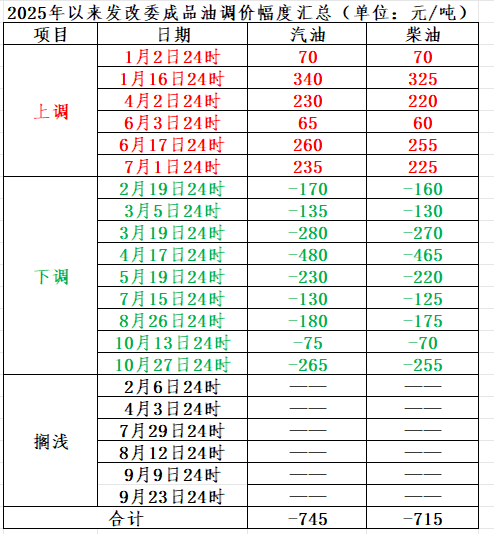
Core Insights - The domestic retail price of refined oil is expected to increase due to a predicted rise in international crude oil prices, with an estimated increase of over 50 yuan/ton [1] - The current pricing cycle shows a positive change rate of 2.82%, leading to anticipated increases of 125 yuan/ton for gasoline and 120 yuan/ton for diesel, translating to a rise of 0.10 yuan/liter for 92 gasoline, 95 gasoline, and 0 diesel [1] Price Adjustments - Since 2025, there have been 21 rounds of adjustments in domestic refined oil retail prices, resulting in six increases, nine decreases, and six instances of no change, with prices down by 745 yuan/ton for gasoline and 715 yuan/ton for diesel compared to the end of last year [2][3] - The specific price adjustments for gasoline and diesel from January to October 2025 show significant fluctuations, with the highest increase of 340 yuan/ton for gasoline and the largest decrease of 480 yuan/ton [3] Market Trends - Recent data indicates a decline in wholesale prices for 92 gasoline and 0 diesel, with average prices at 7325 yuan/ton and 6456 yuan/ton respectively, reflecting a decrease of 2.51% and 0.38% [4][5] - Analysts suggest that the current weak international crude oil market and insufficient demand in the gasoline market are contributing to the price declines, while diesel prices are somewhat supported by seasonal demand [5] Future Outlook - The crude oil market is experiencing fluctuating sentiments, with Brent crude oil prices oscillating between 63 to 65 USD/barrel, indicating a need to monitor the support level at 63 USD/barrel closely [5] - Potential upward risks in the crude oil market are primarily linked to geopolitical issues, although fundamental pressures have not yet eased significantly [5]
今晚过后成品油价将迎年内第四涨,加满一箱油将多花2.5元
Di Yi Cai Jing· 2025-06-03 09:20
Group 1 - The recent adjustment in fuel prices has led to an increase in diesel prices to 6.7-6.9 yuan per liter and 92 gasoline prices to 7.1-7.2 yuan per liter across most regions in China [1] - The National Development and Reform Commission announced a price increase of 65 yuan per ton for gasoline and 60 yuan per ton for diesel, marking the eleventh round of adjustments this year, with a pattern of "four increases, five decreases, and two hold-offs" [1] - After the adjustments, the overall prices of gasoline and diesel have decreased by 590 yuan per ton and 570 yuan per ton respectively compared to the end of 2024 [1] Group 2 - The international crude oil prices experienced a narrow decline followed by a rebound during the pricing cycle, influenced by OPEC+'s discussions on potential large-scale production increases and concerns over supply surplus [3] - The upcoming pricing window on June 17 is expected to show a slight upward trend in refined oil prices based on current international crude oil price levels [3] - Despite OPEC+ maintaining significant production increases in June and July, the traditional peak season for fuel consumption in the U.S. and uncertainties surrounding the Russia-Ukraine and U.S.-Iran situations are expected to provide support for international oil prices [3]
供应端压力增加原油价格反弹空间料有限
Zhong Guo Zheng Quan Bao· 2025-05-13 21:49
Core Viewpoint - International crude oil prices have rebounded significantly since hitting new lows on May 5, with Brent crude reaching a high of $66.4 per barrel and WTI crude hitting $63.61 per barrel, marking increases of 13.50% and 15.03% respectively [1][2]. Price Movement - As of May 12, Brent and WTI crude oil prices reached their highest levels since the beginning of May, following a notable rebound from the lows recorded on May 5 [1][2]. - By May 13, prices adjusted slightly, with Brent at $65.01 per barrel and WTI at $62.03 per barrel, indicating a volatile market despite recent gains [2]. Influencing Factors - The rebound in oil prices is attributed to two main factors: a marginal easing of macroeconomic expectations and the U.S. Treasury's addition of entities related to Iranian oil to its sanctions list, raising supply concerns [2]. - Market sentiment has been influenced by the perception that the negative impact of OPEC+'s accelerated production increases has been priced in, alongside expectations of improved macroeconomic conditions [2][3]. Market Dynamics - The Brent crude futures curve has exhibited a "smile" shape, indicating a divergence in near-term and long-term market expectations, with near-term prices supported by low inventories and seasonal demand, while long-term prices are pressured by anticipated increases in OPEC+ production [3][4]. - Analysts suggest that the current market is characterized by a "strong reality, weak expectation" scenario, where immediate supply-demand dynamics are favorable, but future expectations are clouded by potential oversupply [3][4]. Future Outlook - Short-term projections indicate that oil prices may face downward pressure as OPEC+ begins to increase production significantly in May, amidst a backdrop of weak demand [4][5]. - The medium to long-term outlook suggests that oil prices will likely remain within a defined range, influenced by OPEC+ production policies and market sentiment, with limited upside potential unless significant positive developments occur in macroeconomic or geopolitical contexts [5].