
国际标准转化

Search documents
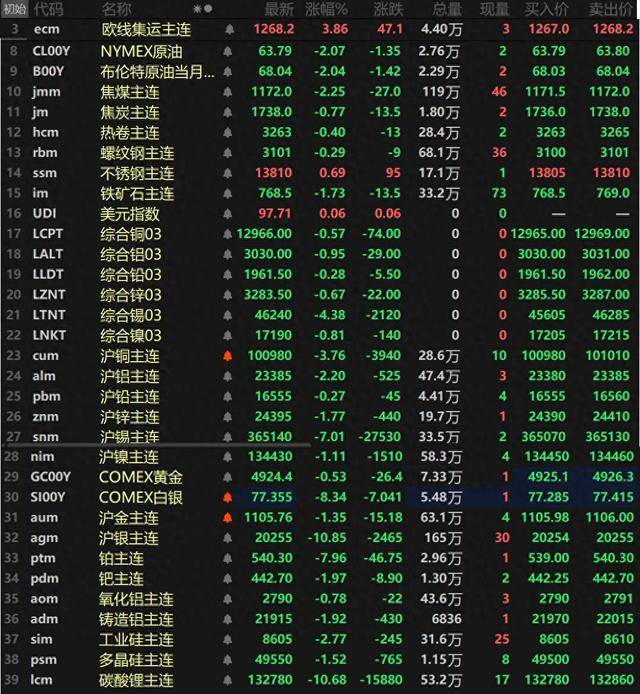
金属近全线下挫 沪锡跌超7% 碳酸锂、沪银跌逾10% 纽银跌超8%
Sou Hu Cai Jing· 2026-02-05 10:16
Metal Market - Domestic base metals collectively declined, with the exception of lead, which fell by 0.27%. Tin led the decline with a drop of 7.01%, while copper fell by 3.76% and aluminum by 2.2%. Zinc and nickel also saw declines of over 1%, with zinc down 1.77% and nickel down 1.11% [1] - Lithium carbonate experienced a significant drop of 10.68%, hitting a limit down before slightly recovering. Other materials like polysilicon and industrial silicon fell by 1.52% and 2.77%, respectively [1] - In the black metals sector, all except stainless steel saw declines, with iron ore down 1.73% and coking coal down 2.25% [1] - In the external market, base metals also showed a downward trend, with tin leading the decline at 4.38% [1][2] Precious Metals - Precious metals saw declines, with COMEX gold down 0.53% and COMEX silver experiencing a significant drop of 8.34%. In the domestic market, Shanghai gold fell by 1.35% and Shanghai silver dropped by 10.85% [1][2] Macro Environment - The State Administration for Market Regulation announced plans to handle 14,600 cases of unfair competition by 2025, aiming to mitigate "price wars" and "subsidy wars" [5] - The central bank conducted a net injection of 645 billion yuan through reverse repos, indicating liquidity management in the market [7] - The dollar index showed a slight increase of 0.06%, reflecting market expectations regarding the Federal Reserve's interest rate policies [8]

市场监管总局:截至2025年底,我国总体国际标准转化率达88.9%
Ren Min Wang· 2026-02-05 06:49
Group 1 - The core viewpoint of the news is that the State Administration for Market Regulation (SAMR) is focusing on "systematic openness" as a key task for economic development in 2023, with standards playing a crucial role in this process [1][2] Group 2 - By 2025, the SAMR aims to achieve an overall international standard conversion rate of 88.9%, with 1,510 international standards converted in that year, particularly achieving a 100% conversion rate in cultural and meteorological fields, and over 90% in aviation, building materials, and machinery [1] - The SAMR plans to lead the development and publication of 285 international standards in fields such as renewable energy and traditional medicine by 2025, representing a year-on-year growth of 26.7% [1] - The SAMR will propose 505 international standard proposals to ISO and IEC in biotechnology, artificial intelligence, and industrial networks, with a year-on-year increase of 15.8% [1] Group 3 - The SAMR is set to deploy 1,176 foreign language standard plans in areas like "new three samples" and large complete equipment by 2025, with 441 foreign language standards published in artificial intelligence and engineering machinery [2] - The SAMR will conduct specialized publicity for Chinese standards through platforms like the China International Import Expo and the China-Arab States Expo, aiming to make Chinese standards easily accessible and understandable [2] Group 4 - By 2025, the SAMR aims to sign multiple standardization cooperation documents with key countries, having reached 130 agreements with 75 countries and organizations [2] - The SAMR successfully hosted the first Shanghai Cooperation Organization Standardization Cooperation Meeting and the eighth Hongqiao International Economic Forum Standard Sub-Forum, expanding its international standardization cooperation network [2] Group 5 - The SAMR plans to promote pilot projects for standard system openness in line with the needs of Hainan Free Trade Port and Free Trade Zone construction, inviting international experts to participate in the development of China's standard system [2]
市场监管总局:我国总体国际标准转化率已达88.9%
Sou Hu Cai Jing· 2026-02-05 03:47
Group 1 - The article emphasizes the fundamental role of standards as a "universal language" in international trade and industrial cooperation [1] - By the end of 2025, the overall international standard conversion rate in China is expected to reach 88.9%, with 1,510 international standards converted throughout the year [1] - In specific sectors, the conversion rate for culture and meteorology is projected to be 100%, while aviation, building materials, and machinery sectors will exceed 90% [1] Group 2 - In the "going out" aspect, China aims to lead the formulation and release of 285 international standards in fields such as renewable energy and traditional medicine by 2025, representing a year-on-year growth of 26.7% [1] - Additionally, 505 proposals for international standards in biotechnology, artificial intelligence, and industrial networks are expected, marking a 15.8% increase year-on-year [1] - The publication of 441 foreign language standards in areas like artificial intelligence and engineering machinery, along with the signing of multiple standardization cooperation documents with key countries, indicates an expanding network of standardization cooperation [1]
市场监管总局:2025全年转化1510项国际标准 总体国际标准转化率达88.9%
Yang Shi Xin Wen· 2026-02-05 03:14
Core Insights - Standards play a fundamental role as a "universal language" in international trade and industrial cooperation [1] Group 1: Standardization Efforts - By 2025, the State Administration for Market Regulation will promote the coordinated advancement of standards "imported" and "exported" [1] - In the "import" aspect, the management method for adopting international standards will be revised, emphasizing "precise adoption" and "efficient transformation" [1] - By the end of 2025, the overall international standard conversion rate in China is expected to reach 88.9%, with 1,510 international standards converted throughout the year [1] Group 2: Sector-Specific Conversion Rates - In cultural and meteorological fields, the conversion rate is projected to reach 100%, while sectors like aviation, building materials, and machinery will exceed 90% [1] Group 3: International Standard Development - In the "export" aspect, China aims to lead the development and release of 285 international standards in fields such as renewable energy, traditional medicine, and brain-computer interfaces by 2025, marking a 26.7% year-on-year increase [1] - Proposals for international standards in biotechnology, artificial intelligence, and industrial networks will total 505, reflecting a 15.8% year-on-year growth [1] Group 4: Collaboration and Agreements - A total of 441 foreign-language standards will be published in fields like artificial intelligence and engineering machinery [1] - China has signed multiple standardization cooperation documents with key countries, reaching 130 agreements with 75 countries and organizations, thereby expanding its standardization cooperation network [1]
市场监管总局:截至9月底我国国际标准转化率整体已达86%
Zhong Guo Xin Wen Wang· 2025-10-31 03:56
Core Viewpoint - The State Administration for Market Regulation announced that by the end of September 2025, China's international standard conversion rate is expected to reach 86%, achieving the goals set in the National Standardization Development Outline and supporting the country's green and low-carbon development [1][2]. Group 1: National Standard System Construction - The National Standardization Development Outline has led to the establishment of China's first carbon peak and carbon neutrality standard system, providing top-level guidance for revising green and low-carbon standards across various sectors [1]. - In 2022, 49 national standards for greenhouse gas emission accounting were released, covering major carbon-intensive industries such as steel, non-ferrous metals, and electricity, addressing the challenges of accurate carbon accounting [1]. - 13 national standards for product carbon footprints have been published for widely traded products like plastics and furniture, providing technical support for China's product carbon footprint management system [1]. Group 2: International Standard Conversion - The implementation of the "Precise Standard Adoption" and "Efficient Conversion" approach has shortened the international standard conversion time by nearly six months since June 1 of this year [2]. - A total of 410 international standards have been converted and adopted in areas such as carbon emissions, carbon accounting, and carbon capture [2]. - The overall international standard conversion rate is projected to reach 86% by September 2025, aligning with the goals of the National Standardization Development Outline [2]. Group 3: International Standardization Participation - China is actively participating in international standardization efforts, utilizing bilateral cooperation mechanisms to promote mutual recognition of carbon information disclosure and carbon emission monitoring standards [2]. - Chinese experts have led 228 working groups and proposed 442 international standard proposals during the 14th Five-Year Plan period, contributing to the achievement of the United Nations Sustainable Development Goals [2]. - Collaboration with countries involved in the Belt and Road Initiative and BRICS nations is being strengthened to advance international standards in green and low-carbon fields such as new energy vehicles and circular economy [2].