地缘政治风险对冲

Search documents
花旗高喊白银是“打了兴奋剂的黄金”,看涨到150美元!中国主导、印度跟买,但全球ETF净流出
Sou Hu Cai Jing· 2026-01-28 05:16
Group 1 - The core viewpoint of the article is that Citigroup has significantly raised its short-term silver price target from $100 to $150 per ounce, indicating a strong bullish sentiment in the silver market driven by capital allocation logic rather than traditional industrial demand [2][10] - Silver is now viewed as a capital allocation asset, mirroring gold's pricing logic, and is seen as a hedge against macroeconomic uncertainties and geopolitical risks, with its price acceleration being notably higher than that of gold [2][3] Group 2 - The current silver bull market is primarily driven by demand from China, with India and global retail demand following suit, as evidenced by rising premiums in both countries [3] - Despite recent regulatory measures in China aimed at cooling the market, Citigroup believes these will not alter the overall upward trend in silver prices [4] Group 3 - An unusual phenomenon is observed where silver prices are surging despite traditional bearish indicators, such as significant outflows from COMEX silver inventories and global ETF holdings [7] - The macro risk premium and strong retail demand from China are currently overshadowing these traditional supply and demand signals, leading to a breakdown of conventional pricing models [7] Group 4 - Citigroup suggests using the gold-silver ratio as a key metric for determining potential price ceilings for silver, indicating that if the ratio falls to historical lows, silver prices could reach between $160 and $300 per ounce [9][10] - The article concludes that the current silver market is characterized by a revaluation driven by capital preferences and collective behavior rather than precise supply-demand calculations [10][11]



危险的牛市:支撑黄金飙升的六大理论,数据证实“都不成立”
Jin Shi Shu Ju· 2026-01-13 04:42
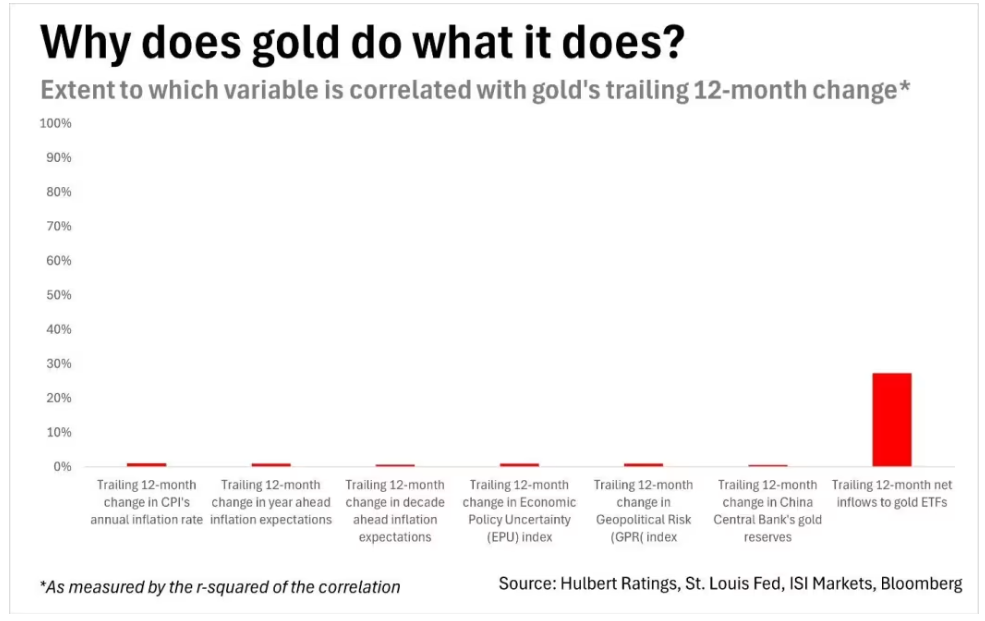
Core Viewpoint - The significant rise in gold prices over the past year lacks a statistically valid explanation, making future predictions uncertain [1]. Group 1: Theories Explaining Gold Price Movements - **Inflation Hedge**: The common belief is that gold serves as a hedge against inflation, with prices rising during inflationary periods. However, the correlation between CPI changes and gold price movements is only 1.1%, indicating a weak predictive power [2][4]. - **Expected Inflation Hedge**: Some argue that gold reacts to expected future inflation rather than actual inflation. Yet, analysis using Cleveland Fed's inflation expectations shows no significant correlation with gold prices, even weaker than actual CPI changes [5][6]. - **Geopolitical Risk**: Another theory posits that gold prices rise with increased geopolitical risks. However, the geopolitical risk index only explains 0.1% of gold price changes, indicating a negligible relationship [7][8]. - **Economic Policy Risk**: The Economic Policy Uncertainty Index (EPU) was also tested, revealing that it explains only 0.9% of gold price changes, further supporting the lack of correlation [9]. - **Chinese Gold Purchases**: The theory linking gold's bull market to increased gold purchases by the Chinese central bank is prevalent, but the correlation is weak, with an R-squared value of only 0.6% [10]. - **Gold ETF Net Inflows**: The highest correlation with gold prices is found in the net inflows of physical gold ETFs. However, even this correlation lacks statistical significance at the 95% confidence level [11]. Group 2: Challenges in Timing the Gold Market - None of the discussed theories provide a solid synchronous or leading indicator for gold price fluctuations, complicating market timing strategies [12]. - Historical data shows that various gold market timing strategies have underperformed the buy-and-hold strategy by an average of 4.0 percentage points annually since the mid-1980s [12].
全球央行加速增持黄金储备,95%的央行计划在未来12个月内继续增加黄金储备
Shang Wu Bu Wang Zhan· 2025-09-20 04:16
Core Insights - Central banks globally are accelerating their gold reserves, with 95% planning to increase their holdings in the next 12 months [1] - The price of gold has reached a historic high of $3,699 per ounce, with a year-to-date increase of over 40% [1] - There is a significant shift in the global reserve system, with a notable decrease in reliance on dollar assets among central banks [1] Group 1 - The rise in gold prices is driven by geopolitical tensions, high inflation expectations, signals of interest rate cuts from the Federal Reserve, and a weakening dollar [1] - The euro to dollar exchange rate has risen to 1:1.187, nearing its highest level since September 2021 [1] - Nearly three-quarters of central banks expect to reduce their dollar asset allocation, indicating a structural change in reserve management [1] Group 2 - The current pace of gold purchases by central banks is the fastest in decades, reinforcing gold's status as a strategic reserve asset [1] - Analysts link the surge in gold buying to the need for hedging against geopolitical risks, increased volatility in dollar exchange rates, and the long-term value preservation characteristics of gold [1]
Why Occidental Petroleum and Other Oil Companies Rallied Today
Yahoo Finance· 2025-09-16 21:08
Group 1 - Occidental Petroleum shares increased by 5% as oil prices rose due to developments in the Russia-Ukraine war affecting Russian oil supply [1] - Oil prices rose by 2% amid concerns over Russian oil supply, with Ukraine increasing drone attacks on Russian oil refineries, leading to a reduction in Russian oil refining below five million barrels per day, the lowest since April 2022 [2] - Prior to the recent rise, oil prices had fallen 9% this year to the $60 range, significantly lower than the $139 peak in 2022, but increased Ukrainian aggression against Russian oil assets could change the pricing dynamic [3] Group 2 - The Federal Reserve is expected to cut the federal funds rate, which could stimulate economic activity and increase oil demand [4] - Warren Buffett has allocated over 11% of his stock portfolio to Chevron and Occidental, viewing them as hedges against geopolitical risks due to their large inventory bases in the U.S. and friendly countries [6][7] - The increased aggressiveness of Ukraine in targeting Russian oil and refining assets has contributed to rising oil prices, benefiting Occidental and other U.S.-based oil companies [8]

金老虎:关税缓和″泼冷水″,黄金冲高翻绿!3358 弱势空
Sou Hu Cai Jing· 2025-08-14 09:06
Core Viewpoint - The recent fluctuations in gold prices are influenced by multiple factors, including the U.S. consumer price index (CPI) data and the extension of the U.S.-China tariff truce, which have both contributed to a favorable environment for gold investment [3][4]. Gold Market Analysis - Gold prices rebounded from 3342 to 3372, with a peak at 3374, primarily due to the U.S. July CPI data aligning with market expectations, reinforcing the anticipation of a Federal Reserve interest rate cut in September [3]. - Lower interest rates diminish the attractiveness of the U.S. dollar, reducing the opportunity cost of holding gold, thus encouraging more investment in gold [3]. - The extension of the U.S.-China tariff truce by 90 days until November 10 has eased trade tensions, reducing inflationary pressures and enhancing gold's appeal as a hedge against geopolitical risks [4]. Technical Analysis - The daily chart indicates that gold is operating within a triangular range, with a recent low at 3331 and a potential upward movement if it breaks above the resistance level at 3430 [5]. - Current price action is around the 20-day moving average at 3358, with the Bollinger Bands indicating consolidation around this level [5]. - If gold remains below 3358, a downward trend may ensue, while holding above this level could lead to a test of 3380-3384 [5]. Trading Strategy - A recommendation is made to sell gold on a rebound to the 3358-3361 range with a stop loss at 3371 and a target of 3346-3348. Conversely, if prices drop to 3315-3317, a buying opportunity is suggested with a stop loss at 3305 and a target of 3327-3329 [7].
美银建议买入美元/日元 对冲中东紧张局势风险
news flash· 2025-06-23 06:12
Core Viewpoint - Bank of America recommends investors to buy USD/JPY to hedge against escalating geopolitical tensions in the Middle East, citing Japan's heavy reliance on oil imports from the region [1] Group 1 - The recommendation is driven by the increasing geopolitical risks associated with the Middle East [1] - Japan's significant dependence on oil imports from the Middle East makes it vulnerable to regional instability [1]

逆袭欧元!黄金成为全球第二大储备资产
Sou Hu Cai Jing· 2025-06-12 01:42
Core Insights - Gold has officially surpassed the euro to become the second-largest reserve asset for global central banks, driven by a surge in gold purchases and rising prices [1] - In 2024, gold is projected to account for 20% of global official reserves, exceeding the euro's 16%, while the dollar remains dominant at 46% [1] - Central banks are increasing gold holdings at a record pace, with net purchases expected to exceed 1,000 tons for the third consecutive year in 2024, doubling the average levels of the 2010s [1] Group 1 - The European Central Bank reports that the share of the dollar has decreased by 4 percentage points since 2020, while the euro's share has shrunk by 8 percentage points over the past five years [1] - Major buyers of gold include China, India, Turkey, and Poland, with China's central bank increasing its holdings by 289 tons, the highest since 2015 [1] - The global central bank gold reserves have rebounded to 3.6 million tons in 2024, nearing levels last seen in 1965, reflecting a strategic demand for non-sovereign credit assets [1] Group 2 - The shift in asset allocation is evident, with a significant increase in global gold ETF holdings in 2024, while developed country bonds face the largest sell-off since 2008 [2] - Investors are now viewing gold not just as an inflation hedge but as a core tool for geopolitical risk management, leading to a 25% year-on-year increase in gold ETF inflows in 2024, the highest in four years [2] - Gold prices surged by 30% in 2024, with further increases of 27% expected in the first half of 2025, reaching historical highs above $3,500 per ounce [2] Group 3 - Despite not generating interest and having high storage costs, gold's unique safe-haven properties make it the "ultimate currency" during crises [4] - The annual storage cost for gold held by global central banks is estimated at $8.7 billion, and the opportunity cost increases with rising interest rates [4] - The European Central Bank warns that gold's liquidity is only 1.2% of the global foreign exchange market, and an expansion of its reserve function could increase market volatility [4]