AI医生

Search documents
平安好医生:25年企业健管业务收入增速超40%,AI持续赋能业务且改善盈利-20260331
Xinda Securities· 2026-03-31 09:50
Investment Rating - The investment rating for Ping An Good Doctor (1833.HK) is not explicitly stated in the provided documents [1]. Core Insights - The company reported a revenue of approximately 5.468 billion yuan for 2025, representing a year-on-year increase of 13.7%. The adjusted net profit was about 414 million yuan, up 161.3%, while the net profit attributable to the parent company reached 380 million yuan, reflecting a significant increase of 366.1% [2][3]. - The enterprise health management business experienced a growth rate exceeding 40% in 2025, driven by improved operational efficiency. The company served over 6,700 paying corporate clients, marking an 83.1% year-on-year increase [3]. - The integration of AI into the business has enhanced profitability, with AI services covering 100% of individual clients within the Ping An Group. The AI doctor service had nearly 12 million users in 2025, with a diagnostic accuracy rate of 95.1% [3]. Financial Summary - For 2025, the total revenue was 5,468 million yuan, with a projected growth rate of 14% for 2026, 7% for 2027, and 10% for 2028. The net profit attributable to the parent company is expected to be 458 million yuan in 2026, 569 million yuan in 2027, and 683 million yuan in 2028, with respective growth rates of 21%, 24%, and 20% [4][5]. - The gross margin for 2025 was 32.41%, with projections of 32.68% for 2026, 32.91% for 2027, and 33.19% for 2028. The return on equity (ROE) was 3.83% in 2025, expected to rise to 5.88% by 2028 [4][5]. - The price-to-earnings (P/E) ratio is projected to decrease from 68.84 in 2025 to 32.49 by 2028, indicating a potential increase in valuation attractiveness over time [4][5].
平安好医生(01833):25年企业健管业务收入增速超40%,AI持续赋能业务且改善盈利
Xinda Securities· 2026-03-31 08:32
Investment Rating - The investment rating for Ping An Good Doctor (1833.HK) is not explicitly stated in the provided documents, but the analysis suggests a positive outlook based on financial performance and growth prospects [1]. Core Insights - The company reported a revenue of approximately 5.468 billion yuan in 2025, representing a year-on-year increase of 13.7%. The adjusted net profit was about 414 million yuan, up 161.3%, while the net profit attributable to shareholders increased by 366.1% to approximately 380 million yuan [2][3]. - The enterprise health management business experienced a growth rate exceeding 40% in 2025, driven by improved operational efficiency and profitability. The company served over 6,700 paying corporate clients, marking an 83.1% increase year-on-year [3]. - The integration of AI into the business model has enhanced profitability, with AI services covering 100% of individual clients and achieving a diagnostic accuracy rate of 95.1% [3]. Financial Performance Summary - **Revenue Growth**: The company expects revenues of approximately 5.873 billion yuan in 2026, 6.431 billion yuan in 2027, and 7.167 billion yuan in 2028, with year-on-year growth rates of 7%, 10%, and 11% respectively [5]. - **Net Profit**: The net profit attributable to shareholders is projected to be 458 million yuan in 2026, 569 million yuan in 2027, and 683 million yuan in 2028, with growth rates of 21%, 24%, and 20% respectively [5]. - **Profitability Metrics**: The gross margin is expected to improve from 32.41% in 2025 to 33.19% in 2028, while the return on equity (ROE) is projected to increase from 3.83% to 5.88% over the same period [4][5]. Business Segments Summary - **Health Management Services**: The enterprise health management segment generated 1.306 billion yuan in revenue, reflecting a year-on-year growth of 40.6%. The company provides comprehensive health management solutions to corporate clients [3]. - **Insurance Collaboration**: The commercial insurance collaboration business generated 3.296 billion yuan, with a year-on-year increase of 11%. The company has significantly improved its service offerings, resulting in a 1.5 times increase in new insurance policies for health rights clients [3]. AI Integration and Service Enhancement - The AI-driven services have significantly contributed to cost reduction and efficiency improvements, with a reported 45% decrease in the cost of consultation services in Q4 2025 [3]. - The company has expanded its service network, collaborating with over 5,100 hospitals and 240,000 pharmacies, enhancing its service delivery across various channels [3].
中国平安(601318.SH)2025年度归母净利增加至1347.78亿元,寿险及健康险业务持续增长
智通财经网· 2026-03-26 16:13
Group 1: Financial Performance - The company reported a total revenue of 1,050.506 billion RMB for 2025, representing a year-on-year growth of 2.1% [1] - Net profit attributable to shareholders reached 134.778 billion RMB, an increase of 6.5% year-on-year [1] - The net profit excluding non-recurring gains and losses was 143.773 billion RMB, showing a significant growth of 22.5% [1] - Basic earnings per share were 7.68 RMB [1] - Operating profit attributable to the parent company was 134.415 billion RMB, up by 10.3% year-on-year [1] - The net assets attributable to shareholders exceeded 1 trillion RMB for the first time, reaching 1,000.419 billion RMB [1] - Total cash dividends for the year amounted to 48.891 billion RMB, marking 14 consecutive years of growth [1] Group 2: Business Growth and Strategy - The new business value in life and health insurance grew by 29.3% year-on-year [1] - The company has deepened its comprehensive financial customer operations, with individual customer numbers reaching 251 million, a 3.5% increase from the beginning of the year [2] - The average monthly active online customer count is approximately 90 million [2] - The retention rate for customers holding three or more products within the group is 99% [2] - The company accelerated its strategic layout in medical and elderly care, with nearly 12 million annual users of AI doctors and over 240,000 customers qualifying for home care services [2] - The company has invested over 10.88 trillion RMB to support the development of the real economy [2] - The MSCI ESG rating has been upgraded to AAA, ranking first in the Asia-Pacific region for four consecutive years in the "comprehensive insurance and brokerage" category [2]

“薄利”的微医:第三次冲击港交所,被AI巨头“抢生意”
Sou Hu Cai Jing· 2026-02-09 05:08
Group 1 - The core viewpoint of the article is that WeDoctor's AI foundation appears unstable, as it relies on third-party foundational models and has seen a decline in R&D expenses, raising concerns about its future in the competitive AI healthcare market [2][21][30] - WeDoctor's IPO attempts have faced challenges, with the recent withdrawal of its coordinator, CMB International, raising questions about its future prospects despite a booming IPO market in Hong Kong [2][4] - The company has reported significant losses, with a cumulative loss of nearly 1.8 billion RMB from 2022 to the first half of 2025, and has not yet achieved profitability [4][6][15] Group 2 - WeDoctor's revenue has shown explosive growth, reaching 30.8 billion RMB in the first half of 2025, a year-on-year increase of 69.43%, but it remains deeply unprofitable [6][8] - The company's business model, which relies on earning from healthcare fund surpluses, is described as a "hard business" with low margins and challenges in scalability [8][11][15] - The health management services segment has seen a nearly tenfold increase in revenue, but its profit margins are extremely low, with a profit margin of only 0.7% in the first half of 2025 [9][10] Group 3 - Major competitors like Ant Group, Baidu, and iFlytek are entering the G-end market, intensifying competition for WeDoctor, which is struggling to establish itself [5][25][29] - WeDoctor's reliance on third-party AI models and reduced R&D spending has raised concerns about its ability to innovate and compete effectively in the AI healthcare space [21][30] - The company has expanded its operations to cities like Shanghai and Hangzhou, but remains heavily dependent on its primary market in Tianjin, which accounted for 77.6% of its revenue in the first half of 2025 [14][15]


AI医生上岗 看病方便多了
Xin Lang Cai Jing· 2026-01-31 07:07
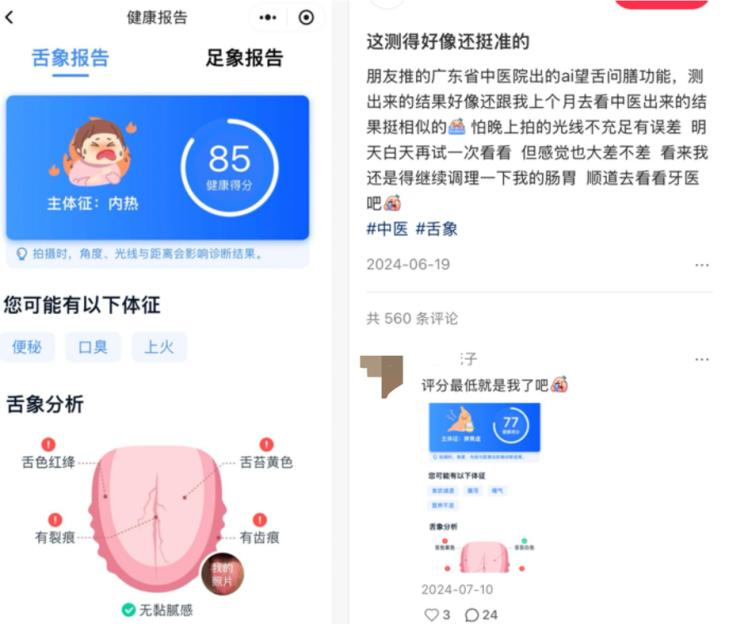
Core Viewpoint - Multiple hospitals in the city have recently launched various AI tools aimed at enhancing patient convenience during medical visits, including AI assistants for navigation, real-time consultations, and traditional Chinese medicine diagnostics [1][9]. Group 1: AI Medical Assistants - The "Health Smart Person" service at the Japan-China Friendship Hospital provides comprehensive assistance, including route guidance, appointment reminders, and medication consultations [3][4]. - The AI assistant proactively sends reminders based on the patient's progress through key stages such as registration, waiting, payment, examination, and medication collection [4]. Group 2: AI Doctors - An AI doctor developed by Ditan Hospital can assess symptoms and provide personalized advice for common illnesses like flu and respiratory infections, with input from nearly 60 infection specialists [7][8]. - The AI doctor is designed to assist in preliminary risk assessments before medical visits and offer medication explanations and recovery guidance afterward [8]. Group 3: Traditional Chinese Medicine Integration - Beijing Friendship Hospital is researching the integration of AI with traditional Chinese medicine, specifically using tongue diagnosis to assess liver disease risks [9][10]. - The goal is to enable patients to use a mobile app to take pictures of their tongues and receive quick assessments of liver fibrosis risk, with a standardized tool for image capture expected to be developed by the end of the year [10][11].

王月丹:双轨并行,AI在健康医学领域不断发力丨生物医药大健康2026思享汇
Jin Rong Jie· 2026-01-29 09:43
Group 1 - The year 2026 is positioned as a pivotal moment for the biopharmaceutical industry, marking the end of the "14th Five-Year Plan" and the beginning of the "15th Five-Year Plan," with a focus on balancing technological innovation and value-driven growth [1] - AI is expected to be a core driver of innovation in the healthcare sector, fundamentally changing service models and industry structures, as highlighted by experts like Wang Yuedan [1][5] - The integration of AI in daily health management is becoming prevalent, with approximately 60% of individuals consulting AI for minor health issues, reflecting the increasing accuracy and capabilities of AI systems [3] Group 2 - AI systems have shown significant improvements in diagnostic accuracy, with the ability to diagnose lung infections increasing from 78% to 92%, while the independent diagnostic capabilities of interns have decreased by 15% [3] - The development of wearable health devices is crucial for AI healthcare systems, with advancements in non-invasive and real-time monitoring becoming essential for health management and disease prediction [4] - AI research robots are increasingly replacing human researchers in biomedical fields, demonstrating strong capabilities in multi-omics data integration and analysis, which aids in personalized treatment design [6] Group 3 - The application of AI in healthcare is expected to expand in both basic disease management and advanced personalized treatments, establishing AI as a central figure in connecting biomedical research with clinical applications [7] - The future of healthcare will see AI playing a dual role in enhancing both general health management and high-end personalized treatment development, fundamentally altering the healthcare service landscape [7]

“AI医生”下月地坛医院出诊
Xin Lang Cai Jing· 2026-01-18 22:33
Core Viewpoint - Beijing Ditan Hospital has launched an AI-based medical assistant for infectious diseases, which can preliminarily assess patient symptoms and provide home care advice and medical guidance. The service is expected to be available for free through the hospital's WeChat mini-program and app by mid-February [1] Group 1: AI Medical Assistant Features - The AI doctor was developed by a team of nearly 60 infectious disease experts and can address common conditions such as influenza, COVID-19, and respiratory infections by analyzing patient symptoms, temperature, and underlying health conditions [1] - It serves as a health assistant, allowing patients to consult it for initial risk assessments and providing medication and rehabilitation guidance post-consultation [1] - The AI doctor integrates various forms of health education content and can proactively recommend relevant health knowledge based on patient inquiries [1] Group 2: Safety and Future Plans - The AI doctor includes a safety control mechanism, reminding users that the service cannot replace in-person medical consultations and guiding them to seek immediate medical attention when necessary [1] - From this year until 2028, the hospital plans to launch a total of 21 AI assistants, aiming to cover the entire process of infectious disease management, including pre-diagnosis, diagnosis, post-diagnosis, and follow-up care [1]

王小川时隔一年再露面谈行业痛点:医疗大模型进入医院内是“隔山打牛” 不认可多模态是主战场
Mei Ri Jing Ji Xin Wen· 2026-01-14 06:53
Core Insights - Wang Xiaochuan reaffirms Baichuan's commitment to the medical AI sector, indicating a strategic shift to focus solely on healthcare applications after diversifying too broadly in the past [1] - The healthcare industry is facing significant challenges, primarily due to a shortage of qualified doctors and an imbalance in the power dynamics between patients and healthcare providers [2] - The emergence of AI in healthcare is seen as a transformative opportunity, with the potential for AI capabilities to surpass human doctors by 2025 [2] - The relationship between patients and doctors is expected to evolve, with AI facilitating better communication and understanding of medical decisions [3] Industry Challenges - The core issues in the healthcare sector are identified as "supply shortage" and "structural imbalance," with a long-standing lack of good doctors [2] - The existing medical system often leads to a disconnect between patients and doctors, where patients are passive recipients of medical decisions [2] - Wang emphasizes that the future of healthcare will involve a shift in decision-making power towards patients, aided by AI [3] Technological Perspective - Wang argues against the mainstream view that multi-modal AI is the primary battleground, asserting that language and symbols are central to AI's intelligence [5] - He categorizes natural language, mathematical language, and code as formal languages, emphasizing that true intelligence lies in the ability to abstract and reason [6] - The focus in healthcare should be on decision-making rather than just image recognition, with AI expected to enhance the interpretative capabilities of medical data [6] Market Strategy - Baichuan plans to target the consumer market directly, moving away from traditional hospital-centric models, and aims to launch two products in the first half of the year [7] - The company is cautious about regulatory boundaries, ensuring that it does not cross into areas of direct diagnosis or prescription but focuses on aiding patient understanding and decision-making [7] - Wang believes that the significant growth potential for AI in healthcare lies outside of hospital settings, particularly in home healthcare scenarios [7] Future Outlook - Baichuan aims to expand internationally, with Wang stating that companies that do not pursue global markets are not competitive [8] - The company is preparing for an eventual public listing, with a focus on refining its business model and ensuring a favorable revenue-cost structure [9] - Wang's long-term vision is driven by a fascination with the complexities of life and the desire to find underlying mathematical models, which he believes AI can help elucidate [9]
蚂蚁阿福:已有500多位三甲医院医生开设了自己的「AI分身」
Xin Lang Ke Ji· 2026-01-12 02:49
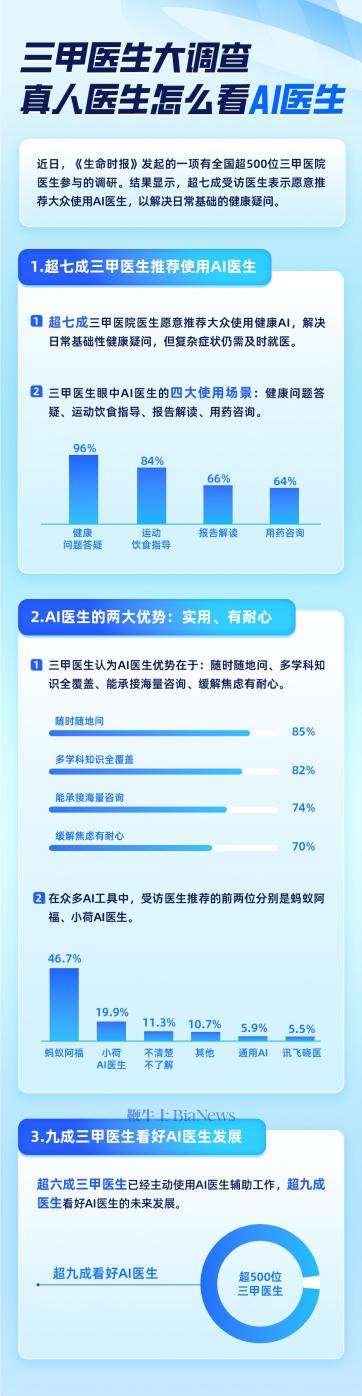
Core Insights - A recent survey conducted by Life Times involved over 500 doctors from top-tier hospitals, revealing that more than 70% of respondents are willing to recommend the use of AI doctors for addressing everyday health inquiries [1] - 62% of the surveyed doctors are already utilizing AI doctors to assist in their work, and 90% express optimism about the future development of AI doctors [1] Group 1: AI Doctor Adoption - Over 70% of surveyed doctors are willing to recommend AI doctors for basic health questions [1] - 62% of doctors are actively using AI doctors to support their work [1] - More than 90% of doctors are optimistic about the future of AI doctors [1] Group 2: AI Doctor Services - The trend of real doctors creating "AI avatars" to expand service reach is emerging in China [1] - More than 500 doctors from top-tier hospitals have established their own "AI avatars" on the health AI platform, Ant Ai Fu, providing 24/7 online consultation [1]
信任与怀疑之间,我们如何与AI医生共存?
3 6 Ke· 2026-01-09 02:19
Core Viewpoint - The rise of AI in healthcare presents both opportunities and risks, with users increasingly relying on AI applications for medical advice, but also facing potential dangers from inaccurate recommendations [1][3][5]. Group 1: AI in Healthcare Applications - Numerous AI diagnostic applications have emerged, with 101 medical AI models registered in China, providing easy access to healthcare advice without the need for professional equipment or appointments [3][14]. - AI is particularly effective in diagnosing common ailments like colds and stomach pain, helping to alleviate healthcare anxiety for users, especially those in areas with limited medical resources [3][14]. Group 2: Risks and Challenges - There have been alarming cases where users suffered serious health issues due to following AI-generated advice, such as a user developing bromine poisoning from incorrect dietary recommendations [5][8]. - AI's limitations in accurately diagnosing complex conditions can lead to misdiagnosis, as it relies on user-submitted information that may be incomplete or inaccurate [9][11]. Group 3: AI's Role in Medical Decision-Making - AI lacks the ability to perform comprehensive assessments that human doctors do, such as physical examinations and nuanced understanding of patient history, which are critical for accurate diagnosis [9][11]. - The technology is primarily trained on common diseases and may overlook rare but serious conditions, potentially delaying critical treatment [11][13]. Group 4: Industry Response and Future Directions - The industry is exploring solutions to improve AI's reliability, such as using high-confidence databases for training and shifting AI's role to support rather than replace human doctors [14][15]. - Current AI applications should focus on low-risk scenarios like medication reminders and health monitoring, while avoiding involvement in complex or urgent medical situations [17][19].