垂直整合创新引擎

Search documents
马斯克超级综合体:SpaceX+xAI……+特斯拉?
Hua Er Jie Jian Wen· 2026-02-04 04:02
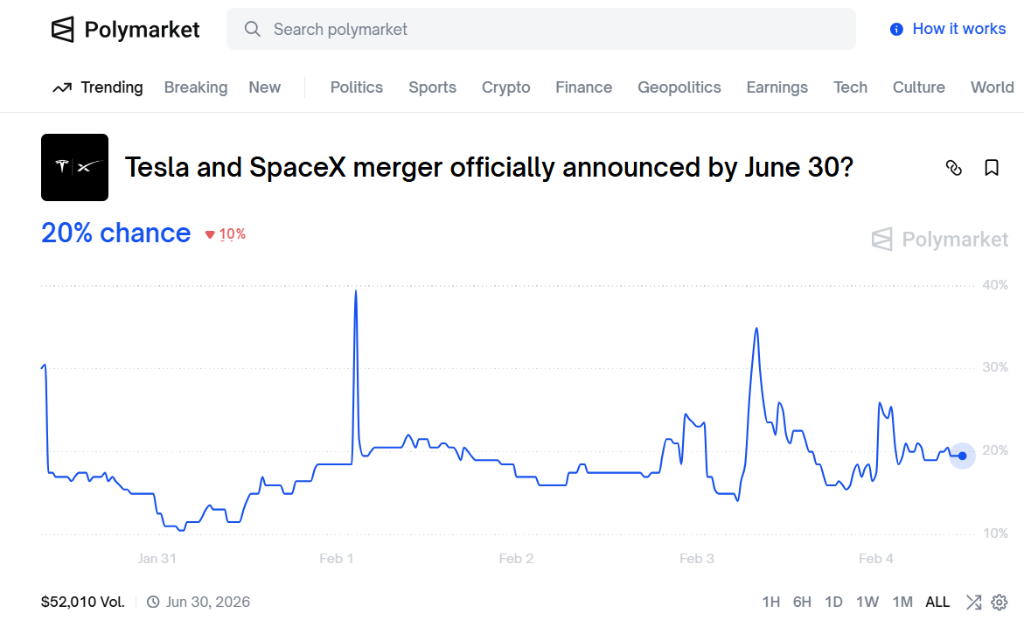
Core Insights - SpaceX has acquired xAI, with a combined valuation of approximately $1.25 trillion, consisting of $1 trillion for SpaceX and $250 billion for xAI [1] - Elon Musk aims to create a vertically integrated innovation engine to accelerate human progress through AI applications powered by solar energy [1] - The market is now speculating about a potential merger between Tesla and SpaceX/xAI, with contract probabilities on Polymarket increasing from 15% to 24% [1] Group 1: Acquisition Details - SpaceX's acquisition of xAI is strategically timed with its planned IPO in mid-2023 [1] - The share exchange ratio for the merger is set at 0.1433 shares of SpaceX for each share of xAI [5] - Tesla has invested $2 billion in xAI, highlighting its focus on AI-related opportunities such as Robotaxi and humanoid robots [4] Group 2: Market Reactions and Predictions - Analysts predict an increasing likelihood of Tesla merging with SpaceX/xAI in the next 12 to 18 months, as Musk seeks to control a larger AI ecosystem [4] - Social media speculation suggests Musk may acquire the stock ticker "X" from U.S. Steel as a preparatory step for the merger [4] Group 3: Capital Requirements and Integration Challenges - HSBC analysts indicate that capital needs may drive the potential merger, as Tesla plans to double its capital expenditures by 2026 [5] - The integration of SpaceX, xAI, and Tesla could be a solution to meet the substantial capital demands of their respective projects [5] - Concerns about valuation mismatches arise, with Tesla trading at approximately 200 times its projected 2026 earnings, while SpaceX is at nearly 400 times [7] Group 4: Business Logic Behind the Merger - The merger's rationale is rooted in the combination of computational power and energy, with SpaceX planning a "space cloud" of up to 1 million satellites to address power and cooling issues for AI data centers [8] - This strategic move aims to support SpaceX's ambitions in the public market and fund a satellite-based data center constellation [8]


Space X收购xAI,“火箭+AI+社交平台”超级巨头成型,马斯克剑指太空数据中心
硬AI· 2026-02-03 07:45
Core Viewpoint - SpaceX has acquired AI company xAI for $250 billion, aiming to integrate rocket, satellite internet, AI technology, and social media platforms, positioning itself as a leading private enterprise in the industry [2][3][4]. Group 1: Acquisition Details - The acquisition price of $250 billion is based on xAI's recent funding round of $20 billion [4]. - Musk's statement emphasizes the goal of creating "the most ambitious vertically integrated innovation engine on Earth and beyond" [4]. - The acquisition is part of Musk's broader strategy to restructure his business empire, following the previous merger of xAI with X [5][17]. Group 2: AI Data Center Strategy - Musk plans to establish a space-based AI data center, utilizing solar energy from space to meet global AI power demands without burdening communities and the environment [5][10]. - The strategy involves launching a constellation of 1 million satellites, which will generate significant AI computing power, estimated at 100 gigawatts annually [11]. - Musk predicts that within 2 to 3 years, space will become the most cost-effective method for generating AI computing capabilities [11]. Group 3: Starship's Role - The success of the space data center relies on the capabilities of the Starship rocket, which is expected to significantly increase payload capacity compared to current Falcon rockets [13][14]. - Starship will facilitate the launch of next-generation satellites, enhancing global connectivity and supporting the deployment of AI satellites into deeper space [13][14]. Group 4: Market Reactions and IPO Plans - Following the announcement of the merger, shares of EchoStar, a major shareholder in SpaceX, dropped nearly 12%, reflecting investor concerns about the complexity of the IPO process [6][7]. - SpaceX is planning an IPO that could raise up to $50 billion, with a projected valuation of approximately $1.5 trillion [6]. Group 5: Integration of Musk's Business Empire - This acquisition marks Musk's third significant corporate restructuring in recent years, further consolidating his various ventures into a cohesive business model [16][20]. - Musk's approach involves reallocating resources and personnel across his companies, which include Tesla, SpaceX, xAI, Boring Company, and Neuralink, creating a unified operational strategy [18][19].

7万亿独角兽正式诞生
21世纪经济报道· 2026-02-03 06:00
Core Viewpoint - SpaceX's acquisition of xAI aims to create a vertically integrated innovation engine that combines artificial intelligence, rocket technology, satellite internet, and real-time information platforms, addressing the limitations of ground-based energy for AI expansion [1][4][10]. Group 1: Acquisition Details - SpaceX officially announced the acquisition of xAI on February 2, 2026, as part of its strategy for vertical integration within its business empire [1]. - The merger is expected to leverage a space-based energy network to build a "stellar-level" AI computing infrastructure, overcoming physical limitations imposed by terrestrial energy sources [1][4]. - The specific terms of the acquisition have not been disclosed by either SpaceX or xAI [1]. Group 2: Company Backgrounds - SpaceX, founded in 2002, is the largest commercial rocket launch service provider globally, with capabilities in manufacturing, launching, recovering, and reusing rockets [4]. - xAI, established in 2023, focuses on AI development with a mission to understand the true nature of the universe, maintaining technical collaboration with platforms like X (formerly Twitter) and Tesla [5]. Group 3: Financial Implications - The merger is projected to create a trillion-dollar non-public company, with SpaceX's valuation reaching approximately $800 billion and xAI's post-funding valuation exceeding $230 billion [5][6]. - Following the merger, SpaceX's overall valuation is expected to rise to $1.25 trillion, making it one of the highest-valued private companies globally [6]. Group 4: Future Plans and Innovations - Musk envisions that space will become the most cost-effective location for AI computing power within the next 2 to 3 years, as current AI development faces physical limits due to energy demands [4][10]. - SpaceX plans to deploy a massive orbital data center system with up to 1 million satellites, which will utilize solar energy for AI computations, significantly reducing operational costs [11][12]. - The company aims to launch 100 tons of payload per hour and potentially deploy 500 to 1000 terawatts of AI satellites into deep space, supporting long-term goals of establishing a self-sustaining base on the Moon and advancing human civilization to Mars [11][12].
全球最贵独角兽诞生!SpaceX并购xAI构建天基算力网络
2 1 Shi Ji Jing Ji Bao Dao· 2026-02-03 04:17
Core Insights - SpaceX has officially acquired AI startup xAI to enhance its vertical integration strategy, driven by the demand for AI data centers in space [1][3] - The merger aims to create a "vertical integration innovation engine" that combines AI, rocket technology, satellite internet, and real-time information platforms [1][3] - The acquisition is expected to enable the construction of a "star-level" AI computing infrastructure utilizing space-based energy networks [1][3] Company Developments - SpaceX, founded in 2002, is the largest commercial rocket launch service provider globally, with capabilities in manufacturing, launching, recovering, and reusing rockets [3] - xAI, established in 2023, focuses on AI development and has launched its first large language model, Grok-1, showcasing unique real-time information processing capabilities [3][4] - The merger positions the combined entity as a trillion-dollar non-public giant, with SpaceX's valuation reaching approximately $800 billion and xAI's post-funding valuation exceeding $230 billion [4][6] Strategic Vision - Elon Musk emphasizes the need for space-based AI data centers to meet the growing global power demands of AI, which cannot be satisfied by terrestrial solutions [6][7] - Musk predicts that within 2 to 3 years, space will become the most cost-effective location for AI computing power, enabling unprecedented model training scales [7][8] - The plan includes launching a million satellites to create an orbital data center, which could generate significant AI computing capacity without ongoing operational costs [7][8] Future Plans - SpaceX aims to establish a permanent base on the Moon to utilize its resources for satellite manufacturing and deep space launches [8] - The company has submitted a proposal to the FCC to deploy up to 1 million satellites with advanced computing capabilities for AI model operations [8][9] - SpaceX's revenue for 2025 is projected to be between $15 billion and $16 billion, with a net profit of $8 billion, positioning the company for a potential IPO with a fundraising target exceeding $50 billion [9]