城市群协同模式

Search documents
29座万亿城市新格局:东北首现万亿之城,沪京并肩5万亿
2 1 Shi Ji Jing Ji Bao Dao· 2026-02-07 01:57
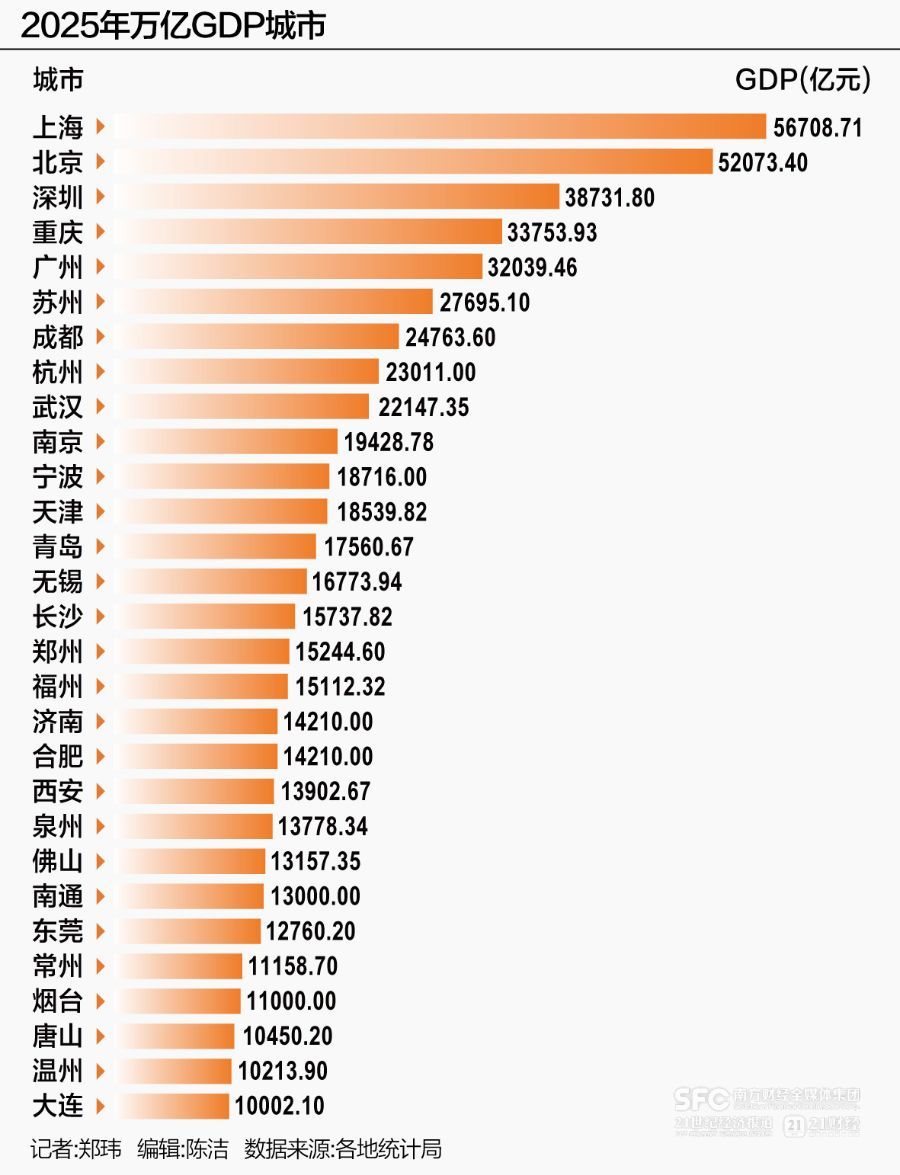
Core Insights - The economic landscape of Chinese cities is undergoing a transformation as Wenzhou and Dalian join the "trillion-yuan club," with Beijing and Shanghai also surpassing the 5 trillion yuan GDP mark, indicating a reshaping of the urban economic hierarchy [1][13][15] - The competition among these trillion-yuan cities is shifting from mere economic scale to a focus on quality of life, innovation ecosystems, and sustainable development [1][14] Economic Growth and Structure - By 2025, 29 cities in China are projected to have a GDP exceeding 1 trillion yuan, with Wenzhou and Dalian being the latest additions, while Shanghai and Beijing reach the 5 trillion yuan threshold [15][20] - Among these cities, 22 are expected to have GDP growth rates exceeding 5%, with Tangshan, Hefei, Yantai, and Wenzhou achieving over 6% [15][16] - The economic structure of these cities varies, with Shanghai and Beijing's growth driven by the tertiary sector, while Wenzhou and Dalian rely on robust industrial growth [16][21] Industrial Performance - In 2025, Beijing's GDP is projected to reach 52,073.4 billion yuan, with a 5.4% year-on-year growth, primarily driven by the information technology and financial sectors [18][19] - Shanghai's GDP is expected to hit 44,958.7 billion yuan, with a 6.0% growth rate, also supported by the service sector [19] - Wenzhou's industrial output is anticipated to grow by 10.3%, with significant contributions from the automotive and electrical industries [21][22] - Dalian's industrial output is projected to increase by 11.7%, with notable growth in the equipment manufacturing sector [22] Future Industry Focus - Many of these cities are now targeting artificial intelligence as a key industry for future development, with plans to integrate AI into various sectors [23][24] - Wenzhou aims to establish itself as a leader in AI innovation, while Dalian focuses on enhancing its digital economy and AI applications in traditional industries [24][25] - The emphasis on AI is seen as a means to drive technological advancement and improve overall economic quality [25][26] Urban Development Trends - The competition among cities is expected to evolve beyond GDP figures to include factors like technological innovation, cultural strength, and livability [26] - The development model is shifting from single-center cities to collaborative urban clusters, enhancing regional synergies and economic dynamism [26]
东北首现万亿GDP之城
21世纪经济报道· 2026-02-06 14:52
Core Insights - The article discusses the expansion of China's trillion-yuan cities, with 29 cities projected to reach this milestone by 2025, including Wenzhou and Dalian, which are new entrants to the trillion-yuan club [1][2][9] - The growth of these cities is characterized by varying economic structures, with leading cities like Shanghai and Beijing focusing on the tertiary sector, while new entrants like Wenzhou and Dalian rely on robust industrial growth [1][8][9] Group 1: Economic Growth and Structure - By 2025, 22 of the 29 trillion-yuan cities are expected to have GDP growth rates exceeding 5%, with Tangshan, Hefei, Yantai, and Wenzhou achieving over 6% [1][2] - Beijing's GDP is projected to surpass 5 trillion yuan for the first time, reaching 52,073.4 billion yuan with a growth rate of 5.4%, driven by significant contributions from the information technology and financial sectors [7][8] - Shanghai's GDP is also expected to grow, with the tertiary sector's value added reaching 44,958.7 billion yuan, growing at 6.0%, supported by strong performance in information technology services [8][9] Group 2: Industrial Performance - Wenzhou's GDP is projected to reach 10,213.9 billion yuan, growing by 6.1%, with significant contributions from the automotive and electrical industries, which saw increases of 19.0% and 13.6% respectively [9][11] - Dalian's GDP is expected to hit 10,002.1 billion yuan, with a growth rate of 5.7%, and notable growth in high-tech manufacturing, particularly in the computer and pharmaceutical sectors [10][11] Group 3: Future Industry Focus - Cities are increasingly focusing on artificial intelligence and high-tech industries as key areas for future development, with Shanghai and Beijing leading the charge in sectors like smart vehicles and advanced manufacturing [13][14] - Wenzhou aims to establish itself as a leader in AI innovation, targeting a revenue of 22 billion yuan from core AI industries [14] - Dalian plans to enhance its digital economy and AI capabilities, focusing on smart manufacturing and software engineering [14][16] Group 4: Urban Development Trends - The competition among cities is shifting from mere GDP growth to a more comprehensive evaluation that includes technological innovation, cultural strength, and livability [16][17] - The development model is evolving from single-center cities to collaborative urban clusters, exemplified by the Yangtze River Delta and the Guangdong-Hong Kong-Macau Greater Bay Area [16][17]

“万亿版图”重新洗牌,哪些城市要爆发
2 1 Shi Ji Jing Ji Bao Dao· 2026-02-06 13:20
Core Insights - In 2025, 29 cities in China will achieve a GDP of over 1 trillion yuan, with Wenzhou and Dalian being the latest additions to this group [1][9] - The expansion of the "trillion GDP cities" indicates a shift towards high-quality development, focusing on technology innovation and ecological livability rather than just scale [2][15] Economic Growth - 22 of the 29 trillion GDP cities will have a GDP growth rate exceeding 5%, with Tangshan, Hefei, Yantai, and Wenzhou surpassing 6% [1] - Beijing and Shanghai will both exceed 5 trillion yuan in GDP, with Beijing reaching 52,073.4 billion yuan and Shanghai 44,958.7 billion yuan in 2025 [5][7][8] Sector Contributions - The tertiary sector will lead growth in Beijing and Shanghai, with their respective growth rates at 5.8% and 6.0%, outpacing overall GDP growth [7][8] - Wenzhou and Dalian will rely on their secondary industries, with Wenzhou's industrial output growing by 10.3% and Dalian's by 11.7% [10][11] Industrial Focus - Wenzhou's industrial growth is driven by automotive and electrical industries, while Dalian focuses on heavy industry and high-tech manufacturing [10][11] - Both cities are adopting different paths to achieve their trillion GDP status, with Wenzhou leveraging its private economy and Dalian building on its industrial base [11] Future Industry Trends - Cities are increasingly focusing on artificial intelligence (AI) as a key industry for future development, with Shanghai and Beijing outlining plans for AI integration in various sectors [12][14] - The emphasis on AI reflects a broader trend towards enhancing technological capabilities and fostering high-quality economic growth [15] Urban Development Dynamics - The competition among cities is shifting from mere GDP comparisons to a multidimensional assessment that includes innovation capacity and quality of life [15] - The development model is evolving from single-center cities to collaborative urban clusters, enhancing regional synergies and growth potential [15]