装备制造等

Search documents
2零碳园区白皮书系列——赤峰高新技术产业开发区
荣续智库· 2026-03-02 09:25
Investment Rating - The report does not explicitly state an investment rating for the industry. Core Insights - The construction of zero-carbon parks is a crucial vehicle for achieving China's "dual carbon" goals and fostering green productivity, while also promoting the synergy between energy revolution and industrial transformation [5] - The Chifeng High-tech Industrial Development Zone is a national pilot area for carbon peaking, leveraging its abundant wind and solar resources to implement a series of green transformation practices [5][6] - The park aims to create a low-carbon development system through "green electricity supply + green manufacturing + resource recycling" [5] - The report emphasizes the importance of replicable and scalable zero-carbon development models to provide references for similar parks nationwide [5] Summary by Sections Overview - The report outlines the foundational conditions and practical paths for the construction of zero-carbon parks, highlighting achievements in energy structure optimization, industrial green upgrading, ecological protection, and institutional innovation [5] Policy Framework - The policy framework supporting the park's development aligns with national requirements for zero-carbon parks, ensuring comprehensive coverage of the necessary tasks [63][64] Construction Goals - The overall goal is to establish a national-level zero-carbon demonstration benchmark, with a focus on deepening zero-carbon transformation practices led by technological innovation [6] Key Tasks - The report identifies several key tasks, including: - Green electricity supply and consumption - Development of green low-carbon industries - Environmental facility greening - Carbon sink capacity enhancement - Resource recycling development [10][11] Supporting Projects - The report details several key supporting projects, including: - Green power construction projects - Infrastructure development projects - Carbon dioxide resource utilization projects [11] Future Recommendations - The report suggests ongoing efforts to enhance zero-carbon transformation practices, emphasizing the integration of energy and industry [6]
成都产业链高质量发展的实践探索与未来路径
Xin Lang Cai Jing· 2026-02-24 20:22
Core Viewpoint - Chengdu is focusing on high-quality development through industrial chain enhancement and innovation, aiming to establish a modern industrial system and improve its competitive edge in the global market [1][6]. Group 1: Industrial Cluster Development - Chengdu is promoting industrial clustering as a core form of high-quality development, transitioning from dispersed layouts to concentrated clusters through systematic policy design [2]. - The city has implemented a "chain leader + special class" mechanism to establish a focused industrial chain promotion system, creating a multi-level industrial cluster framework [2]. - Chengdu has formed trillion-level industrial clusters and hundreds of billion-level industrial chains, leading in the number of national advanced manufacturing clusters among sub-provincial cities [2]. Group 2: Innovation and Digital Transformation - Innovation is identified as the primary driver for high-quality industrial development, with Chengdu focusing on integrating innovation chains with industrial chains [3]. - The city has launched the "Smart Transformation" initiative, establishing a policy support system to facilitate digital transformation for small and medium-sized enterprises [4]. - Chengdu has achieved significant results in digital transformation, becoming the only city in the western region to win three national-level digital transformation pilot projects [4]. Group 3: Element Supply and Business Environment - Chengdu is addressing enterprise development challenges through institutional innovation to optimize resource allocation and enhance service efficiency [5]. - The city has introduced financial tools and investment funds to support key projects and small and medium-sized enterprises, ensuring land supply for priority industrial chains [5]. - Continuous improvement of the business environment has led to increased vitality in the private economy, fostering a favorable development landscape for state-owned, private, and foreign enterprises [5]. Group 4: Strategic Focus Areas - Chengdu is focusing on key areas to deepen the "building circles and strengthening chains" initiative, emphasizing innovation, ecological cultivation, and open collaboration [6][7]. - The city aims to enhance the overall competitiveness of industrial chains by promoting differentiated development of specialized industrial parks and supporting leading enterprises [7]. - Efforts are being made to accelerate industrial transformation and cultivate new productive forces, including the development of green manufacturing and strategic emerging industries [8]. Group 5: Global Integration - Chengdu is enhancing international industrial cooperation through initiatives like the China-Europe Railway Express and the Western Land-Sea New Corridor [8]. - The city is actively engaging in international capacity cooperation and promoting the "Chengdu-made, global sales" campaign to strengthen its manufacturing brand [8]. - Chengdu is working to align with international high-standard trade rules to create a market-oriented, law-based, and international business environment [8].
“万亿版图”重新洗牌,哪些城市要爆发
2 1 Shi Ji Jing Ji Bao Dao· 2026-02-06 13:20
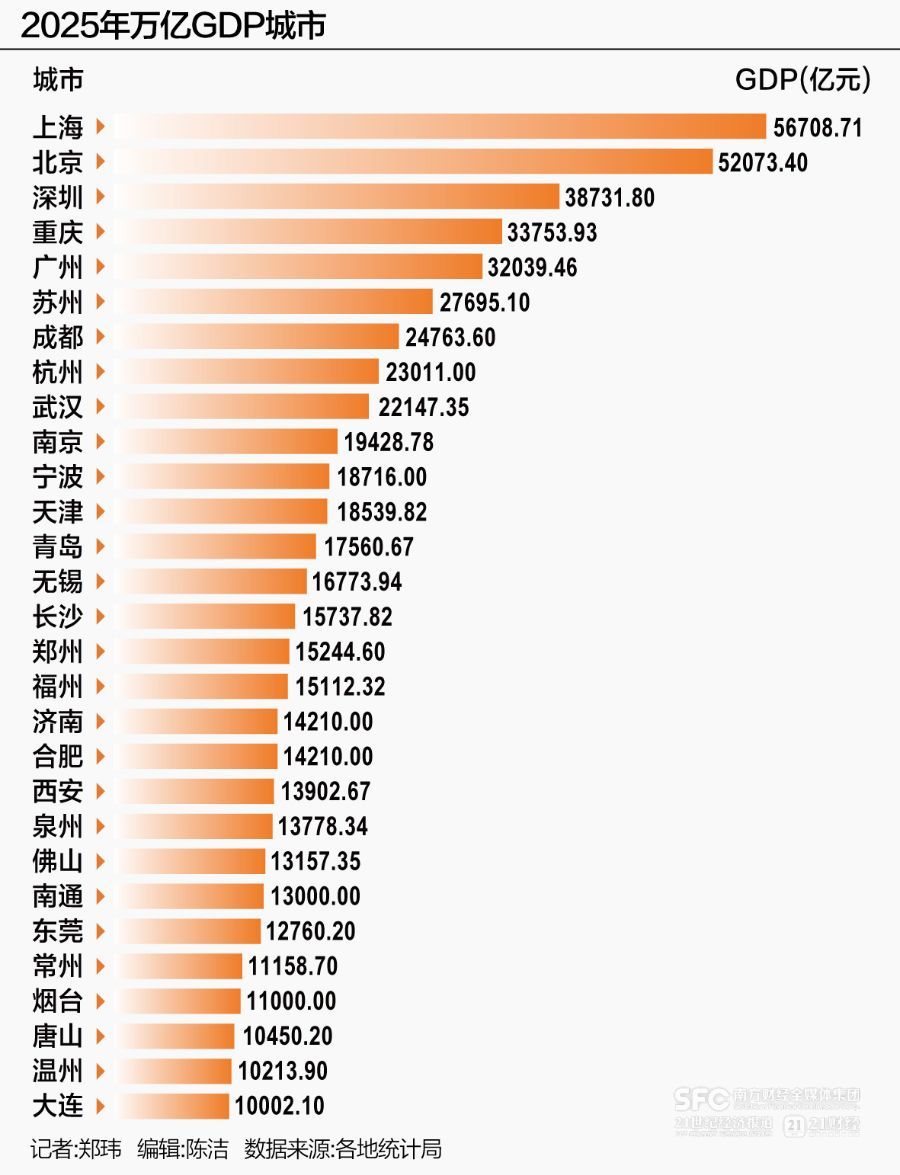
Core Insights - In 2025, 29 cities in China will achieve a GDP of over 1 trillion yuan, with Wenzhou and Dalian being the latest additions to this group [1][9] - The expansion of the "trillion GDP cities" indicates a shift towards high-quality development, focusing on technology innovation and ecological livability rather than just scale [2][15] Economic Growth - 22 of the 29 trillion GDP cities will have a GDP growth rate exceeding 5%, with Tangshan, Hefei, Yantai, and Wenzhou surpassing 6% [1] - Beijing and Shanghai will both exceed 5 trillion yuan in GDP, with Beijing reaching 52,073.4 billion yuan and Shanghai 44,958.7 billion yuan in 2025 [5][7][8] Sector Contributions - The tertiary sector will lead growth in Beijing and Shanghai, with their respective growth rates at 5.8% and 6.0%, outpacing overall GDP growth [7][8] - Wenzhou and Dalian will rely on their secondary industries, with Wenzhou's industrial output growing by 10.3% and Dalian's by 11.7% [10][11] Industrial Focus - Wenzhou's industrial growth is driven by automotive and electrical industries, while Dalian focuses on heavy industry and high-tech manufacturing [10][11] - Both cities are adopting different paths to achieve their trillion GDP status, with Wenzhou leveraging its private economy and Dalian building on its industrial base [11] Future Industry Trends - Cities are increasingly focusing on artificial intelligence (AI) as a key industry for future development, with Shanghai and Beijing outlining plans for AI integration in various sectors [12][14] - The emphasis on AI reflects a broader trend towards enhancing technological capabilities and fostering high-quality economic growth [15] Urban Development Dynamics - The competition among cities is shifting from mere GDP comparisons to a multidimensional assessment that includes innovation capacity and quality of life [15] - The development model is evolving from single-center cities to collaborative urban clusters, enhancing regional synergies and growth potential [15]

2025年研发投入1.1万亿元、战略性新兴产业营收规模增长万亿元 两个万亿元,标注国资央企创新刻度(权威发布)
Ren Min Ri Bao· 2026-01-28 22:08
Core Insights - The State-owned Assets Supervision and Administration Commission (SASAC) announced that central enterprises achieved a total profit of 2.5 trillion yuan, fixed asset investment of 5.1 trillion yuan, and tax contributions of 2.5 trillion yuan by 2025, with total assets exceeding 95 trillion yuan by the end of 2025 [1] Group 1: Scale and Performance - During the 14th Five-Year Plan period, the total assets of central enterprises increased significantly, with an average annual growth rate of 6.9%, reaching over 90 trillion yuan [2] - The added value of central enterprises reached 51.3 trillion yuan, a 44.6% increase compared to the previous five-year period, while total profits grew by 56.2% to 12.7 trillion yuan [2] - Key product outputs showed stable growth, with crude oil production increasing by 24.7%, and electricity generation and sales rising by 38.2% and 40.7% respectively [2] Group 2: Innovation and R&D - Central enterprises invested over 5 trillion yuan in R&D during the 14th Five-Year Plan, with a nearly 50% increase in the number of scientific and technological personnel [2][3] - By 2025, R&D investment is projected to reach 1.1 trillion yuan, with significant achievements in major national technology projects [3] - Central enterprises are leading or participating in all 22 major national technology projects, overcoming 121 leading technologies [3] Group 3: Strategic Emerging Industries - In 2025, revenue from strategic emerging industries exceeded 12 trillion yuan, with a 41.8% share of total investment [4] - Central enterprises have invested over 10 trillion yuan in strategic emerging industries since the beginning of the 14th Five-Year Plan [4][5] - The focus on emerging industries is essential for optimizing structural layouts and ensuring future development [5] Group 4: Traditional Industry Transformation - Central enterprises are upgrading traditional industries by establishing smart factories and promoting green and intelligent transformations [6] - The construction of 70 excellent-level smart factories and 39 projects included in the national green low-carbon advanced technology demonstration project list reflects this transformation [6] Group 5: Technology and Infrastructure - Central enterprises are actively embracing artificial intelligence and investing in new infrastructure, enhancing computational resources to support large model training [7] - The development of high-value application scenarios in key industries such as energy and manufacturing is underway, with over 1,000 application scenarios being created [7] Group 6: Future Goals and Strategies - In 2026, central enterprises will focus on ensuring continuous growth in added value and optimizing various performance indicators [9] - The emphasis will be on enhancing technological innovation, with plans to increase the proportion of basic research investment and tackle key technologies [9] - Central enterprises will also accelerate the construction of pilot verification platforms to facilitate the transformation of innovative achievements into productive forces [9]
重塑产业格局,“三级五集群”如何精准发力
Qi Lu Wan Bao· 2026-01-21 00:38
Core Viewpoint - The "three-level five-cluster" industrial new pattern is a key strategic layout for Yantai during the 14th Five-Year Plan period, aiming to transform the industrial structure and enhance competitiveness [1][2]. Group 1: Strategic Framework - The first level of the industrial cluster includes five major sectors: green chemical, non-ferrous and precious metals, equipment manufacturing, deep processing of food, and modern services, which are the current economic foundation of Yantai [2]. - The second level encompasses emerging industries such as electronic information, advanced structural materials, biomedicine, clean energy, and commercial aerospace, which are crucial for industrial transformation [2]. - The third level focuses on future industries like intelligent robotics, smart connected vehicles, low-altitude intelligent aviation, cell and gene therapy, and hydrogen and LNG comprehensive utilization, representing Yantai's long-term competitiveness [2]. Group 2: Implementation Challenges - The industrial clusters are "large but not strong," with low value chains and collaboration, indicating a need for stronger internal ecosystems and better integration among enterprises [3][5]. - Digital transformation for enterprises faces significant barriers, including insufficient internal motivation, lack of standardized market services, and a shortage of skilled talent, which hampers the effective release of policy benefits [3][4]. - Future industries are still in their infancy, with inadequate infrastructure and weak local ecosystems, highlighting the gap between necessary support and current conditions [4][5]. Group 3: Breakthrough Paths - Leveraging artificial intelligence is seen as a critical breakthrough, with suggestions to transition from "digital transformation" to "intelligent leap" in manufacturing [6]. - Focusing on niche areas, such as the high-end submarine cable project, can provide Yantai with a unique competitive advantage in the marine economy [6]. - Innovating industrial collaboration mechanisms is essential for enhancing cluster effects, with recommendations to establish platforms for cooperation between leading and small enterprises [6]. - Building a robust ecosystem that includes capital, infrastructure, and talent is crucial for long-term support of industrial upgrades [6].
中集集团:12月18日召开董事会会议
Mei Ri Jing Ji Xin Wen· 2025-12-18 12:56
Core Viewpoint - The announcement from China International Marine Containers (Group) Co., Ltd. (CIMC) highlights the company's ongoing related party transactions and its revenue composition for the first half of 2025, indicating a diversified business model across various sectors [1]. Group 1: Company Announcements - CIMC held its 16th board meeting for the year 2025 on December 18, 2025, via telecommunication to review proposals related to ongoing related party transactions with Shenzhen Financing Leasing (Group) Co., Ltd. [1] Group 2: Financial Performance - For the first half of 2025, CIMC's revenue composition is as follows: containers accounted for 27.7%, logistics services for 17.68%, energy and chemical equipment and liquid food equipment for 16.88%, road transport vehicles for 11.15%, marine engineering for 10.44%, and other industries for 6.87% [1]. - As of the report date, CIMC's market capitalization stands at 48.1 billion yuan [2].

成都擘画未来新蓝图,确立“五中心”“五地”新定位
第一财经· 2025-12-12 00:34
Core Viewpoint - Chengdu has established a new strategic positioning for the "14th Five-Year Plan" period, aiming to accelerate the construction of various centers and bases, including economic, technological, cultural, and advanced manufacturing centers, as well as a high-quality living environment [1][3][4]. Strategic Positioning - The new positioning includes five centers: national important economic center, technological innovation center, international communication center, international consumption center, and cultural creativity center [6][8]. - Additionally, it identifies five key areas: important carrier of national strategic scientific forces, advanced manufacturing base, digital cultural and creative industry gathering place, new high ground for reform and opening up, and high-quality livable area [9][10]. Economic Goals - Chengdu's GDP is projected to grow from 1.77 trillion yuan in 2020 to 2.35 trillion yuan by 2024, aiming for a total economic output exceeding 3.2 trillion yuan by the end of the "15th Five-Year Plan" period [4][6]. - The city aims to maintain an annual economic growth rate higher than the provincial average and to have over 16 counties and districts ranked among the national top 100 [4][6]. Development Strategies - The development strategy emphasizes "innovation-driven, open-led, integration of science and industry, and strong counties supporting districts" to address the constraints on high-quality development [5][14]. - Specific tasks include enhancing technological innovation, promoting advanced manufacturing, and building a digital economy [14][15]. Cultural and Creative Industry - Chengdu plans to accelerate the development of the digital cultural and creative industry, with a target of exceeding 410 billion yuan by 2025 and 600 billion yuan by 2030 [10][11]. - The city has implemented a comprehensive policy package to support the digital cultural and creative industry, including the establishment of a 3 billion yuan fund for sci-fi and future industries [10]. Action Plans - The "15th Five-Year Plan" outlines eight key tasks to ensure the implementation of the strategic positioning, focusing on integrating into national strategies and enhancing regional coordination [14][15]. - Specific initiatives include promoting urbanization, rural revitalization, and improving the quality of life for residents through various social and economic measures [17][18].

产业大脑|长三角万亿城市产业布局“星图”
Sou Hu Cai Jing· 2025-11-27 23:05
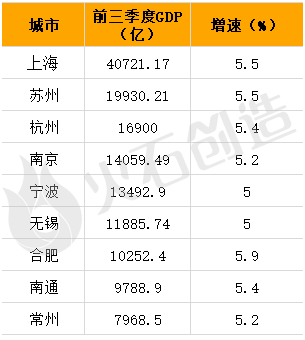
Core Viewpoint - The trillion-yuan cities in the Yangtze River Delta are crucial growth engines for China's economy, contributing significantly to national economic growth and industrial upgrading [1] Economic Performance - In the first three quarters of 2025, the trillion-yuan cities in the Yangtze River Delta demonstrated stable economic performance, with Shanghai leading at an economic total of 40,721.17 billion yuan, followed by Suzhou and Hangzhou [1][2] - Hefei recorded the highest growth rate in the region at 5.9%, while Shanghai and Suzhou both achieved a growth rate of 5.5% [1][2] Industrial Structure - Shanghai has established a modern industrial system framework of "(2+2)+(3+6)+(4+5)", focusing on advanced manufacturing and modern services, as well as digital and green transformations [3][4] - Suzhou's "1030" industrial system emphasizes ten key industrial clusters and thirty key industrial chains, with electronic information, high-end equipment, and advanced materials being the core drivers of its economy [5][6] - Hangzhou is recognized as the "digital economy capital," developing a modern industrial system led by digital economy and multi-industry collaboration, with a focus on advanced manufacturing clusters [8] - Nanjing is building a competitive industrial cluster with a focus on software and information services, intelligent manufacturing, and new energy vehicles [9][10] - Ningbo has developed a "361" industrial cluster system, focusing on digital industries and high-end equipment while maintaining traditional industries [11] - Wuxi has established a "465" modern industrial system, focusing on IoT, integrated circuits, and biomedicine [13][14] - Hefei has rapidly developed a "6+5+X" industrial cluster system, emphasizing new energy vehicles and advanced information technology [15][16] - Nantong's "616" industrial system focuses on shipbuilding and marine engineering, with a complete industrial chain [17][18] - Changzhou has created a "1028" modern industrial system, emphasizing advanced manufacturing and modern services [19][20] Conclusion - The nine trillion-yuan cities in the Yangtze River Delta collectively represent a vibrant and resilient economic landscape in China, characterized by diverse industrial systems and sustained economic growth [21]
品成都“投资盖碗茶”,蒲江精准对话外资企业
Sou Hu Cai Jing· 2025-11-19 11:51
Group 1 - The core idea of the event is to leverage the geographical advantages of Pujiang to expand into the environmental protection market in Central and Western China, aligning with the green development philosophy of the region [1] - The event, guided by the Chengdu Investment Promotion Bureau and hosted by the local government, aimed to connect over 40 enterprises and associations from Germany, Belgium, the United States, and other regions, focusing on cooperation opportunities in biomanufacturing, green food, and equipment manufacturing [1][3] - The promotion highlighted Pujiang's unique advantages in international cooperation, showcasing its industrial layout and functional area development, which instilled confidence in attending enterprises regarding the region's growth prospects [3] Group 2 - The event facilitated practical communication between enterprises and local government officials regarding project implementation processes, cross-border service support, and industrial chain matching [4] - Several enterprises expressed intentions to visit Pujiang for on-site inspections to convert cooperation intentions into substantial projects [4] - The promotion is part of a broader strategy to deepen foreign investment cooperation and enhance Pujiang's service system for foreign capital, aiming to contribute to Chengdu's development as an international open highland [5]

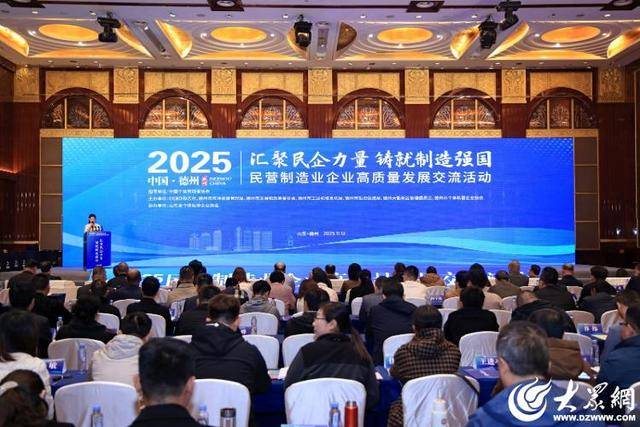
2025民营制造业企业高质量发展交流活动在德州举办
Sou Hu Cai Jing· 2025-11-12 10:46
Core Viewpoint - The event aims to promote high-quality development in the private manufacturing sector, emphasizing its crucial role in the economy and the importance of innovation and quality in building a strong manufacturing nation [3][11]. Group 1: Event Overview - The high-quality development exchange event for private manufacturing enterprises was held in Dezhou, attended by over 120 representatives from key private manufacturing companies across 17 provinces [1]. - The event was guided by the China Individual Laborers Association and co-hosted by various local government departments, focusing on the theme "Gathering Private Enterprise Strength to Forge a Manufacturing Power" [11]. Group 2: Key Messages from Officials - Wang Haidong acknowledged the achievements of Shandong Province and Dezhou in private manufacturing, highlighting its role as a pillar of the real economy and a main force in building a strong manufacturing nation [3]. - Chen Xiaoqiang, representing the Dezhou government, expressed a commitment to providing optimal services and a conducive environment for national enterprises to deepen cooperation [4]. - Zhou Hailiang emphasized the need for a high-level platform for idea exchange and cooperation, aiming to address the challenges faced by private enterprises and ensure that policy benefits reach the grassroots level [6]. Group 3: Industry Insights and Innovations - Representatives from leading companies shared their experiences in smart manufacturing upgrades, digital transformation, and the establishment of green manufacturing systems, providing replicable development paths for attendees [7]. - The event included a practical examination of key enterprises in Dezhou's high-end equipment, sports, and healthcare industries, showcasing innovative models and practical outcomes in promoting high-quality manufacturing [7]. Group 4: Networking and Collaboration - A large screen displayed contact information for numerous private manufacturing leaders, facilitating efficient connections among participating entrepreneurs [9].