
增值税出口退税政策调整

Search documents
集运指数(欧线):关注中东地缘事态,弱势运行
Guo Tai Jun An Qi Huo· 2026-01-15 01:51
Group 1: Investment Rating - There is no information about the industry investment rating in the provided text. Group 2: Core View - The container shipping index (European line) maintained a volatile trend yesterday. The main 2604 contract closed at 1,230.5 points, with an increase of 1,274 lots and a decline of 0.21%. The second - main 2602 contract closed at 1,718 points, with a decrease of 1,401 lots and a decline of 1.18% [11]. - The shipping capacity after the Spring Festival in 2026 has a relatively large growth rate, and the shipping capacity pressure after the festival is relatively greater. Although there is a marginal positive effect of the rush - shipment of photovoltaic and battery products in the first quarter, it cannot reverse the weak supply - demand balance trend of the European line in March - April. The 2602 contract should be mainly observed, the 2604 contract short positions should be held, and the 2610 contract short positions should be lightly held and short positions should be placed on rallies in the medium - to - long term [12][13][15]. Group 3: Summary by Related Catalogs 1. Fundamental Tracking - **Futures Data**: The EC2602 contract closed at 1,718.0, down 1.18%, with a trading volume of 5,642 and an open interest of 10,461, a decrease of 1,401. The EC2604 contract closed at 1,230.5, up 0.21%, with a trading volume of 45,075 and an open interest of 40,044, an increase of 1,274 [1]. - **Freight Index**: The SCFIS European route was 1,956.39 points, with a weekly increase of 8.9%. The SCFIS US - West route was 1,323.98 points, with a weekly increase of 5.9%. The SCFI European route was $1,719/TEU, with a bi - weekly increase of 1.7%. The SCFI US - West route was $2,218/FEU, with a bi - weekly increase of 1.4% [1]. - **Spot Freight Rates**: Different carriers' freight rates from Shanghai to Rotterdam vary, such as Maersk's $2,420/40'GP and $1,510/20'GP [1]. - **Exchange Rates**: The US dollar index was 99.18, and the US dollar against the offshore RMB was 6.97 [1]. 2. Macro News - The US special envoy announced the launch of the second phase of the "Twenty - Point Plan" to end the Gaza conflict, which includes establishing a transitional Palestinian technocratic government in Gaza and starting the demilitarization and reconstruction of the Gaza Strip [10][13]. - Palestinian factions reached a consensus on the requirements for the second phase of the Gaza cease - fire agreement, including establishing an independent committee to manage Gaza [10]. 3. Shipping Capacity Analysis - In January, there are no undetermined voyages, with a weekly average shipping capacity of 309,000 TEU/week, a year - on - year increase of 3.2% and a month - on - month decrease of 3.4%. In February, there are 11 blank sailings, with a weekly average shipping capacity of 271,000 TEU/week, a year - on - year increase of 17.2% and a month - on - month decrease of 12.5%. In March, there are 9 blank sailings and 2 undetermined voyages, with a weekly average shipping capacity of 284,000 TEU/week, a year - on - year increase of 5.4% and a month - on - month increase of 5% [12]. - The average shipping capacity before, during, and after the Spring Festival in 2026 is 313,000, 221,000, and 307,000 TEU respectively, with year - on - year growth rates of 2.3%, 3.3%, and 20.4% [12]. 4. Demand Analysis - In January, most shipping companies felt that the BCO/NVO cargo volume was good, but the FAK side was average. The cargo volume usually peaks around mid - January and then declines [13]. - The cancellation and reduction of export tax rebates for photovoltaic and battery products from April 1, 2026, are expected to boost the overall demand for container shipping (European line) from January to March, but have a marginal negative impact on the demand after April [13]. 5. Spot Freight Rate Forecast - The forecast is that the FAK average in the 3rd - 4th week may be lowered to the range of $2,600 - 2,670/FEU, setting the tone for the first - phase delivery settlement price of the 2602 contract on January 26 [14]. 6. Contract Strategy - For the 2602 contract, it is recommended to mainly observe. Under a neutral - to - pessimistic freight scenario, its valuation center may fall in the range of 1,700 - 1,750 points [15]. - For the 2604 contract, short positions should be held. The short - term target range is 1,050 - 1,100 points, and the upper resistance range is 1,200 - 1,250 points [15]. - For the 2610 contract, short positions should be lightly held, and short positions should be placed on rallies in the medium - to - long term. The upper resistance level refers to the delivery settlement price of the 2510 contract, which is 1,161 points [15]. 7. Trend Intensity - The trend intensity of the container shipping index (European line) is - 1, indicating a relatively bearish view [16].
华泰期货:集运指数(欧线)期货昨日大涨,关注船司定价是否有变
Xin Lang Cai Jing· 2026-01-13 01:58
Core Viewpoint - The cancellation of the VAT export tax rebate policy for photovoltaic products may impact shipping companies' pricing behavior, leading to potential upward adjustments in the valuation of the 02 contract [2][3][9] Group 1: Shipping Pricing and Contract Valuation - The 02 contract valuation is expected to face upward revision risks due to the cancellation of the VAT export tax rebate policy [3][9] - Shipping companies' pricing behavior is under scrutiny, particularly regarding Maersk's quotes in the last week of January and potential price increases in February [2][3] - The MSC price for the second half of January is reported at $2840/FEU, remaining stable compared to the first half, while Maersk's quote for the last week of January from Shanghai to Rotterdam is $2700/FEU, reflecting a $100/FEU increase [2][8] Group 2: Market Dynamics and Seasonal Trends - There is an urgent shipping demand from some solar photovoltaic companies following the policy change, leading to potential export rush [3][9] - The cancellation of the VAT export tax rebate may disrupt the shipping rhythm for the industry, particularly affecting the 04 contract's seasonal characteristics, with expected increased volatility [3][9] - Historically, April and October are the lowest months for shipping rates, and the recent policy change may alter the shipping volume and actual rates compared to typical years [3][9]


4月1日起,取消光伏等产品增值税出口退税!
中国有色金属工业协会硅业分会· 2026-01-12 01:03
Core Viewpoint - The Ministry of Finance and the State Taxation Administration announced the cancellation of VAT export tax rebates for photovoltaic products starting from April 1, 2026, and a reduction in the VAT export tax rebate rate for battery products from 9% to 6% until December 31, 2026, with a complete cancellation effective January 1, 2027 [1][2][4]. Group 1 - From April 1, 2026, the VAT export tax rebate for photovoltaic products will be canceled [1][2]. - The VAT export tax rebate rate for battery products will be reduced from 9% to 6% from April 1, 2026, to December 31, 2026 [4]. - The VAT export tax for battery products will be completely canceled starting January 1, 2027 [4]. Group 2 - The export consumption tax policy for products subject to consumption tax will remain unchanged, continuing to apply the consumption tax rebate (exemption) policy [4]. - The applicable export tax rebate rates for the listed products will be determined based on the export date indicated on the customs declaration [5].
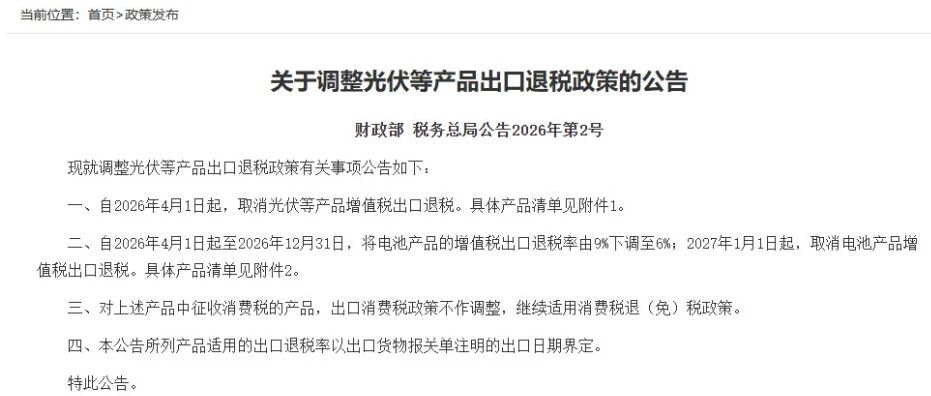
4月1日起,取消光伏等产品增值税出口退税
第一财经· 2026-01-09 10:21
Core Viewpoint - The Ministry of Finance and the State Taxation Administration announced changes to the export tax refund policies for photovoltaic products and battery products, effective from April 1, 2026, which may impact the industry dynamics and profitability of companies involved in these sectors [1] Group 1 - From April 1, 2026, the export tax refund for photovoltaic products will be canceled [1] - The export tax refund rate for battery products will be reduced from 9% to 6% from April 1, 2026, until December 31, 2026 [1] - Starting January 1, 2027, the export tax refund for battery products will also be canceled [1] Group 2 - The announcement specifies that products subject to consumption tax will not see changes in their export consumption tax policies, which will continue to apply [1] - The applicable export refund rates for the listed products will be determined based on the export date indicated on the customs declaration [1]
财政部、税务总局:自2026年4月1日起,取消光伏等产品增值税出口退税
Sou Hu Cai Jing· 2026-01-09 10:15
Core Viewpoint - The Ministry of Finance and the State Taxation Administration announced the cancellation of export VAT rebates for photovoltaic products starting April 1, 2026, with a reduction in the VAT export rebate rate for battery products from 9% to 6% until December 31, 2026, followed by a complete cancellation from January 1, 2027 [1] Summary by Category Policy Changes - From April 1, 2026, the export VAT rebate for photovoltaic products will be eliminated [1] - The VAT export rebate rate for battery products will be reduced from 9% to 6% from April 1, 2026, to December 31, 2026 [1] - Starting January 1, 2027, the export VAT rebate for battery products will also be canceled [1] Taxation Implications - The consumption tax policy for products subject to consumption tax will remain unchanged, continuing to apply the consumption tax rebate (exemption) policy [1] - The applicable export rebate rates for the listed products will be determined based on the export date indicated on the customs declaration [1]
财政部:自2026年4月1日起,取消光伏等产品增值税出口退税
Ge Long Hui· 2026-01-09 09:57
Group 1 - The Ministry of Finance announced the cancellation of the export VAT rebate for photovoltaic products starting from April 1, 2026 [1] - From April 1, 2026, to December 31, 2026, the export VAT rebate rate for battery products will be reduced from 9% to 6% [1] - The export VAT rebate for battery products will be completely eliminated starting January 1, 2027 [1]