
复苏预期

Search documents
中信建投:金价与纳指同涨同跌或不持久 美股后市关注基本面数据
智通财经网· 2025-11-20 00:13
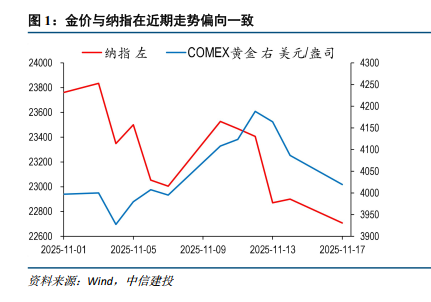
Core Viewpoint - The correlation between gold prices and the Nasdaq index has increased since November, raising concerns about deeper underlying risks, despite liquidity shocks in the money market not being the primary cause [1][2][6]. Group 1: Market Trends - Since November, gold and Nasdaq have shown multiple instances of simultaneous increases and decreases, indicating a rising correlation between a risk asset and a safe-haven asset [2][3]. - For example, on November 4, the Nasdaq fell by 2% while gold dropped by 1.8%, and on November 10, the Nasdaq rose by 2.3% alongside a 2.8% increase in gold [2]. Group 2: Economic Factors - The tightening of the money market and rising funding rates are not likely the main reasons for the observed trends, as liquidity pressures have eased following the resolution of government shutdowns [6][10]. - The underlying driver appears to be concerns over Federal Reserve tightening amid recovery expectations, which often leads to unified movements in major asset classes [7][10]. Group 3: Historical Context - An analysis of the correlation between gold and the Nasdaq throughout the year reveals that their relationship has fluctuated based on economic conditions and Federal Reserve expectations [8]. - In early 2023, trade tensions and recession fears led to a divergence between gold and Nasdaq, while in the third quarter, both benefited from lower interest rate expectations, resulting in increased correlation [8]. Group 4: Future Outlook - The recent simultaneous movements of gold and Nasdaq may not indicate a deeper liquidity crisis, and such trends may not persist long-term [10]. - Future attention should be directed towards fundamental data; if improvements are confirmed, gold prices may face upward resistance while overall risks in the U.S. stock market remain low [10].


金信期货日刊-20250820
Jin Xin Qi Huo· 2025-08-20 01:03
Group 1: Urea Futures - The urea futures price soared on August 19, with the main contract rising by 62 yuan, or 3.53%, to close at 1789 yuan. The surge was mainly due to the unexpectedly high tender offer for urea imports by India's IPL company [3]. - On the supply side, the daily output of the urea industry remained at a high level of 190,900 tons (a week - on - week increase of 50 tons on August 5), the total enterprise inventory climbed to 917,300 tons (a week - on - week increase of 58,500 tons on July 30), and the production enterprise operating rate was 84.93% (a week - on - week increase of 1.58%), indicating high supply elasticity [3]. - On the demand side, it showed the characteristics of "weak domestic demand and uncertain exports". The operating rate of compound fertilizer plants in North and Central China increased slowly, the raw material inventory could be used for about 7 days, and the purchasing willingness was low. Agricultural demand entered a seasonal off - season, and the grass - roots stocking willingness was lacking. Although the export port inspection policy was relaxed, the actual order conversion had not increased significantly [3]. - There are differences in the market regarding the subsequent trend. The bearish view believes that urea is in a pattern with support below and suppression above, and the abundant supply pattern remains unchanged, expecting a weakening oscillation. The cautiously optimistic group points out that the current price is not high, the room for continuous decline is limited, and although one should not be overly optimistic about the upside, the export theme may still ferment [3]. Group 2: Stock Index Futures - News: Li Qiang proposed to further improve the implementation efficiency of macro - policies and stabilize market expectations. Many securities brokerage business departments saw a peak in customer consultations [7]. - Operation: The short - term market will continue to oscillate upward at a high level [7]. Group 3: Gold - The July non - farm payrolls data was significantly lower than expected, especially the significant downward revision of the data for May and June, indicating that the US economy is not as strong as expected. The probability of an interest rate cut in September has increased, which is beneficial to gold. Currently, the weekly adjustment is relatively sufficient, and it is in a short - term small - range oscillation on a platform [11]. Group 4: Iron Ore - The fundamentals are relatively strong as steel mills' profitability has improved, leading to high pig iron production. Also, under the call against involution, the state of the black industrial chain is relatively healthy, showing a resonance upward trend [15][16]. - Technically, it continued to adjust today, and it should be treated as a high - level wide - range oscillation in the near future [15]. Group 5: Glass - The macro - environment has improved and is continuously strengthening under the recovery expectation. The supply - demand situation has slightly improved, but the recovery of terminal deep - processing orders is still weak. The recent market drive mainly comes from the domestic economy [19][20]. - Technically, the lower support is effective, and a low - buying strategy should be maintained [19]. Group 6: Methanol - Last week, the methanol port inventory continued to accumulate. Although the提货 in the mainstream storage areas in East China increased slightly due to a small amount of re - exports and ship departures, the stable supply of foreign vessels led to continuous inventory accumulation. It should be treated with a bearish and oscillating view [22].