外汇对冲比率

Search documents
高盛外汇交易员:下跌才刚刚开始,美元迎来新一轮贬值
Hua Er Jie Jian Wen· 2026-01-28 03:41
Group 1 - The core viewpoint is that the US dollar index has experienced a significant decline, dropping over 3% in the past six trading days, marking the largest six-day drop since April 2025. Goldman Sachs predicts that this depreciation is just beginning, with the dollar index potentially falling further to 92.75, a four-year low, in the coming months [1][2]. - Goldman Sachs' foreign exchange team highlights three main currencies—Yen, Renminbi, and Euro—that are moving in the direction of dollar depreciation. A key driver of this trend has been the New York Fed's inquiry into the dollar-to-yen exchange rate, signaling a stronger government involvement compared to previous years [1][2]. - The narrative of the "exceptionalism" of the US dollar is coming to an end, as various factors are aligning to prepare for the next round of declines. Reports of European pension funds reducing their exposure to US assets are increasing, contributing to the dollar index nearing a four-year low [3]. Group 2 - The US government's approach to the foreign exchange market is becoming more proactive, as indicated by the New York Fed's inquiry into the dollar-to-yen exchange rate, which reflects a heightened concern for exchange rate levels by the current administration [2]. - The weakening of the dollar is causing concerns about cross-asset correlations, which may lead investors to adjust their foreign exchange hedging ratios. Australian pension funds are currently at historical lows in their foreign exchange hedging ratios, prompting discussions about increasing these ratios [3].

道富策略师:日元短期或波动 135–140仍是中长期关键区间
Xin Hua Cai Jing· 2025-12-19 05:33
Core Viewpoint - The article discusses the potential implications of the Bank of Japan's (BOJ) monetary policy decisions, particularly regarding interest rates and the Japanese yen's exchange rate against the US dollar [1] Group 1: Market Analysis - Masahiko Loo, a senior fixed income strategist at State Street Global Advisors, suggests that if the BOJ raises interest rates in the future, the market may interpret it as a "dovish hike," leading to short-term fluctuations in the yen [1] - Despite potential short-term volatility, the yen is expected to be supported in the medium to long term by two factors: increased expectations of the Federal Reserve shifting to a loose monetary policy and Japanese investors gradually increasing their foreign exchange hedging ratios from historically low levels [1] Group 2: Future Expectations - Loo maintains a long-term target for the USD/JPY exchange rate in the range of 135-140 [1] - The focus is shifting to the upcoming press conference by BOJ Governor Kazuo Ueda, where Loo anticipates a neutral tone in his remarks, with forward guidance possibly indicating a gradual normalization of monetary policy between 2026 and 2027 [1] - Ueda is expected to balance the outlook on inflation, wage growth, and financial market stability without signaling overly hawkish or dovish stances [1]
关税冲击减弱 全球投资者削减美元贬值对冲头寸
智通财经网· 2025-08-18 12:31
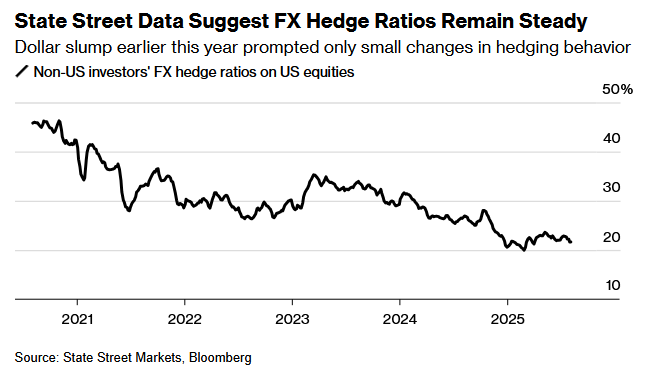
Core Insights - The article discusses the recent changes in the demand for dollar hedging among global investors following the impact of U.S. tariff policies, indicating a reversal in trends observed in previous months [1][3]. Group 1: Dollar Hedging Trends - After the initial shock from U.S. tariff policies in early April, the demand for dollar hedging increased, but recent data from State Street Bank shows that global investors have reduced their hedging positions to levels close to those before early April [1]. - The current hedging ratio stands at 21.6%, down 2 percentage points from May, indicating a stabilization in hedging activities [1]. - Michael Metcalfe from State Street Bank noted that the changes in hedging ratios are not as volatile as previously observed, where fluctuations could reach up to 10% [1]. Group 2: Investor Behavior and Market Dynamics - The correlation between the dollar and U.S. stock market performance has shifted, as both experienced declines after April, challenging the notion that the dollar serves as a reliable hedge against stock market downturns [3]. - Despite the low hedging ratio, Metcalfe pointed out that investor behavior has not significantly changed, suggesting that investors are taking a longer-term view when assessing currency protection levels [3]. - The worst-case scenarios regarding trade tariffs appear to have been avoided, allowing the dollar to gain some stability in July, coinciding with a rebound in the S&P 500 index [3]. Group 3: Costs and Future Outlook - The cost of dollar hedging has increased, with euro-based investors seeing costs rise from a low of 1.31% last September to over 2.40% in June and July, currently remaining above 2.20% [4]. - Investors seem to be adopting a wait-and-see approach, assessing whether the economic conditions observed in the first eight months of 2025 will repeat [4]. - Despite the dollar's significant monthly gain in July, Wall Street forex strategists remain bearish on the dollar, anticipating that its rebound may not be sustainable [4]. Group 4: Economic Concerns and Dollar Outlook - Concerns regarding the reliability of U.S. economic data have been raised due to weak economic indicators and questions surrounding the independence of the Federal Reserve [5]. - Bank of America warned that the dollar could face adverse conditions if the Federal Reserve lowers interest rates amid rising inflation [5]. - Historical analysis indicates that the dollar tends to depreciate before and after interest rate cuts, suggesting a potential continuation of the current trend [5].