
多元策略

Search documents
新加坡太信环球金融集团主席Raymond Tan:对腾讯、阿里等中国科技企业保持长期持有态度
Zhi Tong Cai Jing· 2026-01-16 14:49
Group 1: Investment Opportunities in Chinese Tech Stocks - The core advantage of Chinese tech stocks lies in their relatively low valuation compared to US tech stocks, which have experienced significant valuation expansion in recent years [1][24] - Mature Chinese tech companies like Tencent and Alibaba are viewed as core holdings due to their clear business models, stable cash flows, and strong market positions, making them resilient in complex environments [1][24] - There is caution regarding emerging tech companies in the AI sector due to various uncertainties, including regulatory policies, technological iteration speed, and market acceptance, leading to a preference for observation and selective investment rather than blind entry [1][25] Group 2: Global Asset Allocation Strategy - As global markets enter a multi-polar phase with converging interest rates, there is a recommendation to increase exposure to non-US assets, particularly in Germany and China, which are seen as reasonably valued and in recovery [2][35] - The importance of physical assets like gold is rising in an environment of inflation uncertainty and geopolitical conflicts, with gold serving as a source of stability in investment portfolios [2][35] - Emerging markets are expected to show improved risk-return profiles as US monetary policy potentially shifts towards easing, making these markets more attractive [2][35] Group 3: Investment Strategy Evolution - The investment strategy has evolved from a buy-and-hold approach to a more dynamic, scenario-based strategy that emphasizes cross-asset allocation and multi-strategy deployment to enhance overall portfolio resilience [9][11] - The integration of quantitative methods has become essential in identifying risks and managing uncertainties, with a focus on adapting to rapidly changing market conditions [11][13] - The current investment framework emphasizes a structured approach to risk management, allowing for dynamic adjustments and the ability to switch to core assets or defensive strategies during market shocks [13][15] Group 4: Market Trends and Future Outlook - The investment landscape is shifting, with a notable decline in the "There Is No Alternative" (TINA) logic that previously favored US assets, as non-US markets gain attractiveness [34][35] - The potential for inflation to rise again poses a short-term risk, which could lead to tighter monetary policies and impact market liquidity [36][38] - The increasing wealth disparity and its implications for consumer behavior and economic growth are critical considerations for future investment strategies, focusing on companies with power, resources, and technological monopolies [35][36]


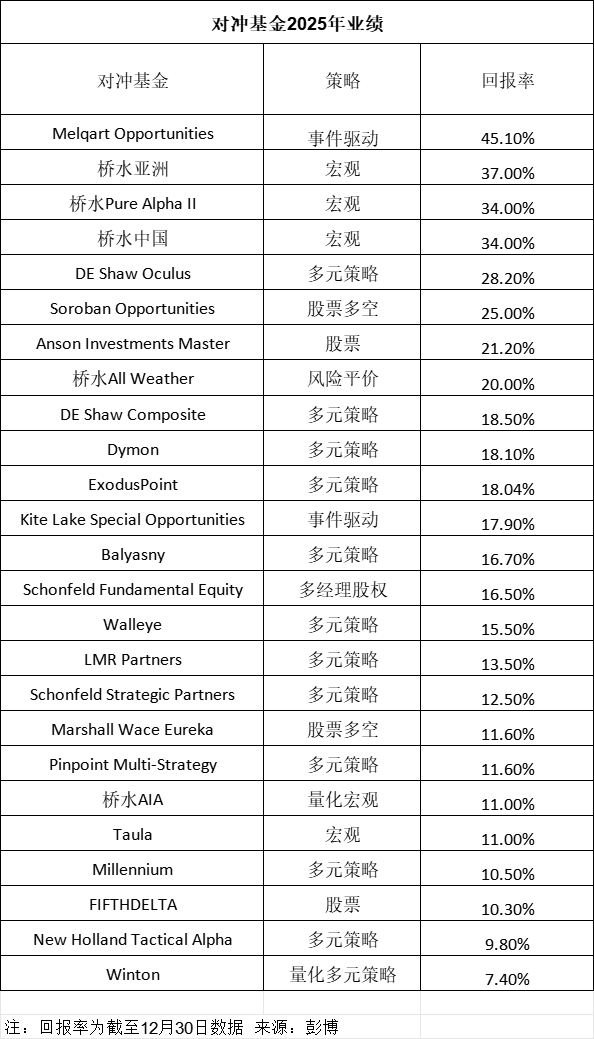
对冲基金2025龙虎榜:桥水旗舰基金回报34%创纪录,桥水中国排名第三超德邵
Hua Er Jie Jian Wen· 2026-01-02 21:23
Core Insights - The hedge fund industry is expected to achieve its strongest performance in at least five years in 2025, driven by market volatility from the Trump administration's trade war, which has created lucrative opportunities for traders [1][2] - Bridgewater Associates' flagship fund, Pure Alpha II, recorded a historic return of 34%, marking a significant recovery from the previous years' returns of less than 3% [1][4] - The overall performance of hedge funds in 2025 is characterized by a mix of strategies, with event-driven funds leading the pack [5][6] Performance Summary - **Top Performing Funds**: - Melqart Opportunities Fund achieved a return of 45.1%, the highest among major hedge funds [5] - Bridgewater's Asian fund recorded a return of 37%, while both Pure Alpha II and Bridgewater China achieved 34% [4] - D.E. Shaw's Oculus fund returned 28.2%, and its Composite fund achieved 18.5% [6] - **Market Context**: - The strong performance of hedge funds is attributed to significant gains in the U.S. stock market, particularly driven by artificial intelligence themes, and the volatility in bond and currency markets due to trade tensions [2] - In 2025, the three major U.S. stock indices recorded double-digit annual gains for the third consecutive year, a trend not seen since 2019-2021 [2] Strategy Performance - **Event-Driven Funds**: - Event-driven strategies have shown flexibility and adaptability, with Melqart Opportunities leading at 45.1% and Kite Lake Special Opportunities at 17.9% [5] - **Multi-Strategy Funds**: - D.E. Shaw's flagship funds outperformed market benchmarks, with Oculus achieving a return of 28.2% and Composite at 18.5% [6] - Other multi-strategy funds displayed varied performance, with Dymon at 18.1% and Millennium at 10.5%, which did not outperform the S&P 500 [6][8] - **Equity Strategies**: - Equity long/short strategies showed significant divergence, with Soroban Opportunities at 25% and Anson Investments Master at 21.2% [7] - Other equity funds like Schonfeld's Fundamental Equity and Marshall Wace's Eureka recorded returns of 16.5% and 11.6%, respectively [7] Quantitative Strategies - **Quantitative Funds**: - Winton's multi-strategy fund had the lowest return at 7.4%, while AQR Capital Management's Apex Strategy achieved a 19.6% increase [8]
“存款搬家”新路径曝光
Di Yi Cai Jing· 2025-10-10 03:14
Core Insights - The A-share market has shown strong performance recently, with the Shanghai Composite Index surpassing 3900 points and the STAR 50 Index experiencing a single-day increase of over 5% [1] - The banking wealth management market is becoming more active as investors focus on asset allocation amid rising international gold prices [1] Market Performance - On October 9, all three major stock indices closed higher, with the Shanghai Composite Index at 3933.97 points, up 1.32%, marking a ten-year high [1] - The total trading volume in the Shanghai, Shenzhen, and Beijing markets reached 26,718 billion yuan, an increase of 4,746 billion yuan from the previous trading day [1] Wealth Management Products - The performance of bank wealth management "fixed income +" products is closely linked to equity market trends, with mixed product scale increasing from 6470.76 billion yuan at the end of June to 6548.11 billion yuan by the end of September, a growth of 77 billion yuan [3] - Analysts expect that the scale of wealth management funds allocated to equities may exceed 100 billion yuan in the second half of the year and throughout 2026 [3] Investment Strategies - Banks are employing various strategies for equity asset allocation, with a focus on sectors such as technology, manufacturing, gold, and dividends [3][4] - The issuance of rights-based wealth management products has significantly increased, with 12 equity products issued this year compared to only 2 last year, and mixed products reaching 202, up from 169 last year [4] Risk Management - Risk management is becoming a core focus for wealth management companies in their "fixed income +" product strategies, with an emphasis on absolute return strategies and multi-asset approaches [6] - Companies are optimistic about the future performance of stocks, bonds, and gold, despite current stock valuations being at historical averages [6] Future Directions - The new directions for "fixed income +" products may include public REITs, with expectations for the total market value of public REITs in China to exceed 200 billion yuan by 2025 [7] - The anticipated normalization of issuance and the growing institutional demand for public REITs may enhance their attractiveness as core assets in the "fixed income +" product lineup [7]
浦银理财叶力俭: ETF是理财公司参与权益市场最好的工具之一
2 1 Shi Ji Jing Ji Bao Dao· 2025-08-19 07:08
Core Viewpoint - The discussion emphasizes that in a low-interest-rate environment, wealth management companies must enhance their core investment research capabilities and seek breakthroughs through diversified assets and strategies [1][2] Group 1: ETF and Investment Strategies - ETFs are highlighted as one of the best tools for wealth management companies to participate in the equity market due to their transparency, tradability, large capacity, and convenience [1] - The future strategy for wealth management companies includes effectively utilizing ETFs and public funds to capture Beta or Smart Beta returns in the equity market [1] Group 2: Investor Expectations and Risk Management - Investor expectations have evolved from "rigid repayment" to emphasizing "fixed income," and now to focusing on "absolute returns," indicating a dynamic change in demand [1] - In the context of increasing market volatility, the focus on "stable returns" necessitates attention to how wealth management companies can achieve relatively stable returns under closing price adjustments [1] - Understanding the risk tolerance and duration requirements of investors is crucial for wealth management companies to effectively manage client relationships and expectations [2] Group 3: Challenges in the Low-Interest Rate Environment - The low-interest-rate era presents a significant challenge for the asset management industry, necessitating a focus on providing stable returns [2] - The concept of "asset scarcity" reflects a mismatch in returns, prompting wealth management companies to enhance their core investment research capabilities [2]