
大豆单产提升

Search documents
我国大豆产能提升关键点:大面积单产提升
Guo Tai Jun An Qi Huo· 2026-02-24 03:47
Report Industry Investment Rating - Not provided in the report Core Viewpoints - The consecutive mention of "large - scale yield per unit area improvement" in the No. 1 Central Documents of 2025 and 2026 is crucial for enhancing China's soybean production capacity. Given limited arable land, increasing soybean yield per unit area is more important than expanding the planting area, and continuous promotion of large - scale soybean yield per unit area improvement is necessary [1][37] - China's soybean yield per unit area has been rising, but there is still a significant gap compared with the global average and other major grain and oil crops. The low yield is due to weak agricultural irrigation infrastructure, poor planting and field management technology, a large gap in mechanization and automation, and slow technology promotion [2][38] - There is a large potential for China to increase soybean yield per unit area. By promoting high - yield, high - oil, and high - protein varieties, supporting planting, field management, and harvesting technologies, and integrating and promoting high - yield and efficient technical models, the goal of an average national soybean yield of 360 jin per mu in 2030 can be achieved, with a compound annual growth rate of about 5.78% from 2026 to 2030 [3][39] Summary by Directory 1. 2026 No. 1 Central Document Continues the Policy of "Promoting Large - Scale Yield per Unit Area Improvement of Grain and Oil Crops" - The 2026 No. 1 Central Document, released on February 3, 2026, proposed to stabilize grain output at around 1.4 trillion jin, and continue to promote large - scale yield per unit area improvement of grain and oil crops and consolidate and enhance soybean production capacity [5] - From 2023 to 2026, the Ministry of Agriculture and Rural Affairs and relevant meetings repeatedly emphasized the policy direction and implementation details of "large - scale yield per unit area improvement". In 2025, the contribution rate of yield per unit area improvement to national grain production increase exceeded 90% [5][7] - Since 2019, the No. 1 Central Document has continuously proposed the policy goal of "expanding soybean planting, stabilizing production, and enhancing production capacity" for eight years. Due to limited arable land, increasing soybean yield per unit area is more important [6] 2. Current Situation and Reasons for China's Soybean Yield per Unit Area Current Situation - In 2025, China's soybean yield per unit area reached a record high of 271.8 jin per mu, with a year - on - year increase of about 1.9%. From 2016 to 2025, the compound annual growth rate was about 1.5% [2][8] - Xinjiang has the highest soybean yield per unit area, followed by the southern regions, while the northern regions, especially Heilongjiang and Inner Mongolia, have relatively low yields. In 2022, Xinjiang's soybean yield per unit area was about 403 jin per mu, higher than the global average [8][9] - Globally, in 2025/26, China's soybean yield per unit area was about 271 jin per mu, ranking 21st, far lower than the global average of 396 jin per mu. It is also lower than other major grain and oil crops such as corn, wheat, rapeseed, sunflower seeds, and peanuts [9][21] Reasons - Weak agricultural irrigation infrastructure, such as low irrigation coverage and a large proportion of medium - and low - yield fields, leads to poor soil water - storage and moisture - retention capacity [31] - Low - quality planting and field management technologies, including unbalanced fertilization, unreasonable planting density, and lagging pest control technologies, result in low production efficiency and resource waste [31] - There is a significant gap in mechanization and automation. For example, the seeding machine in Northeast China has a high missing - seeding rate, and the harvester has a high loss rate [31] - Slow technology promotion and a lagging effect on yield per unit area improvement are due to problems in the agricultural technology service system and small farmers' technology adoption [31] Reasons for Low Yields in Heilongjiang and Inner Mongolia - In Heilongjiang, small farmers have a low rate of proper planting technology application, and there are significant differences among different accumulated temperature zones and production subjects. There is a large yield gap between large - scale production and variety regional and production trials [32] - In Inner Mongolia, climate factors, such as uneven precipitation distribution, limited large - scale operation, and a large area of continuous cropping, restrict the increase in soybean yield per unit area [32][33] 3. Paths and Goals for China's Large - Scale Soybean Yield per Unit Area Improvement Paths - Promote high - yield, high - oil, and high - protein soybean varieties. Recommend representative varieties for different regions according to ecological conditions, planting systems, and market demands [34] - Support planting, field management, and harvesting technologies, such as dense planting and water - fertilizer regulation technology, formula fertilization technology, etc. [34] - Integrate and promote high - yield and efficient technical models, such as the "ridge - three - cultivation" technology in Northeast China, which can increase soybean production by over 10%, and the corn - soybean strip intercropping technology [34] Goals - Nationally, the average soybean yield per mu is targeted to reach 360 jin per mu in 2030, with a compound annual growth rate of about 5.78% from 2026 to 2030 [3][35] - In Heilongjiang, the yield per mu targets are 266 jin in 2025 and 320 jin in 2030, with a compound annual growth rate of about 3.77% from 2026 to 2030 [35] - In Inner Mongolia, the yield per mu targets are 270 jin in 2025 and 320 jin in 2030, with a compound annual growth rate of about 3.46% from 2026 to 2030 [36]
全国秋粮收获过五成 新技术新品种促进大豆单产提升
Yang Shi Wang· 2025-10-11 22:05
Core Insights - As of October 10, over 50% of the autumn grain harvest has been completed nationwide, with soybean harvest reaching 55% [1] - The introduction of new technologies and varieties has significantly improved soybean yield levels [1] Group 1 - The national autumn grain harvest is progressing well, with more than half completed [1] - Soybean harvest has reached 55%, indicating a strong performance in this crop sector [1] - The enhancement in soybean yield is attributed to advancements in technology and the introduction of new varieties [1]
全国秋粮收获过五成!新技术和新品种促进大豆单产提升
Sou Hu Cai Jing· 2025-10-11 11:48
Core Insights - The article highlights the significant progress in soybean production in China, with over 50% of the autumn grain harvest completed by October 10, including 55% of soybean harvest [1][2]. Group 1: Soybean Production and Technology - In Heilongjiang Province, soybean yield has reached 393.98 jin per mu (approximately 262.65 kg) due to new technologies and varieties [3]. - Farmers have reported a yield increase from previous levels of 350 jin per mu (approximately 233.33 kg) to higher levels this year, attributed to techniques such as dense planting and the use of microbial agents [5]. - A new nitrogen-fixing technology developed by the Chinese Academy of Agricultural Sciences has been implemented, resulting in an average income increase of about 400 yuan per mu [7]. Group 2: Agricultural Practices and Innovations - High-yield, drought-resistant soybean varieties are being promoted across major production areas, with demonstration zones achieving yields exceeding 300 kg per mu [9]. - The number of counties implementing large-scale yield improvements has reached 100, focusing on key regions like Heilongjiang and Inner Mongolia [11]. Group 3: Overall Production Trends - China's soybean planting area has stabilized at over 150 million mu, with production surpassing 20 million tons for the first time in 2022, reaching 20.65 million tons last year [13]. - The self-sufficiency rate for soybeans has increased by 4 percentage points since 2020 [13].

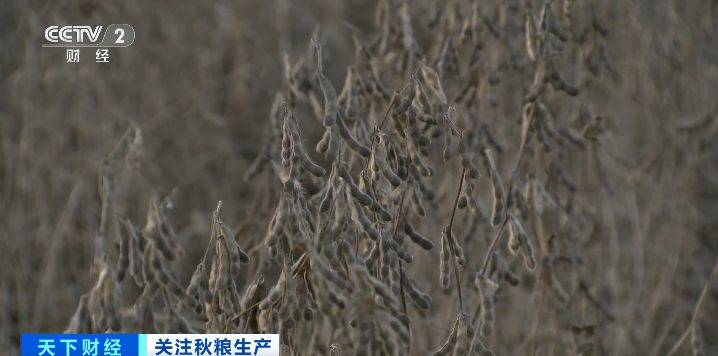
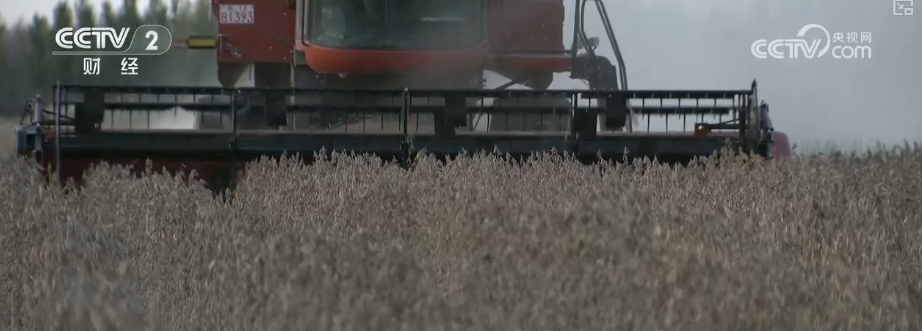
393.98斤!增产、增效、增安全 “新技术+新品种”助推大豆单产水平提升
Yang Shi Wang· 2025-10-11 08:47
Core Insights - As of October 10, over 50% of the autumn grain harvest has been completed nationwide, with soybean harvest reaching 55% [1] - New technologies and varieties have significantly improved soybean yield levels [1] Group 1: Soybean Yield Improvement - In Heilongjiang Province, soybean yield reached 393.98 jin per mu (approximately 262.65 kg) in a saline-alkali land area, a notable increase from previous yields [4] - The new nitrogen-fixing technology developed by the Chinese Academy of Agricultural Sciences has been recognized as one of the top ten major agricultural technologies in 2024, leading to an average increase of 400 yuan per mu in soybean income [8] - The technology has shown an average yield increase of over 15% across more than 200 experimental sites nationwide over four years [10] Group 2: Agricultural Development and Trends - A total of 100 counties will focus on large-scale soybean yield improvements by 2025, primarily in Heilongjiang and Inner Mongolia [13] - The soybean planting area in China has stabilized at over 15 million acres, with production reaching 20.65 million tons in 2024, marking a 4% increase in self-sufficiency compared to 2020 [13] - New high-oil, high-yield soybean varieties are being promoted, with demonstration areas achieving yields exceeding 300 kg per mu [12]
武维华率全国人大常委会调研组到黑龙江省开展大豆单产提升专题调研
Xin Lang Cai Jing· 2025-08-24 06:44
Core Insights - The research team led by Wu Weihua emphasized the importance of enhancing soybean yield and self-sufficiency in China, particularly in Heilongjiang Province, which is a key soybean production area [1] Group 1: Agricultural Development - The research team conducted field visits to various soybean production bases and farms to assess advancements in soybean yield enhancement, research, and new variety development [1] - Wu Weihua highlighted the need to recognize the significance of consolidating soybean expansion achievements and improving production capacity and self-sufficiency [1] Group 2: Policy and Strategy - The team called for strengthened policy support to promote the strategy of "storing grain in the land and technology," aiming to create regionally distinctive agricultural brands [1] - The focus is on integrating quality land, seeds, opportunities, and methods to achieve balanced and substantial increases in grain and oil crop production [1]
新品种新技术助力大豆大面积单产提升
Xin Jing Bao· 2025-07-03 15:20
Group 1 - The core viewpoint of the news is the introduction of a new green production technology for soybeans, which has shown an average yield increase of 15% across various demonstration sites in China [1][3]. - The Chinese Academy of Agricultural Sciences has emphasized the importance of increasing soybean production as a national strategic need, with the central government prioritizing this in its policy documents [2]. - New soybean varieties developed by the oilseed research institute have demonstrated significant yield potential, with "Zhongdou 57" achieving an average yield of 276.1 kg per mu and "Zhongdou 63" reaching 344.3 kg per mu in southern regions [2]. Group 2 - The ARC biological coupling technology, developed by the research team, addresses two major challenges in soybean production: quality improvement and nitrogen fixation, contributing to the overall yield increase [3]. - The new soybean varieties, such as "Zhongdou 62" and "Zhongdou 81," have high protein content, making them advantageous for soybean product processing [2]. - The oil content of varieties "You 6019" and "Zhongdou 79" has been reported at 22.55% and 23.54%, respectively, with a yield increase of over 10% compared to control varieties, showcasing their high yield and disease resistance [2].