太空AI基础设施

Search documents
马斯克抛出“太空算力”,能成为引爆市场的资本故事吗?
3 6 Ke· 2025-12-16 00:19
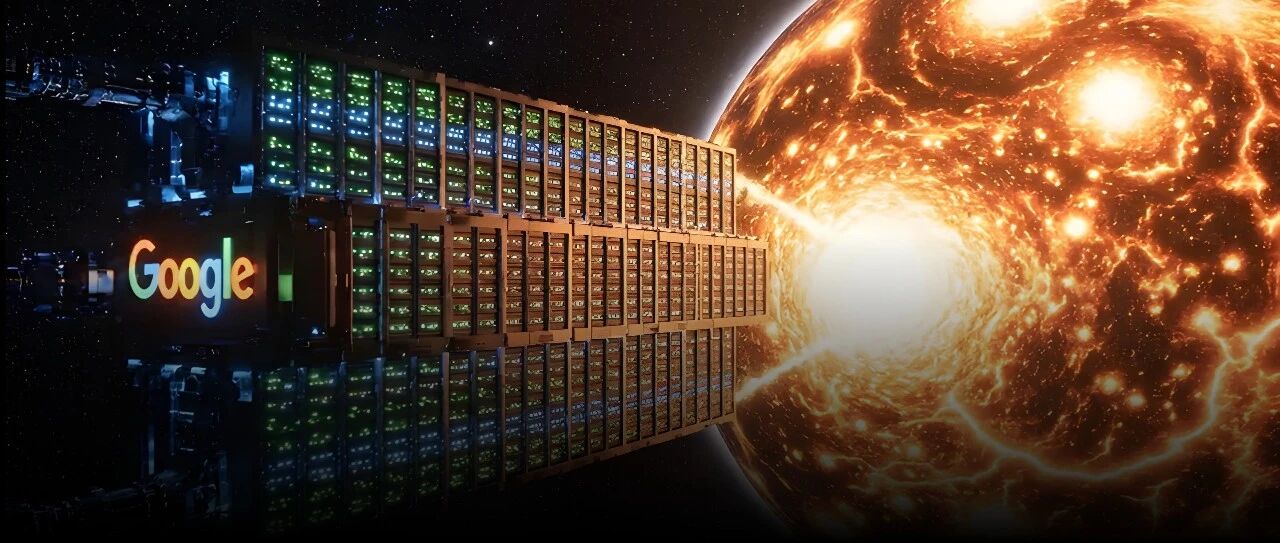
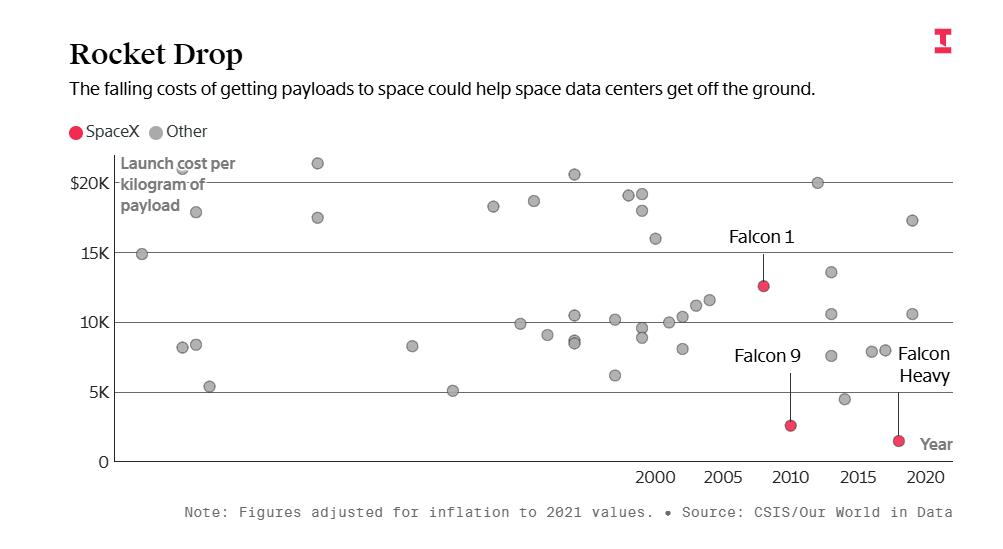
Core Viewpoint - Tech giants are collectively focusing on building data centers in space, driven by the belief that Earth can no longer support the vast computational power and energy needs of AI development [1] Group 1: Key Developments - Elon Musk has sparked interest in space-based data centers, with support from Jeff Bezos, Eric Schmidt, and Jensen Huang [1] - Google plans to launch prototype satellites by 2027 to test the performance of its AI chips in space [1] - Starcloud claims to have trained the first space-based large language model on a satellite equipped with NVIDIA chips [1] Group 2: Economic Implications - The concept of space data centers serves as a capital narrative, potentially enhancing the valuation of companies like SpaceX ahead of its IPO [2] - The decreasing cost of launching materials into orbit, currently around $1,500 per kilogram with SpaceX's Falcon Heavy, is expected to drop to $100 per kilogram with the Starship rocket [6] Group 3: Challenges and Considerations - Critics highlight the technical feasibility issues, such as cosmic radiation damaging sensitive chips and the high costs of maintenance and updates for orbital equipment [3] - The increasing energy demands from AI growth in the U.S. are straining the electrical grid, leading to concerns about power shortages [7] - Community opposition to data centers due to environmental concerns has stalled several multi-billion dollar projects [10]

通信行业周报 2025 年第 45 周:北美光通信企业当季业绩表现亮眼,英伟达、谷歌推进太空算力部署-20251109
Guoxin Securities· 2025-11-09 06:12
Investment Rating - The report maintains an "Outperform" rating for the communication industry [6] Core Insights - North American optical communication companies have shown strong quarterly performance, with significant growth in data center interconnect (DCI) demand [11] - The global computing infrastructure continues to benefit from high demand, particularly in AI and data center technologies [5][11] Summary by Sections Industry News Tracking - Fabrinet reported Q1 FY2026 revenue of $978.1 million, a 22% year-over-year increase and an 8% quarter-over-quarter increase, driven by strong DCI demand [11] - Coherent's Q1 FY2026 revenue was $1.581 billion, up 17% year-over-year, with a Q2 revenue guidance of $1.56 to $1.70 billion [15] - Lumentum's Q1 FY2026 revenue was $533.8 million, with a Q2 guidance of $630 to $670 million [17] - The launch of the scaleX640 super node by Inspur further enhances domestic computing power capabilities [19] - NVIDIA's StarCloud-1 satellite and Google's Project Suncatcher aim to establish AI computing infrastructure in space [25][29] Market Performance Review - The communication index rose by 0.92% this week, outperforming the CSI 300 index, which increased by 0.82% [50] - The optical devices/chips, operators, and satellite internet sectors performed relatively well [50][53] Investment Recommendations - Continuous focus on AI computing infrastructure development is advised, with recommendations for optical devices (e.g., Zhongji Xuchuang), communication equipment (e.g., ZTE), and liquid cooling technologies [60] - The three major telecom operators remain important assets for dividend allocation, with stable operations and increasing dividend ratios [60]


AI太空竞赛?英伟达H100刚上天,谷歌Project Suncatcher也要将TPU送上天
3 6 Ke· 2025-11-05 02:20
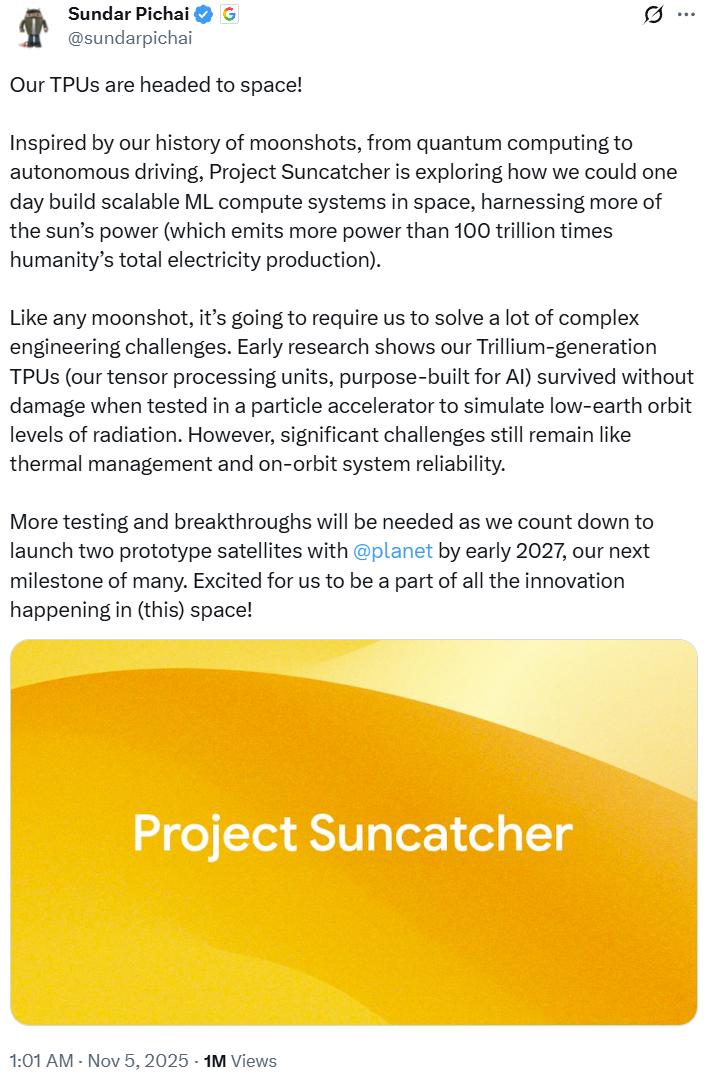
Core Insights - Nvidia has launched its H100 GPU into space, marking a significant milestone in space-based AI infrastructure, while Google has announced its own initiative, Project Suncatcher, to utilize solar energy for AI processing in space [1][3] - Project Suncatcher aims to create a scalable AI infrastructure using a constellation of satellites equipped with TPUs and free-space optical communication links, leveraging the vast energy from the sun [6][8] Project Overview - Project Suncatcher is designed to explore the potential of solar-powered satellite constellations to enhance machine learning capabilities in space, with the sun's energy being 1 trillion times greater than human electricity production [6][8] - Google plans to launch two prototype satellites in early 2027 in collaboration with Planet, addressing engineering challenges such as thermal management and system reliability in orbit [3][18] Technical Challenges - The system will require high-bandwidth, low-latency inter-satellite links to distribute machine learning workloads effectively, aiming for performance comparable to ground data centers [8][10] - Google has developed models to analyze the orbital dynamics of tightly clustered satellites, ensuring they can maintain stable orbits with minimal propulsion [10][12] TPU Radiation Resistance - Google's Trillium TPU has undergone radiation testing, demonstrating resilience to total ionizing dose and single-event effects, making it suitable for space applications [14][13] Economic Viability - Historical data suggests that satellite launch costs could drop below $200 per kilogram by the mid-2030s, making space-based data centers economically feasible [15][18] - The analysis indicates that the operational costs of space-based data centers could become comparable to terrestrial counterparts in terms of energy costs [15] Future Directions - The next milestone for Google involves executing a "learning mission" to test TPU hardware and models in space, paving the way for potential gigawatt-scale satellite constellations [18][19]
AI太空竞赛?英伟达H100刚上天,谷歌Project Suncatcher也要将TPU送上天
机器之心· 2025-11-05 00:18
Core Insights - Google has launched Project Suncatcher, a space-based scalable AI infrastructure system designed to utilize solar energy for AI applications, with the potential to harness energy that exceeds human electricity production by 100 trillion times [8][11][29] - The project aims to deploy a constellation of satellites equipped with Tensor Processing Units (TPUs) and free-space optical communication links to enhance machine learning capabilities in space [7][9][10] Project Overview - Project Suncatcher is a significant exploration initiative that envisions a satellite constellation powered by solar energy, aimed at expanding the computational scale of machine learning in space [7][8] - The first satellite launch is scheduled for early 2027, in collaboration with Planet, to test the feasibility of the proposed system [3][29] Technical Challenges - The project faces several engineering challenges, including thermal management, high-bandwidth inter-satellite communication, and system reliability in orbit [28][29] - Achieving data center-scale inter-satellite links is crucial, requiring connections that support tens of terabits per second [13][14] - The satellites will operate in a dawn-dusk sun-synchronous low Earth orbit to maximize solar energy collection [13][21] TPU Radiation Tolerance - Google's Trillium TPU has undergone radiation testing, demonstrating resilience to total ionizing dose (TID) and single-event effects (SEEs), making it suitable for space applications [21][22] Economic Viability - Historical data suggests that launch costs for satellite systems may decrease to below $200 per kilogram by the mid-2030s, making space-based data centers economically feasible [23][24] - The operational costs of space-based data centers could become comparable to terrestrial counterparts in terms of energy costs [24] Future Directions - The initial analysis indicates that the core concept of space-based machine learning computing is not hindered by fundamental physics or insurmountable economic barriers [28] - The next milestone involves launching two prototype satellites to validate Google's models and TPU hardware in space [29][30]