学区房价格下跌

Search documents
上海有二手房业主“抱团”挂出1460万元统一价 业内称“实际用途不大”
Mei Ri Jing Ji Xin Wen· 2025-11-29 12:40
Core Viewpoint - The emergence of a "price alliance" among homeowners in the Century Jiangwan community in Shanghai, with multiple similar properties listed at a uniform price of 14.6 million yuan, reflects a strategic attempt to stabilize property values amid market adjustments [1][9]. Group 1: Market Dynamics - The average listing price for second-hand homes in Century Jiangwan has exceeded 15,000 yuan per square meter, while the average transaction price in September was 13,500 yuan per square meter, indicating a significant price discrepancy [9]. - The market for second-hand homes in the area has seen a drastic decline, with no viewings recorded for multiple listings over the past 30 days, suggesting a lack of buyer interest [10]. - The price of smaller units in the community had previously soared to 19,000-20,000 yuan per square meter before the market correction [1][11]. Group 2: Buyer Sentiment - Potential buyers express hesitance towards the 14.6 million yuan listings, noting that for the same price, larger and more desirable properties could be purchased in other areas [10]. - Buyers are increasingly considering new developments, such as Jianfa Haichen, which offers more competitive pricing at approximately 11,600 yuan per square meter, compared to the inflated prices of second-hand homes in Century Jiangwan [9][10]. Group 3: School District Influence - The value of properties in the Century Jiangwan area is heavily influenced by the associated school district, which has historically provided a premium but is now perceived as less valuable due to market conditions [11][13]. - The sentiment among real estate agents indicates that the premium associated with school districts has diminished significantly, with some suggesting that the school district is now essentially "given away" with the property [11].


北京楼市:止跌回稳 外资或要进场抄底了
Sou Hu Cai Jing· 2025-06-25 02:41
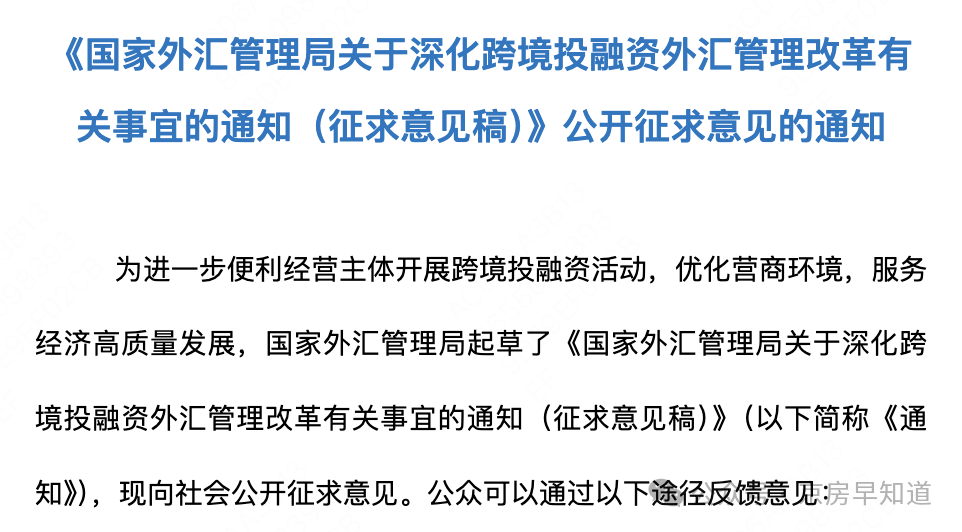
Core Viewpoint - The State Administration of Foreign Exchange (SAFE) has proposed a draft to reform foreign exchange management for cross-border investment and financing, which includes lifting restrictions on foreign capital's use of foreign exchange income for purchasing non-self-occupied residential properties in China [3][4][5]. Group 1: Policy Changes - The proposed changes will allow foreign enterprises and multinational companies to directly convert foreign exchange into RMB for investment in the domestic residential market, thus encouraging international capital to enter the housing market [3][4]. - The lifting of restrictions on foreign investment in residential properties reflects a need for capital influx to stabilize the market, as current market conditions appear somewhat cold [5][23]. Group 2: Market Implications - The entry of foreign capital may lead to a more pronounced market differentiation, with foreign investors likely targeting recognized core quality assets, potentially increasing their prices while less popular properties may continue to struggle [6][23]. - Recent transaction data indicates a downward trend in housing prices, although the rate of decline is slowing, particularly for larger units in newly built communities [7][19]. Group 3: Housing Price Trends - Specific examples of housing price changes show significant declines, such as a 40% drop in the price of a 57㎡ unit in Zhichun East from 2021 to 2025 [14]. - The overall trend in Beijing's housing market indicates a substantial decrease in prices for school district properties, with the premium associated with such properties beginning to diminish [12][23]. Group 4: Economic Context - The current global economic environment presents limited attractive investment channels outside of the stock and real estate markets, making the relaxation of foreign investment restrictions a strategic move to attract more international capital [23]. - The potential expansion of local government bond issuance to support urban redevelopment could further enhance the likelihood of foreign capital inflow into the real estate sector [23].