市场上行趋势

Search documents
量化择时周报:趋势指标进入边缘位置,由重仓位到重结构-20260201
ZHONGTAI SECURITIES· 2026-02-01 11:51
Quantitative Models and Construction Methods 1. Model Name: Timing System Signal - **Model Construction Idea**: The model uses the distance between the short-term and long-term moving averages of the WIND All A Index to determine the market trend. A significant positive distance indicates an upward trend, while a negative distance suggests a downward trend [2][7][13] - **Model Construction Process**: 1. Define the short-term moving average (20-day) and long-term moving average (120-day) of the WIND All A Index 2. Calculate the distance between the two moving averages: $ Distance = \frac{Short\text{-}term\ MA - Long\text{-}term\ MA}{Long\text{-}term\ MA} $ Where: - Short-term MA = 20-day moving average - Long-term MA = 120-day moving average 3. If the absolute value of the distance exceeds 3%, the market is considered to be in a trend (upward or downward depending on the sign of the distance) [2][7][13] - **Model Evaluation**: The model effectively captures market trends and provides a clear signal for timing decisions. However, it may be sensitive to short-term market fluctuations [2][7][13] 2. Model Name: Industry Trend Allocation Model - **Model Construction Idea**: This model identifies industry allocation opportunities based on medium-term reversal expectations and performance trends [6][8][14] - **Model Construction Process**: 1. Monitor industries with potential for medium-term reversal, such as real estate and liquor, and wait for reversal signals 2. Use the "TWO BETA" framework to recommend high-growth sectors like technology and commercial aerospace 3. Focus on performance trends in industries with high growth potential, such as computing power-related industries and upstream cyclical sectors like industrial metals and chemicals [6][8][14] - **Model Evaluation**: The model provides a structured approach to industry allocation, balancing medium-term reversal opportunities with high-growth sectors. However, its reliance on reversal signals may delay entry into emerging trends [6][8][14] 3. Model Name: Position Management Model - **Model Construction Idea**: This model determines the optimal equity allocation for absolute return products based on valuation and market trends [9] - **Model Construction Process**: 1. Assess the valuation of the WIND All A Index using PE and PB ratios 2. Combine valuation levels with short-term trend signals to recommend equity allocation levels 3. Current recommendation: 70% equity allocation for absolute return products, as the WIND All A Index PE is at the 90th percentile (high level) and PB is at the 50th percentile (medium level) [9] - **Model Evaluation**: The model provides a systematic approach to position management, balancing valuation and trend considerations. However, it may not fully account for sudden market shocks [9] --- Model Backtesting Results 1. Timing System Signal - Distance between 20-day and 120-day moving averages: 6.77% (absolute value significantly greater than 3%, indicating an upward trend) [2][7][13] 2. Industry Trend Allocation Model - No specific numerical backtesting results provided in the report [6][8][14] 3. Position Management Model - WIND All A Index PE: 90th percentile (high level) - WIND All A Index PB: 50th percentile (medium level) - Recommended equity allocation: 70% [9] --- Quantitative Factors and Construction Methods 1. Factor Name: Moving Average Distance Factor - **Factor Construction Idea**: Measures the distance between short-term and long-term moving averages to capture market trends [2][7][13] - **Factor Construction Process**: 1. Define short-term (20-day) and long-term (120-day) moving averages 2. Calculate the distance using the formula: $ Distance = \frac{Short\text{-}term\ MA - Long\text{-}term\ MA}{Long\text{-}term\ MA} $ 3. Use the absolute value of the distance to determine the trend strength [2][7][13] - **Factor Evaluation**: The factor is simple and intuitive, effectively capturing market trends. However, it may lag during rapid market reversals [2][7][13] --- Factor Backtesting Results 1. Moving Average Distance Factor - Distance: 6.77% (indicating a strong upward trend) [2][7][13]
频频出现脉冲式卖出,谁的手笔?如何影响市场?
Hu Xiu· 2026-01-25 11:13
Group 1 - The article discusses a significant phenomenon in the A-share market, specifically a large pulse sell-off in the largest ETF fund tracking the CSI 300 index, which led to a notable increase in trading volume and a turnover rate of 10% on that day [3] - The sell-off is attributed to the fund being a major holding of the "national team" in the A-share market, which has a symbolic significance as a leading indicator. Regulatory warnings about market speculation were issued earlier in January, prompting some reduction in holdings by large index funds [3] - Despite the sell-off, the market showed resilience with strong investor sentiment, as evidenced by all three major A-share indices closing in the green and trading volume exceeding 3 trillion yuan, indicating overall positive market conditions [4] Group 2 - The article hints at other topics of interest, such as the surge in the photovoltaic sector and the potential impact of overseas instability on the Hong Kong stock market's performance, although details on these topics are not provided [6]
“旗手”盘中加油!顶流券商ETF(512000)涨逾2%,湘财股份涨停,机构:流动性充裕支撑股市多头蓄力
Xin Lang Ji Jin· 2025-08-25 03:25
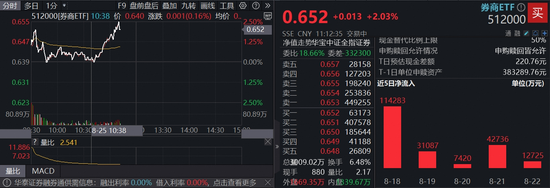
Group 1 - The brokerage sector is experiencing a significant upward trend, with the A-share leading brokerage ETF (512000) rising over 2% and achieving a transaction volume exceeding 1.9 billion yuan within half a day [1] - Major brokerage stocks are showing strong performance, with Xiangcai Securities hitting the daily limit, Changjiang Securities up over 7%, and Guosen Securities rising more than 5% [5] - The market is supported by ample liquidity, and historical factors such as domestic fundamentals and liquidity improvements are driving the market's strength [2][3] Group 2 - The brokerage sector's beta attribute is expected to continue, with the investment value of brokerage stocks being gradually confirmed as market sentiment improves [3] - The brokerage ETF (512000) tracks the CSI All Share Securities Company Index, encompassing 49 listed brokerage stocks, with nearly 60% of its holdings concentrated in the top ten leading brokerages [3] - The MACD golden cross signal has formed, indicating a positive trend for several stocks in the sector [6]





500质量成长ETF(560500)冲击4连涨,成分股长城证券10cm涨停
Xin Lang Cai Jing· 2025-08-13 06:49
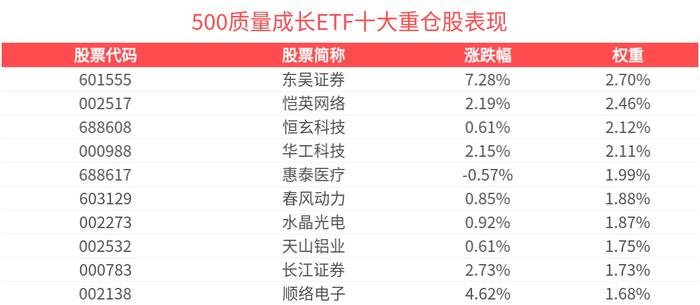
Group 1 - The core viewpoint of the news is that the CSI 500 Quality Growth Index is experiencing a strong upward trend, with significant gains in its constituent stocks and the associated ETF [1][2] - The CSI 500 Quality Growth ETF has seen a notable increase in scale, growing by 11.53 million yuan in the past week, ranking in the top third among comparable funds [1] - The ETF's shares have also increased by 5 million units in the past week, indicating strong investor interest and demand [1] Group 2 - The CSI 500 Quality Growth Index is currently at a historically low valuation, with a price-to-book (PB) ratio of 1.98, which is lower than 81.87% of the time over the past five years, highlighting its attractive valuation [1] - The top ten weighted stocks in the CSI 500 Quality Growth Index account for 20.47% of the index, with East Wu Securities being the highest at 2.70% [3][4] - Analysts expect the upward trend in the market to continue, driven by increased liquidity and the influx of retail investor funds, which will be crucial for the market's performance in the second half of the year [2]